
Professional Workplace Registration & OSHMIS Compliance Support Services in Uganda
- June 2, 2026
- Posted by: Content Team Inverness Consulting Group
- Categories:
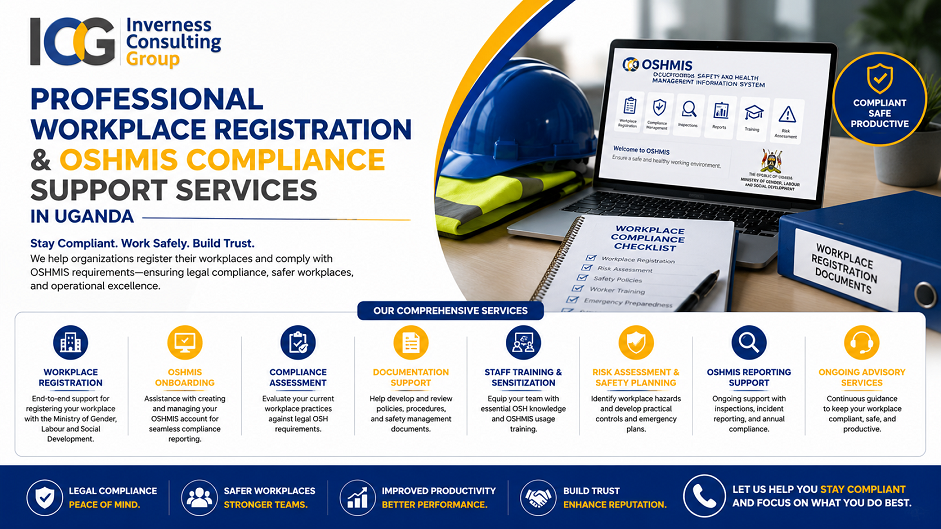
Complete Your Workplace Registration in Uganda Without the Bureaucratic Strain
Ensure 100% compliance with the OSH Act of 2006. Navigate the Ministry of Gender, Labour and Social Development (MGLSD) OSHMIS portal under the expert guidance of Inverness Consulting Group.
Operating an unregistered commercial or industrial facility in Uganda is no longer just a legal omission—it is an imminent threat to your business continuity. Under the Occupational Safety and Health (OSH) Act, No. 9 of 2006, every employer, occupier, and business owner is legally required to register their premises with the Commissioner for Occupational Safety and Health at the Ministry of Gender, Labour and Social Development (MGLSD) at least one month before starting physical operations.
Navigating the traditional paperwork pipeline, or trying to manage the newly digitized Occupational Safety and Health Management Information System (OSHMIS) without technical expertise, often leads to delayed applications, system assessment bottlenecks, and unexpected compliance audits.
Inverness Consulting Group bridges this bureaucratic gap. As Uganda’s premier corporate regulatory advisory, we manage your entire workplace registration cycle. From drafting OSH Form F.11, coordinating with local District Labour Officers, securing correct tax assessments, to uploading documentation on the digital OSHMIS platform, we guarantee a swift, legal, and hassle-free path to obtaining your Certificate of Workplace Registration.
Get a Free Compliance Assessment Today | Speak to an OSH Advisor
Understanding the Statutory Framework of Workplace Compliance in Uganda
Workplace registration in Uganda is not a mere administrative best practice; it is an absolute statutory obligation. To operate legally, every organization must understand the strict confines of the national OSH regulatory framework.
The Foundation: The Occupational Safety and Health Act, No. 9 of 2006
The principal legislation governing safe working environments in Uganda is the Occupational Safety and Health Act, No. 9 of 2006. The Act places a primary duty of care on employers to ensure the physical health, safety, and welfare of all individuals within their premises.
Section 40: Registration of Workplaces
Under Section 40(2) of the OSH Act 2006, any person planning to occupy or use any premises as a workplace must notify the Commissioner for Occupational Safety and Health in writing not less than one month before commencing operations.
- Section 40(1) mandates that the Commissioner maintain a centralized, legally verified register of all active workplaces in the country.
- Any structural or operational change within an already registered workplace (such as changes in machinery, chemical usage, or a change in the physical occupier) requires an immediate update to the register through an amended application.
Section 41: Fees for Registration
Section 41 stipulates that an appropriate registration fee must be paid to the consolidated fund of the Government of Uganda before a Certificate of Workplace Registration can be officially issued. These fees are further operationalized by the Occupational Safety and Health Regulations (2014), which outline a scaled payment structure based on:
- The nature of the work being carried out.
- The category of risk or hazard level associated with the industry.
- The total number of employees stationed at the premises.
The Legal Mandate Chain
- OSH Act 2006 (Section 40): Mandates that all workplaces register with the Commissioner at least 30 days before commencing physical operations.
- OSH Act 2006 (Section 41): Dictates the scale-based statutory fee payments required under the OSH Regulations of 2014.
- MGLSD Enforcement Powers: Non-compliance triggers immediate workplace closure, prosecution of directors, and exclusion from public/private procurement bids.
The Consequences of Non-Compliance & Legal Enforcement
The Ministry of Gender, Labour and Social Development, through its specialized OSH Department, has intensified its physical inspections and enforcement sweeps across Uganda. Operating a business in an unregistered facility carries severe operational and legal risks:
- Imminent Business Closure: The Commissioner for Occupational Safety and Health has the statutory authority to issue immediate prohibition notices, shutting down your factory, warehouse, or corporate office until registration is completed and verified.
- Criminal Prosecution & Fines: Under the OSH Act 2006, failure to register your workplace is a criminal offense. Corporate directors, business owners, and occupiers can face direct prosecution, heavy financial penalties, or imprisonment.
- Disqualification from Public & Private Tenders: Modern procurement guidelines in both the public sector (through the PPDA) and major private industries (such as oil and gas, manufacturing, and telecommunications) mandate that bidders submit a valid Certificate of Workplace Registration to pass preliminary compliance evaluation. Without it, you are locked out of high-value revenue streams.
Deciphering the Occupational Safety and Health Management Information System (OSHMIS)
To modernize administrative workflows and increase the national footprint of inspected workplaces, the Ministry of Gender, Labour and Social Development developed and launched the Occupational Safety and Health Management Information System (OSHMIS). Hosted directly by the Ministry at oshmis.mglsd.go.ug, this system digitizes what was once a slow, paper-driven process.
The OSHMIS Digital Process Flow
- Step 1: User / Compiler InitializationGather completed OSH Form F.11, company registration documents, and Material Safety Data Sheet (MSDS) chemical profiles.
- Step 2: OSHMIS Digital Portal UploadUpload the finalized application package to the digital gateway at oshmis.mglsd.go.ug.
- Step 3: MGLSD Back-End AssessmentThe system interfaces with Uganda Revenue Authority (URA) records to verify your Tax Identification Number (TIN) and generate the official payment assessment.
- Step 4: Verification & Physical AuditDistrict Labour Officers execute physical verification and safety compliance checks of your physical premises.
- Step 5: Registration Certificate IssuanceYour workplace is officially registered and the formal Certificate of Workplace Registration is issued (valid for 3 years).
Key Functions of the OSHMIS Platform:
- Online Workplace Registration: Direct digital upload of application forms and company particulars.
- Statutory Plant & Equipment Tracking: Registration and Scheduling of statutory machinery inspections (boilers, pressure vessels, elevators).
- Accident and Incident Reporting: Digital portal for occupiers to report severe workplace injuries or occupational disease outbreaks within the statutory timeline.
- Architectural Drawing Approvals: Pre-construction review of commercial and industrial building layouts to ensure ergonomic and hazard-prevention compliance before structural engineering begins.
Common Onboarding & Technical Pitfalls Faced by Businesses
While the OSHMIS portal represents a significant step forward, companies frequently encounter technical and procedural roadblocks when attempting self-registration:
- Mismatched TIN and Business Data: The OSHMIS backend integrates directly with the Uganda Revenue Authority (URA) database. If your company’s Tax Identification Number (TIN) data does not perfectly align with your Uganda Registration Services Bureau (URSB) registration details, the system will reject the submission, halting the process indefinitely.
- Incorrect Workplace Categorization: Selecting the wrong industrial or hazard category during online registration can trigger excessively high statutory fees, unnecessary inspection requirements, or outright application rejection.
- Document Formatting Errors: Crucial files, including detailed architectural layouts, localized evacuation protocols, and chemical MSDS forms, must be formatted to precise system specifications. Failing to meet these digital file requirements leads to continuous system loop errors and submission failures.
- Ineffective Communication with District Labour Offices: Even with a digital system, physical inspections and validation by a designated District Labour Officer are required to finalize the application. Many companies fail to bridge the digital-to-physical gap, leaving their digital applications stuck in “Pending Review” status for months.
By partnering with Inverness Consulting Group, you bypass these operational hurdles completely. We handle all system interfaces, resolve database mismatches, and manage direct communications with both regional labour offices and the central Ministry headquarters.
How to Register a Workplace in Uganda: The Official Process
Successfully registering your business premises requires navigating a highly structured administrative path. Under the official Ministry of Gender, Labour and Social Development service delivery standards, the targeted timeline for issuing a Certificate of Workplace Registration is five (5) working days from the receipt of verified payment proof—provided the documentation is flawless. Here is the exact step-by-step workflow that Inverness Consulting Group manages on your behalf:
Step 1: Secure and Complete OSH Form F.11
The foundation of your application is OSH Form F.11 (Application for Registration of a Workplace). This document requires highly granular operational and structural disclosures, including:
- Occupier Details: Registered corporate name, official postal address, and active Tax Identification Number (TIN).
- Precise Physical Coordinates: District, sub-county, division, zone, plot number, street name, and GPS coordinates of the premises.
- Operational Parameters: Detailed nature of the work to be carried out, planned date of operational commencement, and number of daily shifts.
- Workforce Demographics: Total headcount broken down precisely by gender (male and female employees).
- Mechanical and Chemical Inventory: Technical details regarding any mechanical power used (horsepower of engines, types of fuel) and lists of hazardous chemical compounds handled.
Step 2: Verification by the Local District Labour Officer
Before your application can proceed to the Central Government level, the physical details specified in Form F.11 must be validated.
- The completed form and supporting corporate documents (Certificate of Incorporation, Form 20, Trading License) must be taken to the nearest localized District Labour Office.
- A designated Labour Officer reviews the file, assesses physical premises risks if necessary, and officially stamps/approves the initial application.
Step 3: Central Submission to the Commissioner for OSH
Once verified by the local district office, the complete physical application packet, along with all supporting safety profiles, is submitted to the Commissioner for Occupational Safety and Health at the MGLSD main headquarters:
The Commissioner for Occupational Safety and Health
Ministry of Gender, Labour and Social Development
P.O. Box 227, Kampala, Uganda
Step 4: Digital Portal Upload & System Assessment
Using your verified corporate details, Inverness Consulting Group uploads your complete portfolio to the OSHMIS digital portal (oshmis.mglsd.go.ug).
- We link your registration to your corporate URA TIN.
- The system processes the application and generates an official Government Assessment.
- This assessment determines the precise statutory fee structure to be paid via partner commercial banks or the electronic payment gateway.
Step 5: Secure Payment & Present Verification Proof
Upon generation of the payment assessment, we coordinate the safe transfer of funds to the designated Government of Uganda account. Once the payment has been cleared, the physical and electronic payment receipts must be submitted back to the office of the Commissioner as formal proof of statutory compliance.
Step 6: Final Issuance of Compliance Credentials
Upon verifying the payment, the Ministry’s OSH Department completes its final quality assurance process and issues your business its complete Compliance Package:
- The Certificate of Workplace Registration: Your official license to operate, valid for exactly three (3) years from the date of issue.
- The Official Accident/Incident Register: A mandatory ledger where your designated safety officers must document any injuries, near-misses, or hazardous occurrences.
- The National OSH Checklist: A compliance document highlighting safety standards your business must maintain to pass ongoing surprise inspections.
Beyond the Basics: Complex Scenarios and Technical Mandates
A basic registration application is often insufficient for businesses operating in high-hazard, industrial, or highly regulated sectors. The OSH Act 2006 demands additional compliance filings for specialized facilities.
1. Mandatory Declarations for Chemical Users & Distributors
If your business processes, stores, or distributes chemical compounds (including manufacturing plants, agricultural processing facilities, industrial laundries, or pharmaceutical entities), your registration packet must feature:
- A Comprehensive Chemical Inventory: A detailed, quantified list of all active chemicals used on-site.
- Material Safety Data Sheets (MSDS): Legally compliant safety documents detailing chemical composition, fire hazard levels, safe handling protocols, and toxicological data.
- Exposure Controls: Evidence of active hazard mitigation, such as specialized ventilation, localized neutralizers, and appropriate personal protective equipment (PPE).
2. Statutory Plant & Equipment Inspections (Form F.107)
Under Sections 69 to 82 of the OSH Act 2006, specific high-risk plants and heavy equipment must undergo independent statutory safety examinations before they can be legally operated. This is managed via OSH Form F.107 (Plant Inspection Requisition Form).
| Plant/Equipment Type | Statutory Inspection Frequency | Legal Inspection Standard |
|---|---|---|
| Steam Boilers | Every 12 Months | Section 69, OSH Act 2006 |
| Air Receivers & Gas Receivers | Every 24 Months | Section 74, OSH Act 2006 |
| Hoists and Lifts (Elevators) | Every 6 Months | Section 77, OSH Act 2006 |
| Lifting Cranes and Chains | Every 14 Months | Section 79, OSH Act 2006 |
Inverness Consulting Group coordinates directly with the Ministry’s certified mechanical and electrical plant inspectors to schedule, execute, and document these crucial certifications, ensuring your machinery is legally cleared.
3. Workplace Risk Assessments & Policy Formulation
During the registration review, the MGLSD assessors determine whether your enterprise meets the threshold to legally employ a full-time, dedicated Safety and Health Officer.
- Workplace Risk Assessments: Every workplace must conduct a comprehensive, periodic risk assessment. This audit must be designed and led by a designated, certified Safety and Health Representative or a qualified external corporate advisory like Inverness Consulting Group.
- OSH Policy Drafting: Organizations with more than 20 employees are legally required to draft and display a clear, localized Occupational Safety and Health Policy signed by top management, detailing the hazard control systems in place.
Why Partner with Inverness for Your Workplace Registration?
Navigating the administrative pipelines of the Ministry of Gender, Labour and Social Development and resolving OSHMIS technical hurdles requires specialized expertise. Inverness Consulting Group provides a full-service, stress-free compliance path.
The Inverness Compliance Advantage
- Direct Liaison: Active, day-to-day coordination with Central Ministry officials and local District Labour Officers.
- Rapid Turnaround: Targeted 5-day certificate delivery post-payment verification.
- Specialized Engineering Support: Facilitation of mechanical inspections under Form F.107.
- Error-Free Formatting: Perfect processing of OSHMIS portal technical uploads and documents.
- Legal Shielding: Strategic regulatory safety buffers to avoid operational fines and shut-down notices.
Our End-to-End Compliance Delivery Framework
When you retain Inverness Consulting Group, we activate a multi-layered compliance delivery framework designed to guarantee approval:
- Phase 1: The Audit PhaseWe conduct a thorough physical walkthrough of your premises, compiling vital structural, mechanical, chemical, and workforce metrics.
- Phase 2: The Compilation PhaseOur safety and legal experts draft OSH Form F.11, properly format MSDS chemical files, and structure your complete physical and digital compliance package.
- Phase 3: The Interfacing PhaseWe upload your complete application data to the OSHMIS digital portal, resolve database/TIN errors, and secure local validation from your District Labour Officer.
- Phase 4: The Assessment PhaseWe retrieve the official Government of Uganda payment assessment and facilitate a swift, secure transaction through approved statutory banking channels.
- Phase 5: The Delivery PhaseWe collect and hand-deliver your physical Certificate of Workplace Registration, certified Accident Register, and national OSH compliance checklist.
- Phase 6: The Maintenance PhaseWe actively track your 3-year certificate validity cycle, providing proactive reminders and regulatory support for upcoming renewals, audits, and physical inspections.
Why Uganda’s Leading Brands Trust Inverness:
- Deep Regulatory Expertise: Our consultants are certified safety experts and legal advisors intimately familiar with the OSH Act of 2006, the Ugandan Employment Act of 2006, and all auxiliary labour standards.
- Unmatched System Troubleshooting: We possess deep, technical experience navigating the quirks and data integrations of the OSHMIS portal, preventing the standard application rejections that plague self-filing companies.
- Time & Resource Optimization: Your internal HR, operations, and legal teams can remain focused on your core business goals while our dedicated advisors handle the paperwork, queueing, and ministerial follow-ups.
- Strategic Legal Protection: We ensure your operations are fully legal before inspector visits occur, shielding your brand from reputation-damaging closure notices or heavy financial penalties.
DETAILED FREQUENTLY ASKED QUESTIONS (FAQ)
Crucial Insights on Workplace Registration and OSH Compliance in Uganda
Q1: Who is legally classified as an “Occupier” under Ugandan law?
An Occupier is defined under Section 4 of the OSH Act 2006 as the person, company, or institution that has the physical use, control, or immediate management of a workplace. The occupier is held legally responsible for maintaining safety compliance, regardless of whether they own the physical real estate or are simply leasing the premises.
Q2: What physically constitutes a “Workplace” requiring registration?
Under Ugandan legislation, a workplace is any location—whether open-air, temporary, or enclosed within structural walls—where persons perform manual, administrative, technical, or professional work for wages or profit. This includes traditional corporate offices, commercial bank branches, manufacturing factories, assembly units, warehouses, logistics centers, construction sites, civil engineering works, agricultural plantations, greenhouses, hospitals, clinics, and educational institutions.
Q3: My business operates entirely online. Do I still need workplace registration?
Yes. Even if your customer interface is entirely digital, your employees must physically work somewhere to maintain your platforms, manage servers, or process orders. If you lease an office suite, run a small distribution warehouse, or maintain a physical headquarters in Uganda, that physical location is a workplace and must be registered under Section 40 of the OSH Act.
Q4: How long is a Certificate of Workplace Registration valid in Uganda?
A Certificate of Workplace Registration is valid for exactly three (3) years from its date of issue. To maintain legal compliance, the occupier must apply for a formal renewal through the OSHMIS portal at least one month before the active certificate expires.
Q5: What is the official cost of workplace registration?
There is no flat registration fee. The statutory cost is dynamically determined by the Ministry of Gender, Labour and Social Development based on a tiered structure. This scale factors in the total headcount of employees, the risk profile of your industry (e.g., high-hazard mining vs. low-risk professional services), and the total mechanical power footprint of the facility. Inverness Consulting Group provides pre-filing cost estimations to help you budget accurately.
Q6: Can a single company hold multiple workplace registration certificates?
Yes. Workplace registration is site-specific, not company-specific. If your corporate entity operates a headquarters in Kampala, a distribution warehouse in Mukono, and a manufacturing plant in Jinja, you must secure a distinct Certificate of Workplace Registration for each physical location. Each site must be registered under its own unique OSHMIS profile.
Q7: What is an OSH Compliance Audit, and who is authorized to conduct it?
An OSH Compliance Audit is a comprehensive assessment of a workplace’s physical environment, safety systems, and hazard management protocols. Official, punitive audits can only be conducted by designated MGLSD OSH Inspectors or localized District Labour Officers. However, organizations should regularly commission private compliance audits from certified corporate consultancies like Inverness Consulting Group to identify and resolve vulnerabilities before government inspectors arrive.
Q8: What occurs if an inspector discovers my workplace is unregistered?
If an inspector finds your facility operating without a registration certificate, they have the legal authority to: issue an immediate Prohibition Notice to shut down operations, issue an Improvement Notice forcing you to register within a strict, short timeframe (usually 7 to 14 days) under threat of closure, or initiate direct criminal prosecution of the company’s directors and management team for violating Section 40 of the OSH Act 2006.
Q9: What is OSH Form F.11, and where can I find it?
OSH Form F.11 is the official statutory form titled “Application for Registration of a Workplace.” It can be obtained from local District Labour Offices, downloaded from the official MGLSD online resources, or processed digitally through the OSHMIS portal. Inverness Consulting Group supplies, drafts, and verifies this form for all our corporate clients.
Q10: How does the OSHMIS portal integrate with the Uganda Revenue Authority (URA)?
The OSHMIS portal utilizes an automated API to query the URA database. When an applicant inputs their corporate Tax Identification Number (TIN), the system automatically pulls the registered name, physical address, and director details. If your URA profile is outdated, locked, or mismatched with your actual physical setup, the OSHMIS system will block your registration until your tax records are updated.
Q11: What is the mandatory timeline for reporting a severe workplace accident?
Under the OSH Act 2006, any workplace accident that results in death or disables an employee from working for more than three consecutive days must be reported to the Commissioner for OSH within 24 hours of its occurrence. This notification must be logged digitally on the OSHMIS portal or submitted via the physical incident forms.
Q12: Are non-profit organizations and government agencies exempt from registration?
No. The OSH Act 2006 explicitly applies to all workplaces, including government offices, non-governmental organizations (NGOs), religious institutions, and public schools. If people are employed on-site, the facility is legally required to be registered and compliant.
Customized Regulatory Frameworks Tailored to Your Sector
Different sectors face unique hazards and administrative requirements under Ugandan labour laws. Inverness Consulting Group customizes your registration approach to match your sector’s specific profile:
1. Manufacturing, Logistics & Heavy Industrial Sectors
- Primary Hazards: Machinery operations, heavy material lifting, high-voltage electricity, noise pollution, and chemical exposure.
- Crucial Compliance Focus: Heavy focus on Form F.107 for statutory pressure vessel and boiler testing. Detailed machine-guarding evaluations and localized safety layouts must accompany the OSHMIS application.
- Emergency Infrastructure: Mandatory installation of zoned fire suppression systems, clearly marked emergency evacuation routes, and dedicated eyewash stations for chemical handling areas.
2. Corporate Offices, Financial Institutions & Tech Firms
- Primary Hazards: Ergonomic strain, visual fatigue, indoor air quality issues, and fire risks in high-occupancy spaces.
- Crucial Compliance Focus: Proper workspace layouts, emergency escape design, and adequate sanitation installations.
- Structural Audits: Ensuring the office space meets statutory cubic airflow-per-employee standards and features adequate natural or mechanical ventilation.
- Office Occupation Density Standards (Statutory Ratio): For every employee stationed within a closed room, the employer must provide a minimum volume of 10 cubic meters of airspace.
Note: Any vertical space higher than 4 meters from the floor level is mathematically excluded from this volumetric calculation to ensure that high ceilings do not mask overcrowded floor layouts.
3. Civil Works, Road Projects & Building Construction Sites
- Primary Hazards: Falls from heights, collapsing excavations, falling objects, and heavy earthmoving vehicle operations.
- Crucial Compliance Focus: Construction registrations are site-specific and must be completed prior to breaking ground. Detailed safety plans must accompany the application, proving the presence of certified scaffolding, fall protection, and safety PPE.
- Safety Officers: Large-scale civil works must register a dedicated, on-site Health, Safety, and Environment (HSE) Officer on the OSHMIS portal to manage daily safety protocols.
4. Chemical Processing, Petroleum & Pharmaceutical Plants
- Primary Hazards: Toxic exposure, hazardous waste discharge, chemical burns, explosions, and environmental contamination.
- Crucial Compliance Focus: Submission of exhaustive Material Safety Data Sheets (MSDS) with Form F.11. Mandatory registration of on-site chemical storage vessels and toxic waste mitigation plans.
- Medical Surveillance: Proof of pre-employment, routine, and post-employment medical examinations for all personnel handling hazardous chemicals, in accordance with the OSH Act’s health monitoring mandates.
Secure Your Corporate Workplace Registration Today
Don’t wait for a compliance audit or a prohibition notice to disrupt your business operations. Protect your employees, your business reputation, and your bottom line.
Whether you are launching a new industrial facility in the Namanve Industrial Park, moving your corporate headquarters to a new office tower in the Kampala Central Business District, or scaling an infrastructure project in upcountry Uganda, Inverness Consulting Group is your trusted compliance partner. We take the complexity out of the OSHMIS registration system, manage the entire bureaucratic process with the Ministry of Gender, Labour and Social Development, and deliver your completed Certificate of Workplace Registration directly to your desk.
Disclaimer: The information provided on this platform is curated for educational and strategic search purposes in strict accordance with the Occupational Safety and Health Act, No. 9 of 2006, of the Republic of Uganda. For formal legal representation and tailored corporate compliance solutions, please schedule an independent consultation with Inverness Consulting Group.