Introduction: A New Era of Workplace Safety and Legal Accountability in Uganda
The Uganda Occupational Safety and Health (Amendment) Act 2025 marks one of the most significant reforms to Labour and workplace regulation in the country’s modern history. Enacted to address evolving workplace risks, global best practices, and international Labour standards, the Amendment fundamentally reshapes how employers, managers, directors, and workers approach occupational safety and health.
Unlike earlier frameworks that focused primarily on factories and large employers, the 2025 Amendment establishes a universal, risk-based, and prevention-oriented OSH regime. Its scope now extends across all sectors of the economy, including small enterprises, professional services, construction, manufacturing, agriculture, and the informal sector.
The law is explicitly aligned with International Labour Organization principles, Environmental, Social and Governance (ESG) expectations, and modern corporate accountability standards.
This piece of writing explains what has changed, why it matters, and what employers must do to remain fully compliant. It is designed as a practical compliance roadmap for boards, executives, HR leaders, legal practitioners, and OSH professionals operating in Uganda.
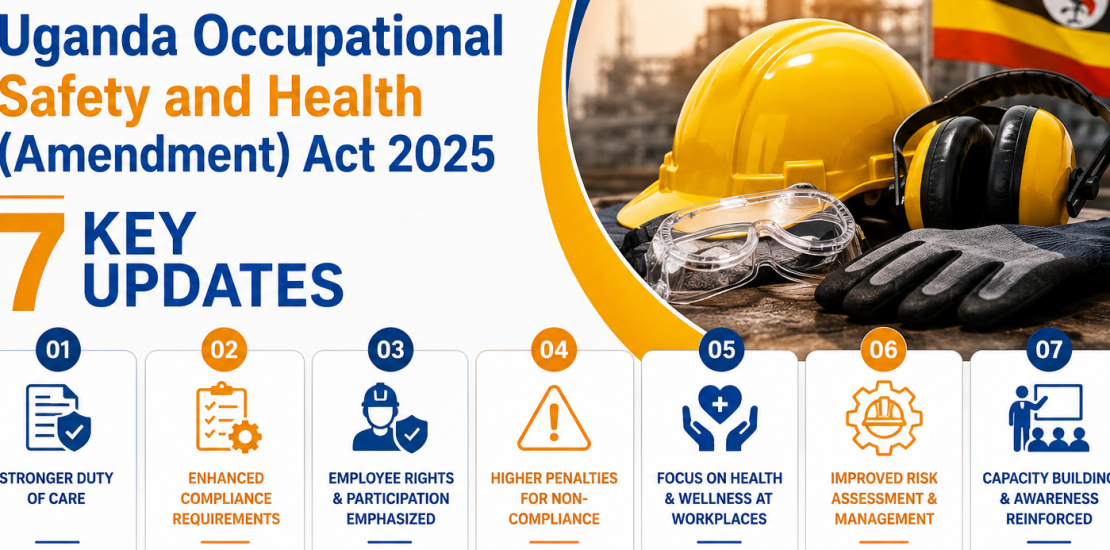
The Following Is a Comprehensive, Expert-Level Analysis of the 7 Key Updates Under the Uganda Occupational Safety and Health (Amendment) Act 2025
Overview of the Uganda Occupational Safety and Health (Amendment) Act 2025
The Amendment Act is not a cosmetic revision of the previous OSH framework. It introduces structural reforms that shift responsibility from reactive accident management to proactive risk prevention and continuous compliance.
The law strengthens enforcement powers, expands employer obligations, and integrates physical, psychological, and environmental health into a single regulatory framework.
Key objectives of the Amendment include:
- Protecting workers across all sectors, regardless of workplace size
- Preventing occupational diseases and injuries before they occur
- Enhancing the accountability of employers, directors, and managers
- Aligning Uganda’s OSH regime with international Labour standards
- Improving national productivity through safer and healthier workplaces
Key Update 1: Universal Application of Occupational Safety and Health Obligations
Removal of the Employee-Number Threshold
One of the most consequential changes introduced by the 2025 Amendment is the removal of any exemption based on workforce size. Previously, many small and medium-sized enterprises operated under the assumption that OSH laws applied only to factories or workplaces with a minimum number of employees. That assumption is now legally obsolete.
Under the amended law, a workplace is defined broadly to include any premises, site, location, or environment where a person performs work, whether on a permanent, temporary, contractual, or casual basis. This includes offices, retail outlets, construction sites, farms, workshops, and mobile or remote work environments.
Legal and Practical Implications
Every employer in Uganda, regardless of size or sector, now carries full responsibility for occupational safety and health. Failure to comply exposes businesses to inspections, enforcement notices, administrative penalties, and potential criminal liability.
Compliance Actions Required
- Formal registration and recognition of the workplace
- Development of a documented OSH policy
- Identification and management of workplace hazards
- Maintenance of basic safety records and accident registers
Compliance Support from Inverness Consulting Group
Small Business or Large Enterprise – OSH Compliance Now Applies to You
With the removal of employee-number exemptions under the Uganda Occupational Safety and Health (Amendment) Act 2025, every workplace is now legally accountable. Inverness Consulting Group supports organizations of all sizes in registering, documenting, and operationalizing OSH compliance efficiently and affordably.
📍 P.O. Box 188439, Kampala GPO
📌 Nakawa Division, Ntinda, Village 1
📞 +256 774 718641
📧 info@invernessconsulting.uk
🕘 Monday–Friday: 9 AM – 5 PM EAT
Key Update 2: Mandatory Annual Occupational Safety and Health Audits
From Voluntary Compliance to Statutory Obligation
The Amendment Act makes annual OSH audits a legal requirement rather than a discretionary best practice. Every employer must now subject their workplace to a structured, documented safety audit at least once a year.
Scope of a Compliant OSH Audit
A legally valid OSH audit must include:
- Comprehensive hazard identification and risk assessment
- Evaluation of physical, chemical, biological, and ergonomic hazards
- Review of emergency preparedness and fire safety systems
- Assessment of training records, incident logs, and medical surveillance data
- Verification of compliance with applicable safety standards
Audits must be conducted by qualified and recognized OSH professionals. During inspections, employers are required to produce current audit reports on demand.
Consequences of Non-Compliance
Failure to conduct or present an annual OSH audit constitutes a serious offense. Enforcement authorities may issue improvement notices, prohibit continued operations, or impose financial penalties.
Compliance Support from Inverness Consulting Group
Avoid Penalties with a Legally Compliant OSH Audit
Annual OSH audits are now a statutory requirement. Inverness Consulting Group provides professional OSH compliance support, audit coordination, and corrective action planning to help your organization meet inspection standards with confidence.
📍 P.O. Box 188439, Kampala GPO
📞 +256 774 718641
📧 info@invernessconsulting.uk
🕘 Monday–Friday: 9 AM – 5 PM EAT
Key Update 3: Mandatory Health Surveillance and Medical Examinations
Preventive Health as a Legal Duty
The 2025 Amendment introduces a comprehensive health surveillance framework that obligates employers to monitor and protect workers’ health throughout the employment lifecycle. The focus shifts from treating injuries to preventing occupational diseases.
Categories of Mandatory Medical Examinations
- Pre-Assignment Medical Examinations
Required before workers are assigned to roles involving hazardous exposure, establishing baseline health data.
- Periodic Medical Examinations
Conducted at regular intervals to detect early signs of work-related illnesses.
- Exit Medical Examinations
Mandatory upon termination or retirement to document the employee’s health status at the end of service.
Legal Risk Management Value
Proper medical surveillance protects both workers and employers. It reduces the risk of occupational disease claims and strengthens legal defense in the event of disputes.
Compliance Support from Inverness Consulting Group
Protect Your Workforce and Reduce Legal Exposure
Non-compliance with mandatory health surveillance creates serious liability risks. Inverness Consulting Group supports employers in designing, documenting, and managing compliant medical surveillance frameworks aligned with OSH and Labour law requirements.
📍 Nakawa Division, Ntinda, Village 1
📞 +256 774 718641
📧 info@invernessconsulting.uk
🕘 Monday–Friday: 9 AM – 5 PM EAT
Key Update 4: Statutory Safety and Health Committees
Formalizing Internal OSH Governance
The Amendment Act now requires employers to establish functional Safety and Health Committees. These committees are no longer optional or symbolic; they are a core compliance mechanism.
Composition and Responsibilities
Safety and Health Committees must:
- Include balanced representation of management and workers
- Meet regularly and keep formal minutes
- Participate in hazard identification and risk control
- Investigate incidents and near-misses
- Serve as the primary liaison with Labour inspectors
Training Obligations
Committee members must possess adequate OSH knowledge. Failure to train committee members may itself be treated as non-compliance.
Compliance Support from Inverness Consulting Group
Build a Safety Committee That Meets Legal Standards
A Safety and Health Committee must now be functional, trained, and properly documented. Inverness Consulting Group helps organizations establish compliant committees, governance structures, and reporting systems that withstand regulatory scrutiny.
📍 P.O. Box 188439, Kampala GPO
📞 +256 774 718641
📧 info@invernessconsulting.uk
🕘 Monday–Friday: 9 AM – 5 PM EAT
Key Update 5: Integration of Mental Health, Wellness, and Ergonomics
Expanding the Definition of Workplace Health
The 2025 Amendment explicitly recognizes mental health, psychosocial risks, and ergonomics as integral components of occupational safety and health. Employers must now consider stress, burnout, fatigue, and workplace design as part of their OSH responsibilities.
Practical Employer Duties
- Identify and mitigate psychosocial risks
- Promote healthy work organization and reasonable workloads
- Implement basic wellness and disease prevention measures
- Address ergonomic risks associated with prolonged sitting or repetitive tasks
This reflects global recognition that mental and physical health are inseparable in modern workplaces.
Compliance Support from Inverness Consulting Group
Integrate Mental Health into Your OSH Framework
Mental health and psychosocial risks are now part of legal OSH compliance. Inverness Consulting Group supports employers in assessing psychosocial risks, implementing wellness measures, and aligning workplace practices with modern OSH expectations.
📍 Nakawa Division, Ntinda, Village 1
📞 +256 774 718641
📧 info@invernessconsulting.uk
🕘 Monday–Friday: 9 AM – 5 PM EAT
Key Update 6: Certified Training and Competency for Machinery and Equipment Operators
End of Informal Training Practices
The Amendment Act mandates certified training and demonstrated competency for workers who operate machinery, equipment, or high-risk tools. Informal or undocumented training is no longer legally acceptable.
Employer Responsibilities
Employers must:
- Ensure operators receive accredited training
- Maintain records of certification and competency
- Restrict operation of machinery to qualified personnel only
Failure to comply significantly increases exposure to enforcement action and liability following workplace incidents.
Compliance Support from Inverness Consulting Group
Ensure Only Certified Personnel Operate Machinery
Operating uncertified machinery exposes employers to severe penalties. Inverness Consulting Group assists organizations in verifying training, maintaining competency records, and implementing legally defensible certification systems.
📍 P.O. Box 188439, Kampala GPO
📞 +256 774 718641
📧 info@invernessconsulting.uk
🕘 Monday–Friday: 9 AM – 5 PM EAT
Key Update 7: Strengthened Enforcement and Personal Liability
Enhanced Powers of Enforcement Authorities
The 2025 Amendment strengthens inspection, enforcement, and prosecution mechanisms. Labour inspectors may issue improvement or prohibition notices and recommend prosecution for serious breaches.
Personal Liability of Directors and Managers
Senior officers may be held personally liable where non-compliance results from negligence, consent, or failure to exercise due diligence. Penalties include substantial fines and, in severe cases, imprisonment.
This change elevates OSH from an operational issue to a board-level governance responsibility.
Compliance Support from Inverness Consulting Group
Protect Directors and Senior Management from Personal Liability
The OSH Amendment Act 2025 increases personal accountability for directors and managers. Inverness Consulting Group provides compliance advisory services that help leadership demonstrate due diligence and reduce exposure to prosecution.
📍 Nakawa Division, Ntinda, Village 1
📞 +256 774 718641
📧 info@invernessconsulting.uk
🕘 Monday–Friday: 9 AM – 5 PM EAT
Industry-Specific Compliance Considerations
Construction and Infrastructure
Construction employers must maintain detailed safety documentation for each project, including risk assessments, training records, and protective equipment registers.
Manufacturing and Industrial Operations
Focus areas include machine guarding, energy isolation procedures, chemical safety, and preventive maintenance systems.
Offices and Service-Based Workplaces
Key risks include fire safety, indoor air quality, ergonomics, and emergency preparedness, all of which now fall squarely under OSH compliance obligations.
Strategic Compliance Roadmap for Employers
Phase 1: Baseline Risk and Compliance Assessment
Conduct a comprehensive review of existing policies, practices, and physical controls against legal requirements.
Phase 2: Policy Development and Governance Structures
Update OSH policies, establish Safety and Health Committees, and assign clear responsibilities.
Phase 3: Training, Medical Surveillance, and Certification
Implement structured OSH training, health surveillance programs, and competency verification systems.
Phase 4: Continuous Monitoring and Improvement
Adopt systems for ongoing audits, record management, and performance monitoring.
Conclusion: Turning Legal Compliance into Organizational Value
The Uganda Occupational Safety and Health (Amendment) Act 2025 represents a decisive shift toward safer, healthier, and more accountable workplaces. While the compliance requirements are more demanding, they also present an opportunity for organizations to strengthen governance, improve productivity, and protect their most valuable asset – their people.
Employers that proactively align with the new OSH framework will reduce legal risk, enhance operational resilience, and position themselves as responsible and competitive organizations in both local and international markets.
Partner with Inverness Consulting Group
Turn OSH Compliance into a Strategic Advantage
Occupational safety and health compliance is no longer optional; it is a governance imperative. Inverness Consulting Group partners with organizations to move beyond minimum compliance and build resilient, legally sound, and productive workplaces.
📍 P.O. Box 188439, Kampala GPO
📌 Nakawa Division, Ntinda, Village 1
📞 +256 774 718641
📧 info@invernessconsulting.uk
🕘 Monday–Friday: 9 AM – 5 PM EAT
Disclaimer: This content is provided for general informational purposes only and does not constitute legal advice. Organizations should seek professional guidance tailored to their specific circumstances.
Other Services


how can we help you?
Contact us at the Consulting WP office nearest to you or submit a business inquiry online.
“Navigating Kenya’s complex tax environment was a major headache—until we engaged Inverness Consulting. Their expert advisory not only helped us save millions in potential penalties but also optimized our tax planning in ways we hadn’t imagined. Their accuracy, timely submissions, and clarity in communication set them apart from any firm we’ve worked with before.”