
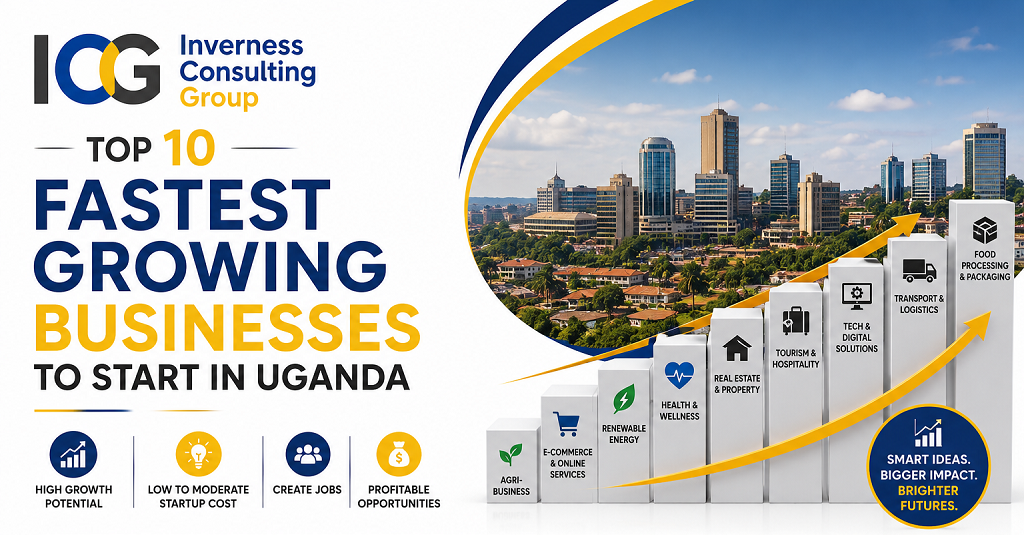
Top 10 Fastest Growing Businesses to Start in Uganda
What are the Top 10 Fastest Growing, Profitable and lucrative Businesses to Start in Uganda?
According to the Uganda Stanbic Bank Purchasing Managers’ Index (PMI), Uganda’s private sector is experiencing robust, sustained expansions in business output and private sector demand. Backed by the strategic pillars of the Government’s National Development Plan IV (NDP IV) spanning 2025–2030, the country has pivoted heavily toward industrialization, digital ecosystems, value addition, and import substitution.
For global investors, corporate strategists, and ambitious local entrepreneurs, identifying where market gaps meet institutional support is the key to capturing high margins.
Below is the definitive, data-backed listicle of the top 10 fastest-growing businesses to start in Uganda, engineered for maximum scalability, structured to provide a clear blueprint for marketplace dominance, and written to directly answer what works in the current economic climate.
Quick Overview: Top 10 High-Growth Businesses in Uganda at a Glance
| Business Sector | Primary Drivers | Key Target Locations | Capital Intensity |
|---|---|---|---|
| 1. Agro-Processing & Fortified Foods | NDP IV subsidies, regional EAC export demand | Luwero, Mbale, Gulu, Mbarara | Medium to High |
| 2. FinTech & Agent Banking Solutions | Mobile-money reliance, financial inclusion gaps | Nationwide (Kampala hubs) | Medium |
| 3. Renewable Energy & Solar Installation | Off-grid demand, green tax incentives | Wakiso, Mukono, Northern Uganda | Medium |
| 4. E-Commerce Fulfillment & Last-Mile Logistics | Urbanization, Jiji/Jumia growth | Kampala, Entebbe, Jinja | Medium |
| 5. Private Data Security & B2B IT Consulting | SME digitization, compliance laws | Kampala Metropolitan Area | Low to Medium |
| 6. Real Estate Development & Satellite Cities | Rapid urbanization, middle-class expansion | Wakiso, Mukono, Mpigi, Gulu | High |
| 7. Specialized Vocational & Tech E-Learning | Massive youth population, human capital deficit | Digital platforms, Kampala, Mbarara | Low to Medium |
| 8. Domestic Tourism Experiences & Eco-Lodges | National infrastructure marketing push | Bwindi, Queen Elizabeth, Jinja, Kidepo | Medium to High |
| 9. Local Pharmaceutical & FMCG Manufacturing | High import reliance (80%+), tax exemptions | Namanve Industrial Park | High |
| 10. Commercial Waste Management & Recycling | Municipal privatization, circular economy push | Kampala, Wakiso, Kira Town | Medium |
The Following Are the Detailed Profiles of The Top 10 Fastest Growing, Profitable and Lucrative Businesses to Start in Uganda?
1. Agro-Processing and Fortified Food Manufacturing
Agriculture remains the central pillar of the Ugandan economy, employing more than 60% of the active domestic workforce. However, the real financial windfall no longer lies in exporting raw, unprocessed agricultural commodities. Raw beans, unground maize, and unrefined fruits yield razor-thin margins and leave local farmers vulnerable to global price shocks.
The fastest-growing enterprise sub-sector within this space is agro-processing and value addition. Driven by the Uganda Investment Authority (UIA) and national import substitution policies, entrepreneurs who process raw harvests into consumer-ready, shelf-stable packages are seeing exponential growth.
Market Opportunities and Verticals
- Coffee & Cocoa Value Addition: Transitioning away from green bean exports into domestic roasting, packaging, and the establishment of soluble coffee or premium chocolate manufacturing plants.
- Grain Milling & Fortification: Setting up processing units for maize, cassava, and millet. Fortifying these flours with essential vitamins targets the massive institutional demand from schools, hospitals, and regional humanitarian relief programs.
- Horticulture & Dried Fruit Export: Processing organic fruits (mangoes, pineapples, bananas) into certified organic juices, premium dried fruits, and specialty essential oils for Western European and Middle Eastern markets.
Strategic Implementation Blueprint
To achieve maximum operational efficiency, forward-thinking investors are moving away from traditional spot-market purchasing and adopting the Nucleus Farming Model.
By setting up a central commercial processing facility surrounded by structured outgrower schemes, your business guarantees a reliable, high-quality raw material supply chain while uplifting local farming communities. Strategic logistics hubs like Luwero are premier locations due to their fertile lands and seamless transport connectivity to Kampala markets and Entebbe International Airport.
2. FinTech, Micro-Lending, and Agent Banking Software
Uganda is fundamentally a mobile-first economy. With mobile money platforms processing trillions of Ugandan Shillings annually, the consumer base has largely skipped traditional brick-and-mortar banking infrastructure. Despite this, a massive portion of the population remains underbanked or lacks formal access to credit lines and structured investment vehicles. This structural gap has turned the Financial Technology (FinTech) ecosystem into an aggressive engine for high-growth venture capital and operational profitability.
Prominent Sectors Driving FinTech Growth
- Micro-Working Capital Lending: Platforms like Numida and Asaak have proved that providing automated, algorithmic credit to informal market traders and motorcycle (boda-boda) operators carries immense interest-yield potential when managed with robust risk software.
- Agri-Tech Financing: Ventures like Emata bridge the financial gap for rural smallholders, allowing cooperatives to access digital credit tailored specifically to crop and dairy production cycles.
- InsurTech & Wealth Management: Digitizing mass-market micro-insurance plans or goal-based digital savings tools (such as Xeno) allows middle-class urbanites to build wealth seamlessly through mobile application portfolios.
Monetization Channels
FinTech monetization strategies rely heavily on transactional micro-fees, SaaS subscription billing for corporate agent networks, or data-driven interest margins on short-term working capital advances.
3. Renewable Energy and Smart Solar Micro-Grids
While Uganda generates substantial hydroelectricity from projects along the River Nile, the centralized national grid remains constrained in its geographical reach, leaving millions of suburban and rural households dependent on expensive, eco-unfriendly energy alternatives. Additionally, the rising cost of industrial electricity tariffs has forced businesses to look for cost-efficient alternatives. Setting up a renewable energy solutions company is an exceptional B2B and B2C commercial play.
Scalable Market Sub-Niches
- Commercial & Industrial (C&I) Solar Systems: Designing, installing, and financing solar arrays for factories, hotels, schools, and large commercial farms looking to lower their grid utility overheads.
- Pay-As-You-Go (PAYG) Home Solar Systems: Delivering affordable solar home systems (lighting, phone charging, and television kits) to rural communities using flexible, mobile-money-integrated daily or weekly installment payment plans.
- Clean Cooking Clean-Tech Solutions: Manufacturing and distributing high-efficiency biomass briquettes and institutional energy-saving cookstoves to reduce corporate reliance on raw wood and charcoal.
Scaling with Strategic Partnerships
To accelerate scaling, market-entry players regularly partner with non-governmental organizations (NGOs), development finance institutions (DFIs), and international carbon-credit offset programs to offset upfront hardware acquisition costs.
4. E-Commerce Infrastructure and Last-Mile Logistics
The rise of digital marketplaces such as Jumia and Jiji Uganda has systematically transformed urban consumer shopping behavior. However, the most critical bottleneck in the entire Ugandan e-commerce value chain is not customer acquisition, it is fulfillment and reliable delivery logistics. Due to irregular urban planning and complex addressing systems in major cities like Kampala, Wakiso, and Kira Town, there is unprecedented demand for tech-enabled logistics operations.
High-Growth Execution Channels
- Third-Party Logistics (3PL) & Fulfillment Centers: Building centralized, multi-tenant warehouses where online merchants can store inventory, handle automated sorting, and hand over packaging to field delivery teams.
- On-Demand Delivery Applications: Operating hyper-local dispatch networks utilizing route-optimized mobile software to service restaurants, grocery stores, pharmacies, and boutique e-commerce stores.
- Cold-Chain Logistics Operations: Providing specialized refrigerated distribution vehicles for the safe transport of perishable horticultural goods, dairy products, and temperature-sensitive pharmaceuticals.
5. Cybersecurity and Corporate B2B IT Consulting Services
As Ugandan small and medium enterprises (SMEs) aggressively transition to the cloud, adopt digital enterprise resource planning (ERP) systems, and process consumer transactions online, they expose themselves to significant digital threats. Combined with strict compliance mandates set by the Data Protection Office under NITA-U, companies are legally required to safeguard consumer information. This has catalyzed a high-margin market for specialized cybersecurity and managed IT consulting agencies.
High-Value B2B Offerings
- Penetration Testing & Vulnerability Assessments: Auditing corporate digital networks, payment gateways, and banking systems to systematically identify security flaws before malicious entities exploit them.
- Custom Enterprise System Development: Designing bespoke internal business solutions, including custom Customer Relationship Management (CRM) tools, automated inventory tracking software, and tailored HR systems for growing local brands.
- Managed IT Compliance & Virtual CISO Services: Serving as an external Chief Information Security Officer for mid-sized corporate firms that require ongoing technical security oversight but lack the capital budget to maintain an expansive, full-time in-house department.
6. Real Estate Development and Satellite City Infrastructure
Uganda features one of the youngest and fastest-growing populations in the East African Community (EAC). This demographic shift is driving massive urbanization, causing traditional metropolitan boundaries to expand outward. The demand for modern, high-quality, and affordable residential and commercial real estate solutions in secondary towns and satellite residential areas (such as Wakiso, Mukono, Mpigi, Gulu, and Mbarara) has reached historic highs.
Investment Frameworks to Capitalize On
- Affordable Gated Residential Developments: Moving away from luxury developments to focus on high-density, mid-tier multi-family apartments targeted directly at young professionals and corporate middle-class families.
- Mixed-Use Suburb Commercial Hubs: Constructing neighborhood commercial plazas that blend retail shops, localized banking branches, pharmacies, and modern remote-working co-working spaces outside the congested central business district of Kampala.
- Industrial Warehousing Real Estate: Developing high-spec, secure logistics warehouses near major transport routes and industrial zones (like Namanve) to lease out to expanding international manufacturing and logistics entities.
7. Specialized Vocational Training and Tech E-Learning Platforms
There is a significant mismatch between the traditional academic curriculum taught in standard institutions and the highly technical skill sets demanded by the modern global economy. Corporations inside and outside Uganda are searching for professionals trained in cloud computing, data analysis, specialized engineering, precision manufacturing, and agribusiness management. Starting a specialized private vocational academy or an online-accessible EdTech platform directly answers this structural economic priority.
Profitable Curricular Directions
- Digital Skills Bootcamps: Offering market-responsive, accelerated certification tracks focusing on UI/UX web development, full-stack programming, automated digital marketing, and AI integration systems.
- Advanced Vocational & Agro-Tech Schools: Constructing technical training programs focused on modern commercial farming methods, specialized industrial machine repair, solar panel assembly, and precision welding.
- Corporate Upskilling B2B Platforms: Developing customized, on-demand training portfolios designed for large enterprises looking to reskill their operational workforces efficiently using digital delivery models.
8. Domestic Experiential Tourism and Luxury Eco-Lodges
Uganda’s global reputation as a premier wilderness and wildlife tourism destination continues to grow. Thanks to significant institutional infrastructure investments, improved regional domestic airstrips, and conservation marketing campaigns, the tourism sector has transformed. The fastest-growing trend in tourism is the shift toward experiential travel and sustainable luxury eco-lodges along major tourist corridors.
Strategic Investment Corridors
- The Entebbe-Kidepo-Bwindi Axis: Developing premium, low-impact, luxury eco-lodges nestled adjacent to national parks like Bwindi Impenetrable National Park, Queen Elizabeth National Park, and Murchison Falls.
- Localized Curated Cultural Experiences: Moving past basic tour transit operations to curate high-end immersive experiences, including guided coffee farm tours, community-led wildlife conservation projects, and premium extreme-sports adventure coordination along the Nile River in Jinja.
- Corporate Retreat Infrastructure: Creating premium weekend escape resorts and fully equipped corporate retreat spaces within close proximity to Kampala to target the expanding domestic corporate events market.
9. Local Pharmaceutical and Import-Substitution FMCG Manufacturing
Uganda currently imports more than 80% of its essential pharmaceutical products and a large volume of daily fast-moving consumer goods (FMCG). This heavy reliance on imports creates an ongoing trade deficit and exposes the local market to supply shortages and inflated landing costs. To reverse this trend, the government offers comprehensive financial incentives, including tax exemptions, zero-tariff import windows on production machinery, and fast-tracked land allocations in industrial parks, for entrepreneurs entering local manufacturing.
Strategic High-Margin Production Gaps
- WHO-Standard Generic Pharmaceutical Manufacturing: Establishing local manufacturing lines for essential generic medicines, veterinary drugs, and medical consumables (like surgical gloves, syringes, and medical gauze) to supply national healthcare facilities.
- Personal Care & Cosmetic Formulations: Formulating organic, high-demand personal hygiene products, infant care products, and cosmetics utilizing locally sourced agricultural inputs like raw shea butter and botanical oils.
- Value-Packaged Food and Beverage Production: Launching automated lines for healthy food options, processed dairy foods, and high-demand consumer goods to cater to the burgeoning urban retail market across East Africa.
10. Commercial Waste Management and Circular Economy Recycling
Rapid urban expansion across Kampala, Wakiso, and Mukono generates thousands of tons of municipal solid waste daily. Municipal authorities are continuously shifting away from direct service provision, transitioning instead to clear frameworks that favor private, commercial waste collection and disposal operators. Integrating modern tech platforms with heavy recycling infrastructure changes waste management from a simple logistics chore into a profitable circular-economy business model.
High-Growth Operational Models
- AI-Enabled Smart Waste Collection Platforms: Using tech-driven applications like Yo-Waste to offer automated, cloud-scheduled commercial waste collection services for residential estates, corporate office blocks, and factories.
- Plastic Recycling & Eco-Pellet Manufacturing: Setting up industrial plants to process plastic waste into high-density industrial raw materials, building materials, or affordable plastic fencing posts.
- Organic Waste-to-Fertilizer Processing: Converting municipal organic waste streams into nutrient-rich organic fertilizers and bio-gas alternatives to supply the agricultural sector.
Navigating the Ugandan Marketplace
Successfully expanding an enterprise in Uganda requires a comprehensive understanding of the local operational environment. Adhering to this structured tactical framework ensures your venture remains compliant, secure, and positioned for long-term growth.
Phase 1: Corporate Legal Registration and Structuring
Every formal business entity must register through the Uganda Registration Services Bureau (URSB). Ensure you acquire a formal Tax Identification Number (TIN) from the Uganda Revenue Authority (URA) early in the setup phase. If your business involves manufacturing, energy, or real estate development, you must secure an Environmental Social Impact Assessment (ESIA) certificate from the National Environment Management Authority (NEMA).
Phase 2: Securing Strategic Location Assets
For manufacturing, agro-processing, and tech-heavy logistics enterprises, anchoring your physical presence within a gazetted Uganda Investment Authority Industrial Park (such as the Kampala Industrial and Business Park in Namanve) unlocks vital infrastructural benefits. This includes direct access to high-voltage industrial grid power, dedicated water mains, streamlined road infrastructure, and hands-on tax-clearance facilitation offices.
Phase 3: Optimizing Digital Acquisition Channels
While traditional relationship networks hold value in regional corporate B2B environments, scalable customer acquisition relies on a modern digital footprint.
Capitalizing on Uganda’s Economic Momentum
Uganda’s combination of rapid demographic growth, positive regulatory adjustments, and deep integration within the East African Community (EAC) market presents a compelling landscape for forward-thinking builders. Whether your organization focuses on expanding tech ecosystems via FinTech or establishing industrial capacity through advanced agro-processing, the timing for decisive market entry is highly favorable. By aligning your commercial goals with the country’s national import-substitution and value-addition priorities, you mitigate operational risk and build a highly scalable, valuable asset.
About Inverness Consulting Group: Inverness Consulting Group is a premier corporate advisory and market-entry strategy consultancy. We assist international investment firms, corporate institutions, and high-growth startups in navigating regulatory legal systems, optimizing supply chain assets, and establishing market dominance across Sub-Saharan Africa.
Explore Our Knowledge and Insight Articles

An HR (Human Resources) manual is an internal document that outlines an organization’s workforce policies, standard procedures, and employee expectations. It ensures fair treatment, legal compliance, and consistent daily operations across the company. Typically, the HR manual includes guidelines on recruitment, onboarding, employee code of conduct, compensation, benefits, leave entitlements, performance evaluation, disciplinary procedures, and termination protocols.
The top HR consulting companies in Uganda for 2026 provide complete workforce solutions for growing businesses. The best HR firms in Uganda specialize in expert HR services, executive recruitment, seamless payroll management, strategic HR outsourcing, strict regulatory compliance, and comprehensive talent management.

Master the new URSB e-Registry portal, local incorporation, foreign company setup, and URA TIN registration. Start a business fast with our 2026 URSB e-Registry company registration Uganda guide. Covers local incorporation, foreign registration company set up.

Top Management Consulting Firms in Uganda: Discover the 10 best locally founded business consulting companies in Kampala for strategic planning, HR advisory, operational improvements, and business growth to transform your corporate enterprise.
Compare the top 5 Employer of Record (EOR) providers in Uganda. Learn about URA taxes, NSSF, labor laws, and how to hire remote workers compliantly. Get the Leading third-party organization that legally hires and employs workers on your behalf.

How to Start a Precious Minerals Mining, Trade & Export Business in Uganda (Gold, Tin, Tungsten & Rare Earths). Discover how to legally and profitably enter Uganda’s precious minerals industry. Learn the step-by-step process for mining, trading, and exporting gold, tin, tungsten, tantalum, and rare earths under the Mining and Minerals Act, 2022.

Discover the 10 top strategic planning consultants in Uganda. Expert guide to business strategy, NDP III alignment, corporate advisory, and organizational development in Kampala.
To successfully navigate this landscape, human resource directors, chief executives, and institutional development partners require an analytical, fact-based map of the training ecosystem. This guide profiles the top 10 providers of professional leadership development in Uganda, Africa, serving as an indispensable buyer’s guide for enterprise-level human resource development.
Violet Kansiime (UFLA-M/26/008) becomes a member of the Uganda Financial Literacy Association (UFLA) in February 2026. A leading financial literacy trainer in Uganda delivering expert training in personal financial management, savings, investment, insurance, debt management, retirement planning, digital financial literacy, and supervised financial institutions for youth, women, civil servants, SACCOs, farmers, families, and the informal sector.

Is Your Company Struck Off the URSB Register in Uganda? Discover Inverness Consulting Group’s Expert 8-Step Guide to Reinstate Your Business Via the OBRS Portal Seamlessly. Learn Critical Compliance, Avoid Penalties, And Ensure Your Company’s Legal Future.
how can we help you?
Contact us at the Consulting WP office nearest to you or submit a business inquiry online.
“Navigating Kenya’s complex tax environment was a major headache—until we engaged Inverness Consulting. Their expert advisory not only helped us save millions in potential penalties but also optimized our tax planning in ways we hadn’t imagined. Their accuracy, timely submissions, and clarity in communication set them apart from any firm we’ve worked with before.”