
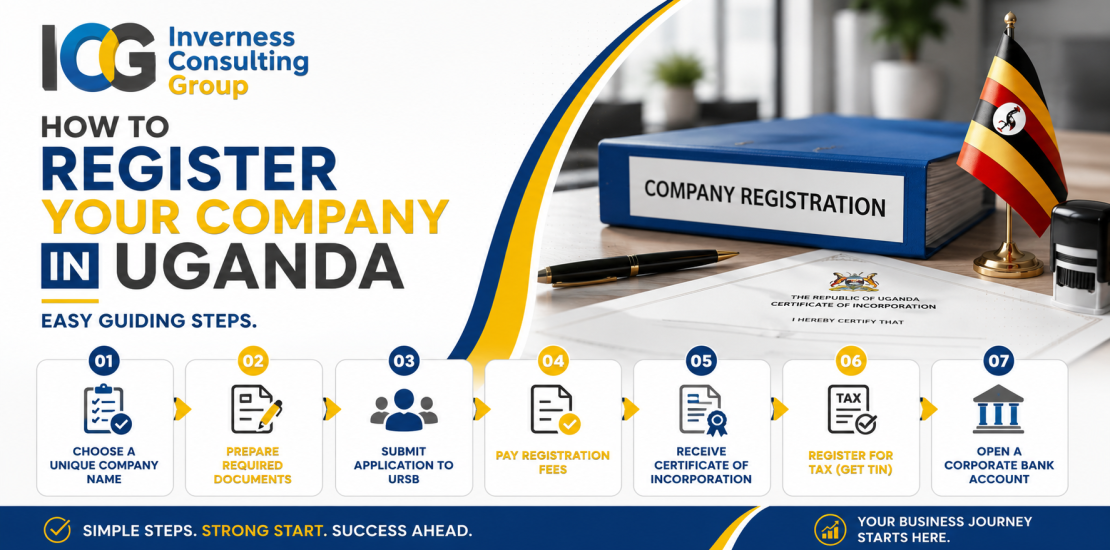
How to Register Your Company in Uganda | Easy Guiding Steps
Registering a company is the foundational step for any entrepreneur looking to tap into the vibrant East African market. In Uganda, this process has been revolutionized by the Uganda Registration Services Bureau (URSB) through the implementation of the Online Business Registration System (OBRS). This guide provides a comprehensive walkthrough of company registration in Uganda, ensuring you meet all legal requirements and avoid common pitfalls.
Whether you are looking to register a business in Uganda as a local startup or incorporate a company in Uganda as a foreign subsidiary, these easy guiding steps will help you navigate the bureaucracy with confidence.
1. Understanding the Core Offering: Why Register?
Before diving into the technical steps to register a company in Uganda, it is essential to understand the strategic and legal benefits of formalizing a business. Moving from an informal setup to a private limited company (Ltd) or a single-member company (SMC) is the primary solution for growth-minded managers. Beyond mere legal compliance with the Companies Act 2012, successful company registration in Uganda provides the following competitive advantages:
Protect Your Brand Name in Uganda
One of the most critical benefits of formalizing a business in Uganda is the protection of your intellectual property. When you register a business name online in Uganda through the URSB online portal, you prevent competitors from using a similar identity. This business name search in Uganda ensures your brand is unique, provides legal grounds to pursue infringement claims, and builds long-term “Brand Trust” in the local market.
Open a Business Bank Account in Uganda
Financial institutions in Kampala and across the country require a Certificate of Incorporation and Form 20 (Particulars of Directors) to facilitate corporate banking. Opening a business bank account in Uganda is a prerequisite for professional financial management, allowing you to separate personal assets from corporate liabilities, a key feature of limited liability protection.
Access Government Tenders in Uganda
For any firm seeking to access government tenders in Uganda, formal registration is mandatory. To bid on lucrative public contracts, your entity must be visible on the PPDA portal with a valid URSB company registration number and a Tax Identification Number (TIN) in Uganda. This formalization enables you to participate in large-scale private contracts and regional trade opportunities that would otherwise be inaccessible to informal traders.
Enjoy Tax Incentives for New Businesses in Uganda
The government offers significant tax incentives to new businesses in Uganda to stimulate investment in sectors such as manufacturing and agriculture. Registered companies can access tax holidays, VAT exemptions on specific industrial machinery, and initial allowance deductions on capital investments. Proper incorporation is the gateway to these fiscal benefits, significantly lowering your operational costs and improving your bottom line.
Limit Personal Liability
A registered private limited company (Ltd) structure creates a “separate legal personality.” This means the company is a body corporate that can own property, sue, and be sued in its own name. For directors and shareholders, this limits your personal liability; your personal assets remain protected if the business faces financial distress or legal challenges, providing a secure environment for starting a business in Uganda.
Need expert advice on business structures? Contact Inverness Consulting Group for a professional consultation. Call, Email, or WhatsApp: +256 774 718641 | info@invernessconsulting.uk
2. Setting Up Your Digital Foundation: The OBRS Account
The journey to register a business name online in Uganda begins at the OBRS portal. To avoid delays in URSB registration, you must first create a personal user account.
Steps to Create an Account on the OBRS System
As per the official URSB Information Guide, follow these precise steps:
- Access the Portal: Open your browser and navigate to https://obrs.ursb.go.ug.
- Initiate Registration: Click the “Create Account” button located at the top right corner of the homepage.
- Select Nationality: For Ugandans: Select “Ugandan” and enter your National Identification Number (NIN). The system is integrated with the National Identification and Registration Authority (NIRA), so ensure your details are up to date.
- For Non-Ugandans: Select your specific nationality. Choose your ID Type (Passport or Alien ID), enter the ID number, your full name, and gender. You will be required to attach a clear scan of your Identity Document.
- Contact Details: Enter a valid email address and a functional phone number. This is crucial for receiving the One-Time Password (OTP).
- Agreement: Check the box to agree to the Terms and Conditions.
- Verification: Click “Register.” An email with a verification link will be sent to you.
- Click the link in your email to verify.
- Enter the OTP code sent via SMS to your phone to verify the mobile number.
- Finalize: Set a strong password and log in.
3. Securing Your Identity: Business Name Search & Reservation
A common problem-solution scenario involves choosing a name that is already in use. To solve this, you must conduct a business name search in Uganda before applying.
How to Reserve a Business Name Online
- Log In: Access your individual account.
- Start Reservation: Click “Start” on the left side menu and select “Reserve Name.”
- Entity Selection: Choose the Entity Type (e.g., Company, Business Name, or Building Society).
- Name Choices: Provide at least three proposed names in order of preference. The system will check these against the existing registry.
- Submission: Preview your details, generate a Payment Reference Number (PRN), and pay the name reservation fee (typically UGX 35,000).
Once approved, the name is reserved for 30 days, during which you must complete the incorporation.
Ensure your brand name is legally secured. Reach out to Inverness Consulting Group for assistance with name searches and reservations. Call, Email, or WhatsApp: +256 774 718641 | info@invernessconsulting.uk
4. Incorporating a Local Company
Once your name is reserved, you can proceed to the official steps to register a company in Uganda. This digital transformation is the ultimate solution for moving from an informal trader to a formal legal entity, unlocking the protections of the Companies Act 2012.
Detailed Incorporation Steps on the OBRS
- Initiate Incorporation: Log into your OBRS dashboard, click the “Start” menu on the sidebar, and select “Incorporate Company.” This begins the formal business incorporation process in Uganda.
- Link Reserved Name: A pop-up window will display your active reservations. Select your approved reserved name. The system will automatically pull your business name reservation data into the application.
- Fill Digital Forms: You must complete several digital forms that serve as the legal record of your entity. These include:
- Form S.18 (Application for Registration): This is the core application under the Companies Act. It captures the company name, nature of business, and the details of the subscribers/shareholders.
- Form 18 (Registered Office): Often confused with S.18, this form provides the particulars of the registered office and postal address. Your company must have a physical presence in Uganda (e.g., an office in Kampala, Entebbe, or Jinja).
- Form 20 (Directors & Secretary): This form captures the particulars of the Directors and the Secretary. You must provide their full names, residential addresses, and occupations. For local companies, at least one director must be a resident of the country.
- Form L1 (Statement of Nominal Capital): This is the Statement of Nominal Capital, declaring the amount of capital the company is authorized to issue. This figure is used to calculate the stamp duty and URSB registration fees.
- Memorandum and Articles of Association (MEMART): The MEMART is the “constitution” of your business. The OBRS offers URSB standard templates that are ideal for most private limited companies (Ltds). However, for specialized ventures, you can upload your own custom-drafted MEMART (in PDF format).
- Upload Identification Documents: Attach high-quality scans of National IDs for all Ugandan directors/shareholders or Passports for foreign participants. Ensure files are under 1MB to avoid upload errors on the URSB portal.
- Assessment and Payment: The system automatically generates a Payment Reference Number (PRN) based on your share capital requirements.
- Standard Fee: For a nominal share capital between 1M and 5M UGX, the total fee is approximately UGX 105,000 (including a fixed stamp duty of UGX 35,000).
- Variable Fee: For capital above 5M UGX, the registration fee is 1.5% of the total share capital, plus a variable stamp duty of 0.5%.
- Note: Payments can be made via Mobile Money (MTN/Airtel), Bank Branch, or Credit/Debit Card.
- Review and Submit: Perform a final check of all “Particulars” to avoid “Queries” from URSB registrars. Once submitted, the status will change to “Pending Review.”
- Obtain Certificate of Incorporation: Once the URSB registrar approves (typically within 2-5 working days), you will receive an email notification. You can then download your digital Certificate of Incorporation, which marks your official entry into the Uganda business registry.
Save time on documentation. Inverness Consulting Group handles all digital filings and MEMART drafting. Call, Email, or WhatsApp: +256 774 718641 | info@invernessconsulting.uk
5. Foreign Company Registration in Uganda
Uganda’s strategic location makes it a prime destination for international trade. For global entities, registering a foreign company in Uganda (commonly referred to as “domiciling a branch”) is a streamlined process under Part X of the Companies Act 2012. Unlike local incorporation, you do not necessarily need to reserve a new name; you register the entity as it exists in its country of origin.
Critical Requirements for Foreign Company Registration
- Certified & Notarized Documents: You must provide a certified and notarized copy of the parent company’s Certificate of Incorporation, and the Charter, Statutes, or Memorandum and Articles of Association (MEMART). These must be authenticated by a Notary Public in the country of origin to verify the parent firm’s “Legal Standing”.
- Certified Translation: If the original corporate documents are not in English, a certified translation performed by a recognized authority is mandatory. This is a common Requirement for company registration in Uganda to ensure the URSB registrar can verify the company’s objectives.
- Local Representative (Form 25): Every foreign branch must appoint at least one Local Representative resident in Uganda. Under Form 25, you provide the details of this individual who is legally authorized to accept service of process and any official notices on behalf of the company.
- Physical Address (Form 26): You must declare the full address of the principal place of business in Uganda. Using Form 26, you specify the office location (e.g., a business hub such as Kampala), which serves as the official point of contact for the Uganda Registration Services Bureau.
- Director Particulars (Form 24): A comprehensive list of the current directors and secretary of the parent company must be submitted. Form 24 captures their names, nationalities, and residential addresses, ensuring transparency in corporate governance.
The Detailed Registration Process
The steps to register a foreign company in Uganda are strictly digital. Follow this walkthrough to avoid “Administrative Queries”:
- Step 1: Document Upload: Log into the OBRS portal and upload the notarized constitutional documents. Ensure the files are in PDF format and clearly legible to avoid delays.
- Step 2: Complete Form 24: Enter the particulars of the international directors and company secretary. This links the parent company’s legal identity to the Ugandan registry.
- Step 3: File Form 13 (Statement of Charges): You must file a Statement of all subsisting charges created by the company. This discloses any existing debentures or mortgages secured against the company’s assets (excluding property situated outside Uganda).
- Step 4: Statutory Fee Payment: The system will generate a PRN for the foreign company registration fees. Currently, the standard fee is $250 USD (or the UGX equivalent), plus a nominal stamp duty and filing fees for the various forms.
- Step 5: Beneficial Ownership Disclosure: In line with AML (Anti-Money Laundering) regulations, you must disclose the Beneficial Owners of the international entity.
- Step 6: Receive Certificate of Registration: Once the URSB registrar verifies the submission (usually within 2-5 working days), you will be issued a Certificate of Registration. This confirms you are a legally recognized foreign branch in Uganda.
International investor? We specialize in foreign company registration and compliance. Call, Email, or WhatsApp: +256 774 718641 | info@invernessconsulting.uk
6. Post-Registration Compliance: Your Checklist
To be fully operational, registration with URSB is just the beginning. To maintain “Good Standing” and avoid de-registration, you must complete the following mandatory steps:
- Register for Tax (TIN): Access the Uganda Revenue Authority (URA) portal to apply for a Tax Identification Number (TIN).
- Requirements: You will need a computer with Microsoft Excel (to fill out the registration template), a valid email address, and a referee (an individual with an active TIN).
- Corporate TIN: For companies, you must provide the Certificate of Incorporation, Form 20, and the individual TINs of all directors.
- Obtain a Trading License: This is required under the Trade Licensing Act.
- Process: Apply via the Kampala Capital City Authority (KCCA) e-Citie portal or your local Municipal Council.
- Cost: Fees vary based on the nature of the business and its location (grading area). You must present your TIN, Certificate of Incorporation, and a valid tenancy agreement for your premises.
- NSSF Employer Registration: Under the NSSF Act, every employer must register with the National Social Security Fund once they have at least one employee.
- Contributions: The total contribution is 15% of the employee’s gross monthly wage (10% contributed by the employer and 5% deducted from the employee).
- Deadline: Remittances must be made by the 15th day of the following month.
- File Annual Returns: All companies must file Annual Returns with URSB to update the registry on changes in shareholding, directorship, or registered address.
- Timeline: Returns must be filed within 42 days of the Annual General Meeting (AGM).
- Penalties: Failure to file for five consecutive years results in the company being struck off the register. The standard filing fee for local companies is UGX 50,000.
- Acquire a Corporate Seal: Per Section 117 of the Companies Act 2012, every company must have its name engraved on a metal seal. This seal is required to authenticate formal documents, bank resolutions, and land transactions.
Stay compliant and avoid penalties. Contact us for TIN, Trading License, and Annual Return filings. Call, Email, or WhatsApp: +256 774 718641 | info@invernessconsulting.uk
7. Expert Tips for Success
- Avoid Common Mistakes: Ensure your passport-sized photographs and ID scans are high resolution. Low-quality uploads are the primary cause of queries and delays.
- Local Assistance: While the system is DIY, many choose to use company registration agents in Kampala or certified public accountants (CPA) in Uganda to ensure the Memorandum and Articles of Association are legally sound.
- Beneficial Ownership: Be prepared to disclose Beneficial Ownership Information, a new mandatory requirement for transparency in Ugandan law.
Conclusion: Fast-Track Your Business Today
Mastering the steps to register a company in Uganda is the most effective solution for entrepreneurs ready to move from informal trade to a legally recognized entity. By utilizing the URSB online portal and the OBRS system, you can register a business in Uganda with unprecedented speed and transparency. Whether you are navigating share capital requirements, drafting your Memorandum and Articles of Association (MEMART), or seeking tax incentives for new businesses in Uganda, formalization is the key to unlocking growth.
To avoid delays in URSB registration, ensure you have all the requirements for company registration in Uganda 2026 ready, including your NIN and high-resolution ID scans. Once you incorporate a company in Uganda, remember that staying compliant with annual returns, TIN filings with the Uganda Revenue Authority, and NSSF registration is vital for long-term success. Don’t let bureaucracy hold you back. Follow these easy guiding steps, visit the URSB offices in Uganda if needed, and fast-track company registration in Uganda today to secure your place in the Uganda business registry.
Ready to get started? Let Inverness Consulting Group take the hassle out of your registration. Contact us today via Call, Email, or WhatsApp: +256 774 718641 | info@invernessconsulting.uk
Other Services



how can we help you?
Contact us at the Consulting WP office nearest to you or submit a business inquiry online.
“Navigating Kenya’s complex tax environment was a major headache—until we engaged Inverness Consulting. Their expert advisory not only helped us save millions in potential penalties but also optimized our tax planning in ways we hadn’t imagined. Their accuracy, timely submissions, and clarity in communication set them apart from any firm we’ve worked with before.”