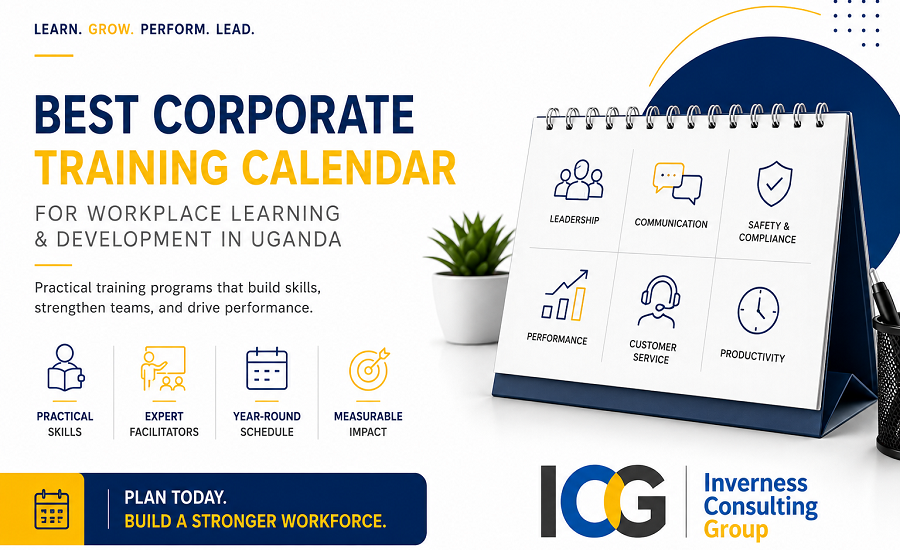
Corporate Training Calendar for Workplace Learning and Development in Uganda 2026Best Corporate Training Calendar for Workplace Learning and Development in Uganda 2026
What Is A Workplace Learning And Development Training Calendar?
A workplace learning and development (L&D) training calendar is a strategic, scheduled plan of educational programs and skill-building activities offered to employees over a specific period (usually a quarter, half-year, or full year).
At Inverness Consulting Group, A well-structured L&D calendar acts as an actionable roadmap, ensuring that training is consistent, relevant, and aligned with both individual career goals and broader business objectives.
Modern organizational growth in East Africa demands more than standard human resource management; it requires a deliberate, strategic approach to continuous capability enhancement. As the corporate ecosystem in Kampala and the broader East African region undergoes rapid changes driven by technological integration and shifting economic demands, companies must proactively invest in their most valuable asset: their people. Inverness Consulting Group, a leading pioneer in corporate upskilling, is proud to present the definitive corporate training calendar for 2026 in Uganda. This publication serves as an essential framework for institutions aiming to align their talent development strategies with regional economic trends, technological advancements, and international standards of corporate governance.
Whether you are looking for a short-course training calendar for Uganda 2026 or searching for corporate training calendars in Uganda to guide your annual planning, this comprehensive guide outlines a series of highly practical programs designed to drive measurable business impact. Each of our carefully curated sessions is structured to address the specific skills gaps identified by leading industries in Uganda, including the financial services, public sector, non-governmental organizations, telecommunications, and agricultural sectors. Our primary goal is to provide corporate leaders, human resource professionals, and procurement officers with a highly reliable roadmap that transforms traditional workforce training into a continuous engine for business innovation.
2026 Master Corporate Training Calendar Summary Schedule
The following structural master calendar provides an immediate, high-level overview of our scheduled corporate upskilling programs in Kampala in 2026. This layout is engineered to offer immediate clarity for annual planning, corporate budgeting, and training selection.
| Month (2026) | Program Title | Scheduled Dates | Primary Target Audience Location | |
|---|---|---|---|---|
| July | Advanced Corporate Sales Mastery | July 29th, 30th, and 31st | Corporate Sales Executives, Business Development Leads, Account Managers | Kampala |
| August | Administrative Assistant, Office Management, and Executive Office Professional Course | August 26th, 27th, and 28th | Executive Assistants, Office Administrators, Executive Office Professionals | Kampala |
| September | Corporate Artificial Intelligence and Machine Learning Integration | September 23rd, 24th, and 25th | Executives, Department Heads, Innovators, Strategy Directors | Kampala |
| October | Advanced Microsoft Excel, Financial Modeling, and Data Analytics | October 28th, 29th, and 30th | Financial Analysts, Accountants, Operations Managers, Data Analysts | Kampala |
| November | Organizing and Conducting Successful Meetings | November 25th, 26th, and 27th | Board Secretaries, Administrative Coordinators, Meeting Facilitators | Kampala |
| December | Strategic Leadership and Digital Transformation Capstone | December 9th, 10th, and 11th | C-Suite Executives, Directors, Board Members, Permanent Secretaries | Kampala |
The Strategic Imperative of Workplace Learning and Development in 2026
To understand the necessity of a structured annual corporate training calendar for 2026, one must analyze Uganda’s current economic and business landscape. The national focus on industrialization, digital infrastructure, and professional services under the national planning frameworks has created an unprecedented demand for advanced corporate skills. It is no longer sufficient to conduct ad hoc training sessions when performance gaps appear. Organizations that succeed in this highly competitive environment are those that treat corporate learning as an ongoing, strategic asset. By integrating our professional development training calendar in Kampala into your annual planning, your organization ensures that skill development is synchronized with quarterly performance reviews, project launches, and annual budget cycles.
A structured learning and development calendar for 2026 in Kampala allows human resource departments to transition from reactive administrative units to proactive strategic partners. Instead of scrambling to address individual performance challenges, companies can leverage our 2026 staff capacity-building calendar in Uganda to build collective institutional capabilities. This long-term planning prevents training fatigue, optimizes training budgets, and ensures that employees are systematically prepared to handle tomorrow’s challenges. When employees see a clear, organized path for their career growth, retention rates increase, recruitment costs decrease, and organizational morale rises significantly.
Furthermore, as a leading business-to-business partner, Inverness Consulting Group is recognized as one of the best learning and development firms in Kampala. Our reputation is built on delivering training that is not merely educational but truly transformative. We will design our corporate upskilling programs in Kampala in 2026 to reflect the cultural, regulatory, and economic realities of the Ugandan market. We understand that local businesses must navigate unique infrastructural challenges, specific regulatory compliance rules under the Uganda Revenue Authority and the Capital Markets Authority, and diverse workplace dynamics. Our training materials, case studies, and practical exercises are fully localized to ensure instant relevance and immediate execution in the workplace.
Master Training Calendar Schedule for July to December 2026
To assist corporate planners, human resource managers, and procurement professionals in organizing their training initiatives, Inverness Consulting Group has structured its 2026 courses on a highly predictable, standardized schedule. This organization allows companies to plan their work schedules, manage client deliverables, and ensure maximum attendance without disrupting daily operations.
Except for our highly anticipated year-end capstone program in December, which takes place during the second week of the month, all other corporate training programs are scheduled to happen on Wednesday, Thursday, and Friday of the last week of each month. This precise scheduling allows human resource teams to confidently integrate these programs into their internal staff capacity-building calendar for 2026 in Uganda.
July Session: Advanced Corporate Sales Mastery
The July training program is scheduled for Wednesday, July 29th, Thursday, July 30th, and Friday, July 31st, 2026. This intensive session is tailored for corporate sales executives, account managers, and business development leads seeking to dominate the East African regional market.
August Session: Administrative Assistant, Office Management, and Executive Office Professional Training Course in Uganda
The August training program is scheduled for Wednesday, August 26th, Thursday, August 27th, and Friday, August 28th, 2026. This comprehensive course targets the essential administrative professionals who keep corporate and public sector offices running smoothly, securely, and efficiently.
September Session: Corporate Artificial Intelligence and Machine Learning Integration
The September training program is scheduled for Wednesday, September 23rd, Thursday, September 24th, and Friday, September 25th, 2026. This highly specialized, forward-looking program is designed for executives, innovators, and department heads who need to leverage modern digital tools to drive organizational efficiency.
October Session: Advanced Microsoft Excel, Financial Modeling, and Data Analytics
The October training program is scheduled for Wednesday, October 28th, Thursday, October 29th, and Friday, October 30th, 2026. This hands-on masterclass is built for financial analysts, accountants, operations managers, and data-driven professionals who require maximum efficiency in spreadsheet automation.
November Session: Organizing and Conducting Successful Meetings
The November training program is scheduled for Wednesday, November 25th, Thursday, November 26th, and Friday, November 27th, 2026. This vital communication course focuses on board secretarial roles, administrative coordination, meeting facilitation, and effective minute-taking processes.
December Session: Strategic Leadership and Digital Transformation Capstone
The December training program is scheduled for Wednesday, December 9th, Thursday, December 10th, and Friday, December 11th, 2026. This elite year-end program brings together corporate executives, directors, and permanent secretaries to reflect on annual performance and plan their strategic digital transformation initiatives for the upcoming fiscal cycle.
July 2026: Advanced Corporate Sales Mastery
Dates: July 29th, 30th, and 31st, 2026
The contemporary sales landscape in Uganda has shifted from transactional relationships to highly complex, value-driven corporate partnerships. As businesses seek to expand their market share within the East African Community, sales professionals must possess advanced consultative selling capabilities, exceptional negotiation strategies, and the ability to navigate multi-layered procurement processes. Our Sales Training course in July is designed to equip sales teams with the exact methodology required to secure high-value B2B contracts, build long-term client loyalty, and consistently hit revenue targets in a competitive economic environment.
Over the course of three intensive days, participants explore the psychological frameworks that govern modern purchasing decisions. We demystify the complex corporate buying center, helping sales professionals identify key influencers, gatekeepers, economic buyers, and technical evaluators within their target organizations. By learning how to map the customer journey, participants can tailor their sales messaging to address the specific pain points of different organizational stakeholders, ensuring that their proposals resonate with both technical experts and financial directors.
A major focus of this July training is on mastering the art of consultative questioning. Rather than delivering generic product pitches, sales professionals learn how to conduct deep discovery sessions that uncover latent organizational challenges. We guide participants through our proprietary questioning models, demonstrating how to quantify the cost of inaction for a client. This approach shifts the sales conversation from price to return on investment, enabling sales teams to maintain healthy profit margins and defend their pricing structures against aggressive competitors.
Furthermore, the session addresses the realities of corporate negotiation and contract closing within East Africa. Participants engage in interactive role-playing exercises simulating complex, multi-party negotiations. They learn how to handle common objections related to budget constraints, competitor offerings, and implementation timelines. By exploring win-win negotiation frameworks, sales executives discover how to trade concessions strategically, ensuring that closed deals remain profitable while establishing a foundation of trust and mutual benefit with the new client.
August 2026: Administrative Assistant, Office Management, and Executive Office Professional Training Course in Uganda
Dates: August 26th, 27th, and 28th, 2026
The smooth functioning of any modern corporate office or public sector agency depends heavily on the competence, organization, and emotional intelligence of its administrative professionals. Often acting as the first point of contact for external stakeholders and the primary coordinators for internal leadership, executive assistants and office managers require a unique blend of technical, organizational, and interpersonal skills. The Administrative Assistant, Office Management, and Executive Office Professional Training Course in Uganda, scheduled for August, provides these vital professionals with the comprehensive toolkit needed to manage busy offices, coordinate complex schedules, and support executive decision-making.
Our curriculum begins with a deep dive into modern office management techniques and digital coordination. In 2026, administrative professionals must look beyond physical filing cabinets and manual logs; they must master cloud-based document management, digital collaborative platforms, and automated workflow systems. This course teaches participants how to design and implement highly efficient, paperless administrative systems that ensure data security, quick information retrieval, and seamless collaboration across remote and hybrid office environments.
Beyond technical organization, the training emphasizes the critical role of professional communication and relationship management. Executive assistants learn the principles of executive presence, corporate etiquette, and high-impact written communication. We teach participants how to draft clear, concise executive briefs, professional emails, and official correspondence that reflect the high standards of their organization. Special attention is given to the art of managing up, helping administrative professionals anticipate their executives’ needs, manage competing calendar priorities, and protect their executives’ time from unnecessary interruptions.
Additionally, we address the highly critical area of conflict resolution and emotional intelligence in the workplace. Office managers frequently navigate interpersonal challenges, coordinate diverse teams, and manage demanding stakeholders. Through practical case studies and interactive discussions, participants learn how to de-escalate workplace tension, manage difficult personalities, and foster a collaborative, positive office culture. This focus ensures that administrative professionals return to their organizations not just as organizers, but as positive culture builders who enhance overall team productivity.
September 2026: Corporate Artificial Intelligence and Machine Learning Integration
Dates: September 23rd, 24th, and 25th, 2026
As the fourth industrial revolution reshapes global commerce, artificial intelligence has transitioned from a futuristic concept to a practical necessity for daily business operations. Organizations that fail to adopt cognitive technologies risk obsolescence, while those that strategically integrate these tools experience monumental gains in productivity, customer satisfaction, and operational efficiency. The September session of our 2026 workforce development training calendar is dedicated to the integration of Artificial Intelligence and Machine Learning, providing business leaders, operational managers, and technology professionals with a clear, non-technical blueprint for executing AI strategies in the Ugandan corporate context.
This training begins by demystifying artificial intelligence, machine learning, and natural language processing for business leaders. We ensure that participants understand what these technologies can realistically achieve and, equally importantly, what they cannot. By exploring the core pillars of AI capability, managers learn how to identify high-impact use cases within their specific departments, whether in automated customer support, predictive inventory management, intelligent lead generation, or automated financial analysis. This foundational knowledge empowers organizations to make smart, informed technology investments that deliver measurable value.
A substantial portion of this September program is dedicated to the practical application of generative AI tools and prompt engineering. Participants engage in hands-on workshops where they learn how to utilize advanced language models to accelerate content creation, automate routine report generation, analyze market trends, and streamline market research. We teach business managers how to construct precise, context-rich prompts that yield highly accurate, professional-grade outputs, transforming these AI applications into powerful digital assistants that amplify individual employee productivity.
Furthermore, we address the highly critical ethical, security, and governance implications of adopting AI in the workplace. As companies integrate these technologies, they must navigate complex issues regarding data privacy, intellectual property rights, and algorithmic bias. This training provides participants with robust frameworks for establishing internal corporate AI policies. We guide organizations on securing sensitive corporate data, ensuring compliance with regional data protection acts, and maintaining the human-in-the-loop oversight necessary to protect organizational integrity and public trust.
October 2026: Advanced Microsoft Excel, Financial Modeling, and Data Analytics
Dates: October 28th, 29th, and 30th, 2026
Data is often described as the new currency of business, but raw data is virtually useless without the analytical capabilities required to transform it into actionable business intelligence. Despite the emergence of complex data visualization software, Microsoft Excel remains the undisputed, universal standard for business analysis, financial modeling, and operational reporting worldwide. The October session of our short courses training calendar in Uganda 2026 focuses on Advanced Microsoft Excel, equipping financial analysts, accountants, auditors, and business managers with the sophisticated modeling and analytical capabilities needed to make rapid, data-backed decisions.
The three-day masterclass begins by optimizing fundamental data management and preparation techniques. Many professionals spend hours manually cleaning, sorting, and formatting data before any actual analysis can occur. We introduce participants to the transformative power of Power Query, a tool within Excel that automates the extraction, transformation, and loading of data from diverse corporate databases. By mastering Power Query, analysts can create automated data pipelines that refresh instantly, saving dozens of hours of manual labor every month.
The second phase of the course focuses on advanced logical functions, complex lookups, and dynamic array formulas. We move participants beyond basic tables, training them to use advanced formulas that handle multi-conditional analysis with ease. Participants discover how to construct robust, flexible financial models that can handle scenario analysis, stress testing, and risk forecasting. This training is highly valuable for finance professionals who need to build dynamic budgets, evaluate capital investment opportunities, and project future cash flows under various economic assumptions.
Finally, we explore the principles of high-impact data visualization and interactive dashboard creation. Analysts learn how to synthesize thousands of rows of operational data into single-page, interactive executive dashboards. By utilizing advanced pivoting techniques, slicers, and dynamic charts, participants learn how to present complex information in a clear, visually compelling manner. This enables executives and board members to grasp key performance indicators at a glance, accelerating decision-making processes and ensuring organizational alignment on critical business metrics.
November 2026: Organizing and Conducting Successful Meetings
Dates: November 25th, 26th, and 27th, 2026
In the modern corporate world, meetings represent a massive investment of organizational time and resources, yet they are frequently cited as a primary source of workplace frustration and operational inefficiency. Poorly planned, unstructured, and badly facilitated meetings lead to decision paralysis, misaligned priorities, and wasted corporate capital. The November training course, Organizing and Conducting Successful Meetings, addresses this critical operational challenge directly. It provides corporate secretaries, administrative coordinators, and business leaders with the professional frameworks required to transform meetings into highly productive, action-oriented, and decisive corporate events.
The training begins with the vital pre-meeting planning phase, which is often neglected yet dictates the success of any gathering. Participants learn how to define clear, measurable meeting objectives and determine whether a meeting is even necessary. We teach the principles of structured agenda design, detailing how to allocate time realistically to specific topics, assign discussion leads, and distribute preparation materials well in advance. This structured approach ensures that attendees arrive fully prepared, focused, and ready to contribute constructively to the agenda items.
During the session, we explore the dynamics of effective meeting facilitation and stakeholder management. Participants learn how to steer discussions productively, keeping attendees focused on the agenda, managing vocal personalities, and encouraging input from quieter, expert team members. We cover proven techniques for constructively managing disagreements, resolving deadlocks, and driving consensus among diverse stakeholders. These facilitation skills are highly valuable for managing complex project reviews, executive alignment sessions, and formal board meetings.
The final day of this November course focuses heavily on the administrative discipline of recording decisions, writing high-quality minutes, and tracking action items. Participants learn how to capture the essence of complex discussions, document critical decisions clearly, and assign specific action items with clear deadlines. We provide practical exercises in writing professional, objective, and legally sound meeting minutes that serve as a reliable reference point for future action. This guarantees that the momentum generated during a meeting translates into actual organizational results and timely project execution.
December 2026: Strategic Leadership and Digital Transformation Capstone
Dates: December 9th, 10th, and 11th, 2026
To conclude our annual corporate training calendar for 2026, Inverness Consulting Group hosts its premier, high-level executive capstone program earlier in the month, specifically from Wednesday, December 9th to Friday, December 11th, 2026. This strategically scheduled session acts as an intellectual laboratory for corporate leaders, C-suite executives, directors, and senior public officials. The program focuses on the intersection of strategic leadership, organizational digital transformation, and modern artificial intelligence integration, offering a high-impact environment for reflection, strategic planning, and leadership refinement ahead of the upcoming fiscal year.
This prestigious capstone program is built on the premise that modern leadership is inseparable from technological literacy. Leaders must understand how digital tools, data analytics, and cloud computing can be leveraged to redesign business models, optimize operational cost structures, and create superior customer experiences. We guide executives through real-world case studies of successful digital transformations in emerging markets, highlighting both the technological requirements and the essential change-management strategies required to transition legacy organizations into highly agile, digital-first entities.
A major focus of the December session is on strategic decision-making and risk management in a volatile, uncertain business environment. Leaders explore advanced frameworks for strategic planning, resource allocation, and organizational alignment. We address the critical human element of technological change, teaching executives how to foster an organizational culture that embraces innovation, continuous learning, and digital experimentation. By understanding how to manage the anxieties associated with automation, leaders can build highly resilient teams that are enthusiastic about technological progress.
Finally, the December program provides a unique networking and collaborative space for senior leaders in East Africa. Participants engage in peer-to-peer strategic exercises, sharing insights, challenges, and successes from their respective industries. This collaborative environment fosters cross-sector partnerships, encourages regional trade opportunities, and helps leaders align their organizational strategies with the broader national economic objectives of Uganda and the East African Community. It is the perfect strategic capstone to a year of dedicated workplace learning and capability development.
Navigating the L&D Landscape: Where to Find Corporate Training Calendars in Uganda
For human resource managers, learning and development directors, and corporate procurement officers, identifying reliable, high-quality professional development programs is a major operational challenge. The search for the right educational provider often involves sorting through a disjointed mix of local colleges, independent consultants, and international institutions that may not fully understand the local market realities. When looking for the best L&D services training calendar in Uganda, organizations must seek providers who offer a structured, comprehensive, and highly practical curriculum aligned with regional business requirements and modern technological trends.
A key indicator of high-quality corporate training in Uganda is the level of institutional accreditation and alignment with national development guidelines. Top-tier providers work in close alignment with national bodies such as the Directorate of Industrial Training and the National Council for Higher Education. This alignment ensures that the training programs meet rigorous quality standards, utilize effective adult learning methodologies, and deliver measurable performance outcomes. Inverness Consulting Group is recognized as one of the highly accredited L&D service providers in Uganda, known for our uncompromising standards of educational quality, professional training delivery, and customer service.
When evaluating where to find corporate training calendars in Uganda, organizations should prioritize providers who make their schedules available well in advance. This early availability allows human resource departments to plan their annual talent development programs strategically, coordinate individual staff training paths, and secure the necessary corporate budget approvals. A highly organized provider like Inverness Consulting Group publishes its 2026 annual corporate training calendar early, providing detailed course descriptions, clear learning outcomes, target audience profiles, and predictable dates to facilitate effortless planning and seamless integration into corporate schedules.
Furthermore, outstanding training providers stand out by offering flexible, customized delivery models that adapt to their clients’ unique operating requirements. While our open-enrollment public workshops provide exceptional opportunities for peer-to-peer learning and professional networking, we also deliver our curriculum as highly customized, in-house corporate training solutions. If your company has a large team requiring specialized training in sales, advanced analytics, administrative excellence, or modern artificial intelligence, we can customize our modules to incorporate your internal datasets, corporate policies, and operational workflows, delivering maximum relevance and an outstanding return on investment.
How to Plan Your Corporate Training Budget in Uganda for 2026
Planning a corporate training budget is a critical strategic task that requires a careful balance between immediate operational cost control and long-term capability building. Too often, organizations view training as a discretionary expense that can be easily reduced or deferred when financial pressures mount. However, progressive organizations view talent development as an essential capital investment that directly influences long-term productivity, operational efficiency, and overall market competitiveness. Understanding how to plan the corporate training budget in Uganda for 2026 is critical for human resource leaders who need to justify their training investments to financial directors and corporate board members.
The first step in a successful budget planning process is to conduct a comprehensive organizational skills gap analysis. Rather than allocating training funds evenly across departments or selecting courses at random, HR leaders must work closely with business unit managers to identify the critical capabilities required to achieve the company’s strategic goals. If the company’s priority is digital expansion, the budget should prioritize digital transformation corporate training in Uganda and artificial intelligence training for business managers in Kampala. If the goal is to improve compliance and financial oversight, resources should be directed toward the CPD training calendar 2026 Uganda and risk management and compliance training in Kampala.
The second key element in planning your L&D budget is to consider the full scope of training-related costs to ensure a highly realistic financial plan. Beyond the direct tuition or facilitation fees charged by corporate training providers, a comprehensive budget must account for travel, accommodation, venue hire for offsite sessions, learning materials, and the indirect cost of employee time away from work. By choosing structured, localized short courses in Kampala, organizations can significantly reduce travel and logistics costs while ensuring that their teams receive world-class training without the high expense of international travel.
The third and most crucial aspect of budget planning is establishing a clear framework for measuring training return on investment. To defend and sustain their L&D budgets, human resource professionals must demonstrate how training initiatives contribute directly to business performance. This involves setting clear, quantifiable performance metrics before the training begins, such as a percentage reduction in administrative errors, an increase in sales conversion rates, or a drop in IT security incidents. By partnering with Inverness Consulting Group, organizations receive detailed post-training evaluation reports and practical action plans that facilitate performance tracking, making it easy to demonstrate the tangible impact of L&D initiatives on the corporate bottom line.
Why Inverness Consulting Group is the Premier Choice for L&D in Uganda
Selecting the right partner for corporate training is one of the most critical decisions an organization can make, as the quality of instruction directly impacts workforce competence, operational safety, and overall business performance. Inverness Consulting Group has established itself as the leading partner for organizations across East Africa by consistently delivering training programs that combine academic rigor with practical, real-world execution. Our team of highly experienced consultants, industry practitioners, and executive coaches brings unmatched expertise to every training session, ensuring participants receive practical, high-value guidance they can apply immediately in their daily roles.
Our training methodology is built on the principles of active adult learning, moving far beyond passive lectures and generic slide presentations. We believe that true learning occurs through doing, which is why our courses are highly interactive and experiential. Our sessions incorporate real-world case studies, hands-on computer-based exercises, interactive role-playing simulations, and structured group problem-solving workshops. This practical approach ensures that participants do not just memorize concepts but actively develop the skills, confidence, and critical thinking required to apply what they have learned to their specific operational challenges.
Furthermore, we recognize that learning does not end when the training session concludes. Many training programs fail to deliver long-term value because participants lack the support needed to apply new concepts upon returning to their busy day-to-day work environments. To address this challenge, Inverness Consulting Group provides robust post-training support, including follow-up implementation materials, structured self-assessment tools, and options for group coaching sessions. This ongoing support helps reinforce learning, troubleshoot real-world execution challenges, and ensure that the new capabilities are fully integrated into the organization’s daily workflows.
Finally, our deep commitment to E-E-A-T (Experience, Expertise, Authoritativeness, and Trustworthiness) is reflected in every aspect of our business. We do not use generic, off-the-shelf training manuals; instead, our expert content designers research and develop comprehensive, highly customized learning resources that reflect the latest industry standards, regional regulatory developments, and international best practices. When you partner with Inverness Consulting Group, you are partnering with a highly respected, deeply trusted institution that is fully dedicated to helping your organization unlock its full potential and achieve sustained corporate success.
Sector-Specific Training Applications in Uganda
To maximize the impact of our corporate upskilling programs in Kampala in 2026, Inverness Consulting Group tailors its curriculum to the unique operational requirements of key sectors in Uganda’s economy. We understand that a public sector agency, a commercial bank, a multinational telecommunication firm, and a donor-funded non-governmental organization operate under very different regulatory frameworks, governance models, and strategic priorities. Our instructors customize their case studies, group exercises, and discussion topics to ensure that the learning experience is highly relevant and immediately actionable for every participant.
Public Sector and Government Agencies
Our public sector procurement training in Uganda is designed to help government ministries, departments, and local authorities navigate the complex legal frameworks governing public expenditure. We focus heavily on transparency, risk mitigation, and compliance with the Public Procurement and Disposal of Public Assets Act. Public officials learn how to design fair, competitive bidding processes, evaluate complex contractor proposals, and manage large-scale public contracts effectively, ensuring maximum value for taxpayer money and full compliance with national anti-corruption guidelines.
Financial Services and Insurance Sectors
For the highly competitive banking and insurance industries, we offer specialized programs focusing on risk management, regulatory compliance, and digital financial innovation. Our risk management and compliance training in Kampala helps financial institutions navigate evolving anti-money laundering regulations, central bank guidelines, and cybersecurity challenges. We train credit officers, risk managers, and compliance professionals to identify, assess, and mitigate operational risks, protecting institutional assets while supporting sustainable business growth in an increasingly digital financial ecosystem.
Non-Governmental Organizations and Donor-Funded Projects
Non-governmental organizations and donor-funded projects operate under strict accountability, monitoring, and reporting requirements. Our donor-funded financial management training is designed to help NGO directors, project coordinators, and finance managers maintain the highest standards of financial stewardship. We cover grant management, donor-specific reporting templates, multi-currency budgeting, and audit preparation. This training ensures that organizations can confidently demonstrate financial transparency, satisfy rigorous donor requirements, and secure ongoing funding for their vital community development initiatives.
Corporate Telecommunications, Manufacturing, and Logistics
For rapid-growth commercial enterprises, our training programs emphasize digital agility, supply chain efficiency, and operational excellence. Through our digital transformation corporate training in Uganda, companies learn how to leverage automation, cloud computing, and big data to optimize their manufacturing processes, manage warehouse operations, and deliver superior customer service. We help commercial organizations build highly responsive, tech-enabled workforces that adapt to shifting market demands and outperform competitors in the regional market.
Frequently Asked Questions
What are the main benefits of using a structured training calendar rather than booking individual courses on demand?
Using a structured training calendar allows organizations to transition from reactive administrative management to proactive strategic planning. By scheduling training dates well in advance, human resource departments can align staff development initiatives with annual performance goals, project timelines, and corporate budget cycles. This prevents operational disruption, ensures high attendance rates, and enables the organization to build institutional capabilities across departments over the fiscal year systematically.
How does Inverness Consulting Group ensure that its training content remains highly relevant to the Ugandan business environment?
Our content development team continuously monitors the local regulatory, economic, and technological landscapes to ensure that our curriculum remains highly accurate and fully localized. We integrate practical case studies based on real-world challenges faced by Ugandan organizations, including local tax compliance under the Uganda Revenue Authority, regional trade dynamics within the East African Community, and local infrastructure constraints. Our facilitators are highly experienced local and regional experts who understand the cultural and operational nuances of doing business in East Africa.
Can our organization request customized versions of these calendar courses to be delivered in-house?
Yes, all the courses featured in our 2026 training calendar can be fully customized and delivered as dedicated, in-house corporate training programs. This model allows us to tailor the curriculum to incorporate your company’s specific datasets, internal operational policies, and unique corporate culture. In-house training is highly cost-effective for larger teams, eliminates travel and accommodation logistics for your staff, and enables confidential discussions about your organization’s specific strategic challenges and opportunities.
What post-training support does Inverness Consulting Group provide to ensure successful skills application in the workplace?
We are deeply committed to ensuring that our training programs deliver long-term performance improvements. To facilitate this, we provide participants with a comprehensive post-training support package, including digital reference materials, structured action-planning templates, and self-assessment tools. Additionally, we offer optional follow-up coaching sessions and group review workshops for our corporate clients to help troubleshoot real-world implementation challenges, reinforce core concepts, and track the ongoing return on your training investment.
Are the courses offered by Inverness Consulting Group eligible for Continuing Professional Development (CPD) credits?
Yes, our professional development programs are structured to meet the rigorous quality standards required by major professional bodies in Uganda and East Africa. Many of our finance, accounting, risk management, and governance programs are eligible for Continuing Professional Development credits under relevant professional associations. We provide all participants with accredited certificates of completion that can be used to satisfy annual professional licensing and continuing education requirements.
Strategic Action Steps
To maximize the benefits of this comprehensive 2026 workplace learning calendar, corporate leaders and human resource directors should take immediate, decisive action to integrate these programs into their annual business planning. The journey to building a highly competitive, future-ready workforce requires a methodical approach that translates strategic intent into practical, everyday organizational development.
The first step is to share this master training calendar with department heads, business unit leads, and executive team members. Use this document as a framework for a collaborative discussion to identify which specific courses align with your company’s strategic priorities for the third and fourth quarters of 2026. This collaborative selection process ensures that training initiatives are closely aligned with actual business needs and have the full support of departmental leadership.
The second step is to engage our corporate advisory team at Inverness Consulting Group to discuss your specific training requirements, coordinate participant registration, or explore custom in-house delivery options. Our expert consultants are ready to assist you in designing a comprehensive talent development roadmap that fits your budget, meets your performance goals, and positions your organization for sustained operational excellence and market leadership.
Other Services










how can we help you?
Contact us at the Consulting WP office nearest to you or submit a business inquiry online.
“Navigating Kenya’s complex tax environment was a major headache—until we engaged Inverness Consulting. Their expert advisory not only helped us save millions in potential penalties but also optimized our tax planning in ways we hadn’t imagined. Their accuracy, timely submissions, and clarity in communication set them apart from any firm we’ve worked with before.”