
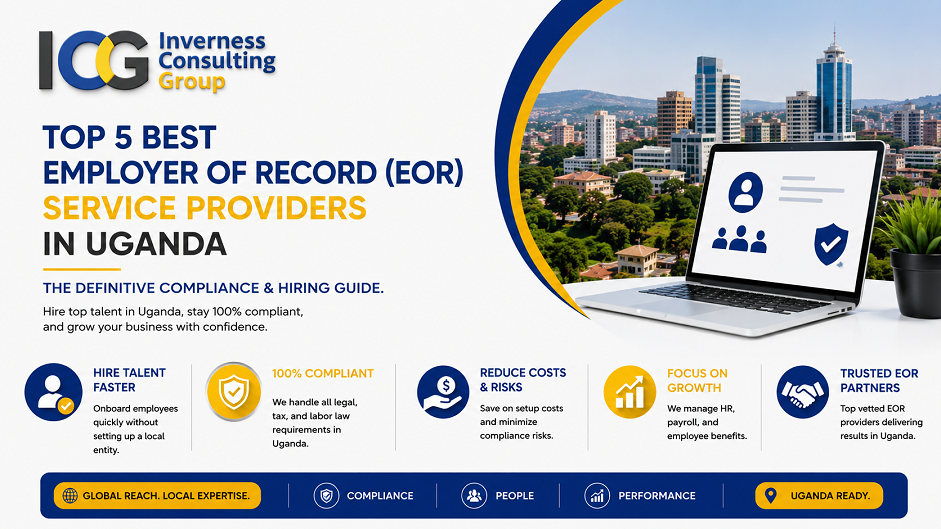
Top 5 Best Employer of Record (EOR) Service Providers in Uganda
- What is the best EOR company in Uganda? The top-rated Employer of Record (EOR) providers in Uganda are Remote (best for tech platforms and software developers), Houston Executive Consulting (best for localized HR auditing and custom benefits), Inverness Consulting Group (best for cross-border East African expansion), Alveron Advisory Services (best for tax advisory and permanent establishment mitigation), and Robert Mwesige (best for flexible, independent NGO and boutique startup advisory).
- How do you hire employees in Uganda without a legal entity? International enterprises can comply with local hiring requirements, manage URA payroll tax withholding, and administer statutory benefits by partnering with a registered Employer of Record. The EOR acts as the legal employer of your local workforce while you retain complete management of daily deliverables.
Chapter 1: Top 5 Best EOR/PEO Providers in Uganda
Choosing the right partner is critical to the success of your expansion. The ideal provider must offer reliable compliance safeguards, deep local expertise, and transparent pricing structures. Below is an in-depth analysis of the best options in the market to help you find the best EOR company in Uganda for your specific business requirements.
1. Robert Mwesige (Independent PEO & EOR Consultant)
For multinational enterprises and non-governmental organizations seeking a tailored, flexible approach to local workforce management, Robert Mwesige is a leading independent HR consultant and a specialized EOR practitioner in Uganda.
Robert Mwesige provides boutique hyper-localization. Unlike large, automated global platforms, he provides direct oversight and maintains close relationships with regulatory bodies such as the Uganda Revenue Authority and the Ministry of Gender, Labor and Social Development. This localized approach provides valuable insights into competitive compensation standards in Kampala and the surrounding areas.
He also excels in flexible contract structuring, specializing in designing custom employment frameworks that balance international corporate requirements with the legal nuances of the Uganda Employment Act, helping to ensure smooth onboarding.
As a direct liaison service, this independent consulting model reduces corporate bureaucracy. It provides fast response times for managing employee grievances, setting up medical insurance, and handling termination procedures.
2. Alveron Advisory Services
Alveron Advisory Services is a respected, full-service corporate advisory and human resource outsourcing firm based in Kampala. Known for its legal and regulatory expertise, Alveron is well-suited for medium-sized corporations and fast-growing startups that require meticulous legal safeguards.
Alveron integrates its PEO services and EOR mechanisms with professional, comprehensive legal and tax advisory workflows. This helps businesses optimize their workforce infrastructure while mitigating risks of permanent establishment corporate tax in East Africa.
Their experienced payroll team manages detailed payroll logistics, processing complex salary structures that include field allowances, night-shift differentials, medical insurance premiums, and localized transport stipends compliant with Uganda Revenue Authority tax regulations.
For strategic dispute resolution, Alveron’s team of legal experts and HR strategists provides direct mediation when labor disputes or union negotiations arise, helping protect your company from disruptive legal exposure in the local market.
3. Inverness Consulting Group
Inverness Consulting Group is a leading partner for market-entry consulting, delivering data-driven EOR and PEO solutions across East Africa.
Inverness offers cross-border scalability, making it an ideal partner for businesses looking to scale teams simultaneously across Uganda, Kenya, Rwanda, and Tanzania. They help harmonize regional payroll and compliance via unified management systems.
The firm has a strong track record of managing expatriate mobility and visa support, navigating complex immigration pipelines, securing valid work permits, arranging corporate housing, and handling local tax equalization rules.
To protect your intellectual property and operational integrity, Inverness conducts thorough background checks, performing exhaustive local pre-employment screening, academic verification, and criminal background checks through official state channels.
4. Houston Executive Consulting
Houston Executive Consulting is one of the most prominent localized management consulting and human resource execution firms in Uganda. They provide reliable EOR infrastructure combined with modern HR technologies.
Houston Executive Consulting handles end-to-end workforce lifecycle management, managing the entire employment relationship from drafting localized job descriptions and candidate sourcing to contract execution, ongoing statutory compliance, and final offboarding or exit interviews.
Their proactive compliance management and internal auditing processes ensure that National Social Security Fund filings, Pay-As-You-Earn returns, and workers’ compensation insurance policy premiums are accurately calculated and submitted on time under the Workers’ Compensation Act.
Leveraging their strong local market presence, they secure competitive premium rates to deliver tailored benefits packages for group life insurance, private medical coverage through providers like IAA or Prudential Uganda, and performance-bonus schemes designed to support employee retention.
5. Remote (Global EOR & Digital HR Platform)
For companies looking for a tech-first, unified platform to manage international hiring, Remote is a leading global EOR provider that natively supports the Ugandan market.
Remote operates through an owned local legal entity. Unlike aggregators that outsource your employees to secondary local vendors, Remote owns and operates its legal corporate entity in Uganda. This guarantees direct control over compliance, eliminates hidden middleman fees, and ensures strong security for your corporate intellectual property.
Their centralized HR platform allows your finance and HR managers to approve payroll, view URA tax receipts, track paid time off, manage expenses, and distribute equity or bonuses to Ugandan employees through a single, centralized digital dashboard.
Remote provides robust intellectual property protection through its specialized legal framework, ensuring that all software code, creative assets, and proprietary patents developed by your Ugandan developers or engineers remain securely owned by your parent enterprise.
Chapter 2: Direct Comparison of Ugandan EOR Providers
| Provider Name, Operational Model, Best | Operational Model | Best Suited For | Core Strengths |
|---|---|---|---|
| Robert Mwesige | Independent Specialist | NGOs & Boutique Startups | Direct executive access, hyper-localized advisory, rapid setup |
| Alveron Advisory | Corporate Advisory Firm | Medium Enterprises | Strong permanent establishment risk mitigation, corporate tax alignment |
| Inverness Consulting | Regional Consulting Group | Cross-Border East African Expansion | Multilateral visa sponsorship, expat logistics, regional scaling |
| Houston Executive Consulting | Dedicated Local HR Partner | High-Growth Enterprise Teams | Institutional-grade compliance auditing, tailored local benefits packages |
| Remote | Global Tech-First EOR | Tech Companies & Remote Teams | Owned local entity structure, SaaS payroll dashboard, robust IP protection |
Chapter 3: Deciding Your Market Entry Path: Legal Entity Setup vs. EOR Uganda
When expanding your business, you must choose between establishing a direct local subsidiary or utilizing an EOR. Comparing legal entity setup vs EOR Uganda reveals distinct differences in resource allocation, regulatory risk, and timelines.
The direct subsidiary route requires registering a foreign-owned subsidiary with the Uganda Registration Services Bureau. This process involves drafting Articles of Association, obtaining local business licenses, securing physical office leases, opening local corporate bank accounts, and registering with local tax and social security authorities. This route typically takes between 3 and 6 months and involves high initial setup fees, substantial legal overhead, and ongoing maintenance.
Conversely, the employer-of-record route allows you to hire employees in Uganda without entity registration. The EOR partner uses their pre-existing, fully registered Ugandan legal entity to employ your workforce. They handle compliance, draft localized contracts, run monthly payroll, and remit statutory taxes. The onboarding timeline is typically completed in 2 to 5 business days for a predictable monthly fee per employee, avoiding heavy upfront capital expenditures. For organizations evaluating market fit, hiring remote software developers, or running lean pilot programs, utilizing EOR services in Uganda offers a flexible, low-risk alternative to subsidiary registration.
Chapter 4: Deep Dive into Ugandan Labor Laws and Employer Compliance Requirements
To manage a remote team effectively, you must understand the regulatory frameworks that govern employment in Uganda. Uganda’s labor laws for employers are primarily defined by the Employment Act of 2006, along with tax regulations updated by the Income Tax Amendment Act. Failing to comply with these regulations can lead to substantial financial penalties, audits, and legal disputes in local industrial courts. Below is a detailed breakdown of the compliance requirements that any professional EOR partner must manage on your behalf.
1. Statutory Tax Rates and Pay-As-You-Earn (PAYE)
The Uganda Revenue Authority mandates that all resident individuals who earn income be taxed under progressive monthly tax brackets. Under the tax changes, the monthly tax-free threshold provides relief for lower-income earners, while high earners remain subject to a progressive system.
The PAYE tax rates for Uganda resident individuals’ monthly bands are structured as follows:
For monthly chargeable income not exceeding UGX 335,000, the tax rate is 0%, serving as the tax-free threshold.
For income exceeding UGX 335,000 but not exceeding UGX 410,000, the tax is calculated at 10% of the amount exceeding UGX 335,000.
For income exceeding UGX 410,000 but not exceeding UGX 10,000,000, the tax is a flat fee of UGX 7,500 plus 20% of the amount exceeding UGX 410,000.
For income exceeding UGX 10,000,000, the tax is a flat fee of UGX 1,925,500 plus 30% of the excess.
If an individual’s annual chargeable income exceeds UGX 120,000,000, which is equivalent to UGX 10,000,000 per month, an additional high-earner surcharge of 10% is applied to the income exceeding that limit. This progressive system requires careful monthly calculations to avoid payroll errors and ensure compliance with the URA.
2. National Social Security Fund (NSSF) Contributions
The National Social Security Fund is a statutory provident fund mandated by the NSSF Act. All employers, regardless of size, must register and remit contributions for their employees.
The NSSF employer contribution rate in Uganda is set at a mandatory 10% of the employee’s gross monthly salary. In addition, the employer must deduct 5% from the employee’s gross salary, resulting in a total monthly remittance of 15% of the gross salary to the fund.
These contributions must be remitted to the NSSF by the 15th day of the following month. Late payments or failure to register employees will result in a penalty of 10% interest per month on the overdue amount, making timely compliance essential.
3. Leave Policies and Employee Rights
Ugandan labor laws establish clear guidelines for paid time off, medical leave, and parental entitlements. Under these regulations, employees are entitled to a minimum of 21 consecutive days of fully paid annual leave for every 12 months of continuous service.
The statutory maternity leave policy in Uganda guarantees female employees a minimum of 60 working days of fully paid maternity leave, and employers are legally prohibited from dismissing an employee due to pregnancy. For male employees, the law guarantees at least 4 working days of paid paternity leave immediately following the birth or adoption of a child.
After one month of continuous service, an employee is eligible for up to 30 days of fully paid sick leave, which may be extended by an additional 30 days at half pay if supported by a medical certificate from a registered practitioner.
4. Probationary Contract Parameters
Setting expectations during the hiring process is essential for long-term retention. Under the Employment Act, the statutory probation period in Uganda allows employers to set an initial probation period of up to 6 months. With the employee’s explicit written consent, this probation period may be extended to a maximum of 12 months. During probation, either party may terminate the employment agreement with a shorter statutory notice period, typically 14 days, unless otherwise agreed in the contract.
5. Termination and Severance Pay Structure
Ending an employment relationship in Uganda requires following a strict legal process to avoid costly constructive dismissal claims. Employees must receive a formal written warning, followed by a fair hearing, before termination. Statutory notice periods depend on the employee’s length of service, ranging from 1 week’s notice for less than 1 year of service, to 4 weeks for up to 5 years, 2 months for up to 10 years, and 3 months’ notice for service exceeding 10 years.
If an employee is dismissed due to redundancy or organizational restructuring, they are entitled to severance pay. The severance pay calculation in Uganda does not follow a fixed statutory multiplier; instead, it is determined by collective bargaining agreements, individual employment contracts, or negotiations guided by local labor officers. A standard market formula calculates this by multiplying the weekly salary during the notice period by the total years of continuous service. For employees who have served the same employer for 10 years or more, only 75% of their gross termination lump sum is subject to tax, while the remaining 25% is fully exempt from PAYE.
6. The Minimum Wage Standard
Navigating the legal minimum salary requirements is another key compliance consideration. The statutory minimum wage in Uganda remains set at a very low historical rate of UGX 6,000 per month. In practice, this statutory minimum does not reflect the economic realities of the modern workforce. Competitive starting salaries for professional services, remote developers, and office staff in Kampala range from UGX 1,500,000 to UGX 8,000,000 or more per month. Your EOR partner can help you benchmark salaries accurately to ensure you offer competitive compensation that attracts top local talent.
Chapter 5: Contractor Management vs. Full-Time Employment
Many international companies begin their expansion by working with local independent contractors before transitioning to full-time hires. While this approach can be cost-effective, it comes with significant legal and regulatory risks.
1. The Risk of Contractor Misclassification
The Ministry of Gender, Labor, and Social Development and the URA actively audit companies to prevent employee misclassification. If a contractor works exclusively for your organization, uses company-provided equipment, and has set working hours, local authorities may deem them a de facto employee. If misclassification is found, your organization could be liable for years of back taxes, unpaid NSSF contributions, and potential fines.
2. How to Pay Contractors in Uganda Compliantly
If you choose to work with independent contractors, you must structure your agreements and payments carefully to establish compliant contractor management. This involves ensuring that contractors submit professional invoices for all services rendered, avoiding the dictation of exact daily working hours, and refraining from providing company-branded equipment. You should also draft clear service-level agreements rather than employment contracts, and regularly review the contractor relationship. When you are ready to transition them, use EOR services to convert contractors into full-time employees, eliminating misclassification risks and standardizing contractor pay in Uganda.
3. How to Hire Remote Workers in Uganda Safely
To build a sustainable remote team, your organization must provide a reliable operational environment. This includes handling onboarding, structuring local benefits, and ensuring tax compliance. By leveraging safe methods for hiring remote workers in Uganda through an EOR or PEO framework, you can offer remote workers localized contracts that include mandatory benefits such as health insurance, social security contributions, and paid time off. This approach helps you stay compliant while providing a competitive benefits package that supports long-term employee retention.
Chapter 6: Global Aggregators vs. Localized EOR Providers
When researching EOR options, you will encounter two primary operating models: local EORs, which are providers with a direct presence in Uganda, and global aggregators, which are international tech companies that partner with local providers. Understanding the differences between a local EOR and a global aggregator in Uganda is essential for managing your budget, service expectations, and risk profile.
In the direct, owned-entity model, the EOR provider owns the legal entity in Uganda, as seen with Remote or localized firms such as Houston Executive Consulting. This model guarantees transparent pricing, direct communication with the team handling compliance, and faster resolution of legal or payroll queries. However, it may require using specific software platforms that might not integrate with your existing systems.
In the partner-aggregator model, a global EOR provider serves as a single point of contact but outsources payroll, contract administration, and compliance to a local Ugandan subcontractor. While this allows you to manage employees across dozens of countries through a single global platform, it can result in slower support response times due to communication going through third-party intermediaries, a higher risk of compliance errors, and potential markup costs from partner margins.
If you prefer a software-first approach, it is helpful to compare the leading global platforms. When evaluating Deel Uganda pricing for global payroll and compliance, plans typically start around USD 599 per employee per month, depending on contract volume and customization. Remote provides competitive, flat-rate pricing with no hidden fees, supported by its own local entity structure. If you are exploring Remote alternatives in Uganda, platforms such as G-P (Globalization Partners), Multiplier, and Lano offer varying levels of support. In the comparison between G-P vs Multiplier in Uganda, G-P is a well-established pioneer in the EOR space with comprehensive legal backing. At the same time, Multiplier is often favored by growing startups for its competitive pricing and integrated employee benefits tools.
Chapter 7: Expatriate Mobility and Visas
While EOR services are primarily used to employ local talent, companies also use them to relocate key foreign executives or technical specialists to Uganda. Managing expatriate transitions requires careful navigation of immigration frameworks, and working with a partner that offers specialized expatriate work permit services in Uganda can help ensure compliance with all local immigration rules.
Any foreign national intending to work in Uganda must obtain a valid work permit, also known as an Entry Permit, issued by the Directorate of Citizenship and Immigration Control in accordance with the work visa requirements for foreigners in Uganda. The primary permit categories include Class G for professionals and expatriates employed by an authorized company in Uganda, and Class D for individuals looking to establish a business or trade in the country. To secure an Entry Permit, your company must justify the employment of a foreign national over a local citizen, submit certified academic credentials, provide a police clearance certificate, and post a security bond.
Once a work permit is approved, the expatriate must be registered with the URA. Their salary must be processed through local payroll, with the correct resident or non-resident PAYE taxes applied. An experienced EOR partner can manage these processes, helping you handle currency conversions, tax equalization, and regulatory filings smoothly.
Chapter 8: Critical Evaluation Metrics for EOR Partners
When selecting an Employer of Record partner to manage your remote workforce in Kampala or regional offices, you should evaluate your options against four key operational areas:
- Entity ownership vs. partner network models: Ensure you ask potential EOR firms if they operate via an owned subsidiary or a local third-party subcontractor. Direct owners minimize compliance latency and prevent hidden margin markups.
- Service Level Agreement liability shifts: Determine who bears financial responsibility for errors in statutory calculations or late monthly filings. Your contract should explicitly state how your business is indemnified against local audits.
- Local payout currency and payroll delivery: Select an EOR that handles foreign exchange processing transparently. This means receiving invoices in USD, EUR, or GBP while paying out exact amounts in UGX to workers’ local accounts or mobile wallets.
- Exit protocols and compliant terminations: Ensure your provider understands local contract termination procedures, including proper notice periods, formal hearing requirements, and compliant severance pay calculations.
Chapter 9: Comprehensive FAQ Section
What is the average cost of using an EOR in Uganda?
EOR services typically operate on one of two pricing models. Under the fixed monthly fee model, you pay a flat fee per employee, which typically ranges between USD 200 and USD 599 per month. Under the percentage-based fee model, the fee ranges from 10% to 15% of the employee’s total gross monthly compensation.
Can an EOR in Uganda pay workers via Mobile Money?
Yes, many EOR providers in Uganda integrate their payroll outsourcing services with corporate mobile wallets. This allows them to distribute salaries, allowances, and expense reimbursements directly to MTN Mobile Money or Airtel Money accounts, a preference among field staff and remote workers operating outside Kampala.
How long does it take to onboard an employee in Uganda via an EOR?
If the candidate’s documentation, such as their National ID, Tax Identification Number, and academic certificates, is ready, onboarding via a localized EOR typically takes 2 to 5 business days. This is significantly faster than the 3 to 6 months required to register a local subsidiary through the URSB.
Who is liable if a worker suffers an on-the-job injury?
Under the Workers’ Compensation Act of Uganda, the legal employer is liable for workplace injuries. When using an EOR, the EOR provider assumes this legal liability by maintaining active workers’ compensation insurance policies to cover medical costs and statutory settlements.
Is there a mandatory probation period under Ugandan labor law?
Yes, the Uganda Employment Act permits a probation period of up to 6 months, which may be extended to 12 months with the employee’s explicit written consent. Your EOR partner will structure employment contracts to reflect these statutory parameters.
What is co-employment, and how does it relate to PEO services?
The term co-employment services in Uganda refers to a relationship where a Professional Employer Organization (PEO) shares employment responsibilities with your company. Under a PEO model, your company remains the primary legal employer and requires a local entity, while the PEO manages payroll, tax filings, and benefits. If you do not have a registered local entity, you must use an EOR model where the provider assumes 100% of the legal employer responsibilities.
How does Uganda compare to other regional hiring markets?
When assessing the best employer-of-record options for regional expansion in Africa, Uganda is highly regarded for its highly skilled workforce, widespread English fluency, and competitive salary benchmarks compared to larger markets such as Kenya and South Africa. Choosing an EOR with regional capabilities allows you to scale across multiple East African markets using unified payroll and compliance systems.
Conclusion
Leveraging an Employer of Record is a highly efficient way to scale your operations in Uganda without the delays and compliance risks of establishing a local subsidiary. By choosing the right partner, your business can build a high-performing remote team in Kampala while remaining fully compliant with all local labor and tax regulations.
When evaluating potential EOR partners, prioritize those with direct ownership of entities in Uganda, strong local legal and compliance teams, transparent pricing models with no hidden currency exchange margins, and integrated payroll systems that support both local bank transfers and mobile money payments. By keeping these factors in mind, you can select the ideal partner to support your growth in East Africa’s dynamic business landscape.
Other Services

Top 10 Fastest Growing Businesses to Start in Uganda
Uganda’s fastest-growing business sectors span across digital finance, agro-processing, and real estate. Driven by a young population and a booming tech scene, Fintech (like mobile money and lending apps) leads scaling opportunities. For small enterprises, street food vending (chapati, rolex) and agro-processing (cassava flour, groundnut paste) offer the highest daily demand.

Top 10 Best HR Firms in Uganda for Writing Employee Handbooks, HR Manuals & Policies
An HR (Human Resources) manual is an internal document that outlines an organization’s workforce policies, standard procedures, and employee expectations. It ensures fair treatment, legal compliance, and consistent daily operations across the company. Typically, the HR manual includes guidelines on recruitment, onboarding, employee code of conduct, compensation, benefits, leave entitlements, performance evaluation, disciplinary procedures, and termination protocols.

Top 10 Leading HR Firms in Uganda (2026 Guide)
The top HR consulting companies in Uganda for 2026 provide complete workforce solutions for growing businesses. The best HR firms in Uganda specialize in expert HR services, executive recruitment, seamless payroll management, strategic HR outsourcing, strict regulatory compliance, and comprehensive talent management.

How to Register a Company in Uganda on the URSB e-Registry Portal | Easy Guiding Steps 2026
Master the new URSB e-Registry portal, local incorporation, foreign company setup, and URA TIN registration. Start a business fast with our 2026 URSB e-Registry company registration Uganda guide. Covers local incorporation, foreign registration company set up.

What are the Top 10 Best Locally Founded Management Consulting Companies in Uganda?
Top Management Consulting Firms in Uganda: Discover the 10 best locally founded business consulting companies in Kampala for strategic planning, HR advisory, operational improvements, and business growth to transform your corporate enterprise.
how can we help you?
Contact us at the Consulting WP office nearest to you or submit a business inquiry online.
“Navigating Kenya’s complex tax environment was a major headache—until we engaged Inverness Consulting. Their expert advisory not only helped us save millions in potential penalties but also optimized our tax planning in ways we hadn’t imagined. Their accuracy, timely submissions, and clarity in communication set them apart from any firm we’ve worked with before.”