
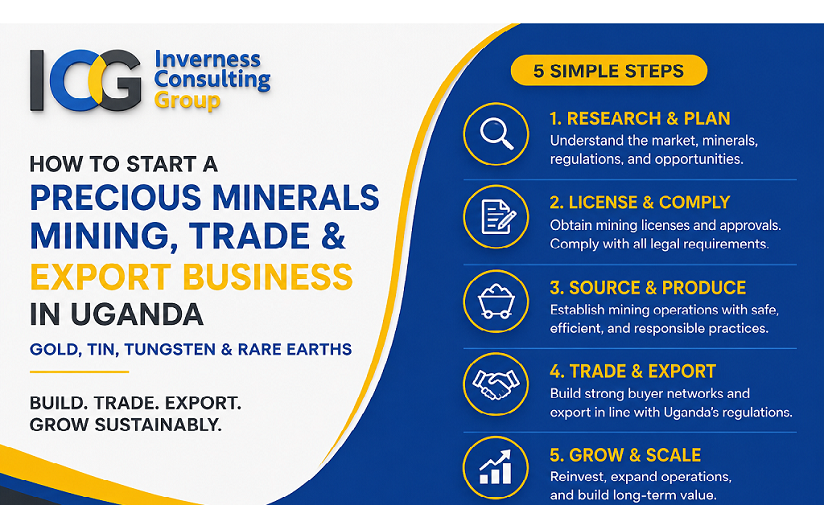
How to Get into the Business of Precious Minerals Mining, Trade, and Export in Uganda (Gold, Tin, Tungsten & Rare Earths)
Introduction: Unearthing Uganda’s Golden Potential
Uganda is emerging as one of Africa’s most exciting mining frontiers, endowed with rich deposits of gold and other precious minerals. In 2022, a major discovery was announced: up to 31 million tonnes of gold ore with an estimated 320,000 tonnes of pure gold, sparking global interest in the country’s mineral wealth.
Beyond gold, Ugandan geologists confirm large deposits of tin, tungsten, tantalum, rare earth elements, and more. Gold has quickly become Uganda’s top export, earning over $2 billion in 2022 alone. This thriving sector offers lucrative opportunities for local entrepreneurs and international investors alike, provided they navigate it legally and responsibly.
Crucially, Uganda’s mining industry is undergoing formalization under the Mining and Minerals Act, 2022, a comprehensive new law that aims to structure and legitimize the sector. This law represents a turning point for the first time, artisanal miners are legally recognized and supported, and the government is pushing for full value addition and traceability in minerals.
For example, the Act bans the export of certain unprocessed ores (like raw iron, tin, and tungsten) to encourage local refining. It also introduced a requirement for regional certification of minerals to combat illicit trade. In short, Uganda is laying a solid legal foundation to ensure that mineral businesses operate transparently and profitably within the law.
Why Uganda?
For those looking to get into gold or other mineral trading, Uganda offers a high-reward environment. Neighboring countries such as the DRC and South Sudan produce significant amounts of gold, and Kampala has become a regional gold-trading hub. Local production, though largely artisanal, accounts for the majority of output, leaving ample room for partnership and growth.
With the Mining and Minerals Act, 2022, in place to formalize operations, and the government championing initiatives like the Regional Certification Mechanism (RCM) to certify conflict-free minerals, the stage is set for legitimate and profitable ventures. This guide provides a step-by-step breakdown from understanding legal requirements and securing a mining site to building your trading network and safely exporting your product. Whether you’re a Ugandan entrepreneur or a foreign investor, read on to learn how to unearth Uganda’s golden potential responsibly and successfully.
The Legal Foundation – Navigating the Mining and Minerals Act, 2022
Uganda’s Mining and Minerals Act, 2022, is the bedrock of all mining and mineral trade activities in the country. It was enacted to modernize the sector’s governance, replacing the 2003 law, and it introduces stringent requirements as well as new opportunities for participants.
Getting into the precious minerals business starts with understanding this law and the licenses, regulations, and bodies it establishes. This section breaks down the key legal considerations:
Licensing and Permits
Know the Licenses: The Mining and Minerals Act, 2022, prohibits any prospecting, mining, buying, or selling of minerals without an appropriate license or permit. Depending on your role in the business (miner, trader, exporter), you will need one or more of the following licenses:
- Artisanal Mining License (AML): This license is for small-scale, manual mining operations using basic tools. It is intended to formalize artisanal and subsistence miners who historically operated informally. An artisanal license typically limits the scale and depth of mining (for example, digging is restricted to shallow depths to prevent unsafe operations).
Eligibility: Artisanal licenses are reserved for Ugandan citizens or Ugandan-owned entities only, to empower local communities. An individual must be a Ugandan national (18+ years old) to apply, or a cooperative/partnership/company that is 100% Ugandan-owned (or with a majority Ugandan shareholding). This ensures that small-scale mining remains in local hands. The artisanal license has a lower application cost and covers a relatively small plot of land. It usually runs for a short term (often one year, renewable) and has simpler requirements, though holders must still follow safety and environmental rules.
- Small-Scale Mining License (SML): This is the next tier up, intended for mining operations with a moderate investment and some mechanization. Small-scale licenses allow the use of machinery and can cover a larger area than an artisanal license. Under the 2022 Act, Uganda classifies mining licenses by capital investment: a Small-Scale Mining License may be appropriate for projects investing roughly between hundreds of millions and a couple of billion Ugandan shillings (exact threshold values are defined in regulations) beyond the artisanal scope but below large industrial mines.
Eligibility: Small-scale licenses may be held by companies or partnerships registered in Uganda (including those with foreign ownership, provided the entity is incorporated locally). This means foreign investors must register a local company to obtain a mining license. The application requirements are more rigorous: you’ll need to submit a geological work plan, proven financial and technical capacity, and an environmental and social management plan. Small-scale licenses typically last for several years and can be renewed if you comply with all conditions.
- Medium-Scale and Large-Scale Mining Licenses: For very substantial mining projects, the law provides medium and large licenses (each with higher investment thresholds and broader acreage). Major international mining companies usually seek these. While our focus is on getting started (likely at an artisanal or small-scale level), it’s worth noting that large-scale projects entail significant obligations. Under the new law, the Ugandan government automatically takes a 15% free equity stake in all medium and large-scale mining operations.
This is designed to ensure the country benefits directly from big projects. Large mines also require comprehensive feasibility studies, environmental impact assessments, community development agreements, and often production-sharing agreements with the government. If you aim to scale up to this level, be prepared for intensive regulatory oversight and substantial capital requirements (e.g., Uganda’s first large-scale gold mine, the Chinese-owned Wagagai project, required a $250 million investment).
- Mineral Dealer’s License (MDL): This is essential for anyone looking to trade or export minerals. If you plan to buy gold (or other minerals) from miners and sell or export it, you must obtain a Mineral Dealer’s License. The law explicitly forbids buying or selling minerals without this license. A Mineral Dealer’s License authorizes you to source minerals from lawful miners and to trade/export them. Application: You apply to the Ministry of Energy and Mineral Development, providing details such as the specific minerals you will deal in, your business premises (office and secure storage facilities), and a marketing plan for how you’ll buy and sell. You must also show that you have adequate financial resources and expertise. Each MDL is valid for one calendar year (expiring on December 31st of the year issued) and must be renewed annually.
Notably, an MDL holder is obligated to pay mineral royalties on any minerals they purchase or export (if the producer hasn’t already paid those royalties). This ensures that, at some point, the government receives its due share of the minerals’ value.
MDL holders also have strict record-keeping requirements: you must keep a register of every purchase and sale, including details of the seller (and proof that the seller had a legal right to that mineral), the origin of the mineral, the quantity and price, and the buyer or consignee.
Quarterly copies of these records must be submitted to the Ministry. Failure to maintain and report these records is a criminal offense that can lead to fines or imprisonment. In short, the MDL is the cornerstone license for the trading business. It legitimizes your role as a gold trader/exporter and holds you accountable to operate transparently.
- Export Permit: In addition to a dealer’s license, each export shipment of minerals (gold, tin, etc.) requires an Export Permit from the Ministry. An export permit is a consignment-specific authorization to ship minerals out of Uganda legally. To obtain it, you must present all required documentation (discussed in Section 3.3) and show that you’ve met conditions like paying taxes and obtaining a Certificate of Origin. The export permit process ensures that only licensed dealers with compliant minerals can export, acting as a final checkpoint.
- Other Specialized Licenses: The Act also provides for Prospecting Licenses (for preliminary mineral searches), Exploration Licenses (for detailed exploration work up to 3–4 years), Retention Licenses (if you find a deposit but need to pause development), and even Gold Refining Licenses or Goldsmith’s Licenses for those who want to process or manufacture jewelry.
For instance, a Goldsmith’s License is needed if you intend to craft jewelry or other articles from gold or any precious mineral. Most newcomers won’t need these immediately, but it’s good to be aware of them. Notably, a goldsmith license is not required for ordinary retail jewelers selling finished pieces (unless that is their primary business). Still, anyone melting down raw gold to make new products must have one.
Bottom Line: Before you start mining or dealing in gold (or any mineral) in Uganda, get the right licenses in place. Choose the license category that fits your scale of operation. Many small entrepreneurs begin by partnering with licensed artisanal miners or obtaining a Mineral Dealer’s License to start trading.
Always operate within your license limits dealing in minerals outside the scope of your license or buying from unlicensed sources is illegal and can lead to severe penalties, including fines or imprisonment.
The 2022 Act has teeth: it aims to eliminate the “black market” in minerals by ensuring every actor is registered and accountable. By securing the proper permits and approvals upfront, you establish a legal foundation for your business and build credibility with both government and trading partners.
As you plan, remember that only entities registered in Uganda can hold mineral rights foreign individuals must incorporate locally or team up with Ugandan partners. This local incorporation requirement is a crucial first step for any international investor eyeing Uganda’s mineral sector.
Key Regulatory Bodies
Successfully navigating the mining business in Uganda also means understanding the regulators and their roles. Several government bodies will interface with your operations, from licensing to export clearance. The primary authorities include:
- Ministry of Energy and Mineral Development (MEMD): This is the lead ministry overseeing the mining sector. Within MEMD, the Directorate of Geological Survey and Mines (DGSM) now part of the broader Mineral Development Department handles day-to-day regulation of mining activities. The Ministry (through DGSM) is responsible for issuing licenses (prospecting, exploration, mining, dealer’s licenses, etc.), conducting inspections, and enforcing compliance with the Mining and Minerals Act. They maintain the Mining Cadastre (a registry of mineral rights). Uganda now uses an online cadastre portal for applications and reporting, making the licensing process more transparent and accessible. If you need to apply for or renew a license, you will be dealing with this Ministry. The Ministry also drafts regulations and guidelines, such as setting royalty rates or export levies (with parliamentary approval). In short, MEMD is the custodian of Uganda’s mineral resources on behalf of the state. Expect to engage with them for approval of your business plans, environmental and social management plans, and any changes in your operations. They also provide geological data useful when researching where to explore or mine.
- Uganda Revenue Authority (URA): URA is the government’s tax collection agency, and it plays a critical role in the mineral trade business. URA handles all tax and royalty payments related to mineral production and export. Under the new regime, all fees, charges, and mineral royalties payable to the state are paid through URA (often accompanied by specific documentation to inform MEMD. For example, when you buy gold from a miner, a royalty (a percentage of the gold’s value) is due you, as the licensed dealer, are responsible for ensuring that the royalty gets paid to URA if it wasn’t paid at the mine head. URA is also responsible for customs and export clearance. When you are ready to export a shipment of gold, URA customs officers will verify that you have an export permit from MEMD, that all owed royalties or export taxes have been paid, and that you have a tax clearance certificate (proving your business has no outstanding tax liabilities). They will then oversee the physical export at the point of exit (e.g., Entebbe Airport or a border post). URA and MEMD coordinate closely; however, it’s worth noting that in the past there were discrepancies in data for instance, MEMD’s records of gold production vs URA’s records of gold exports didn’t always match. This is being addressed through better enforcement of documentation. As an exporter, you effectively report to both MEMD (for sector regulation) and URA (for financial regulation). URA has also been involved in recent reforms, such as the introduction of export levies and the enforcement of international anti-money laundering standards in the gold trade.
- Uganda Investment Authority (UIA): If you are an international investor or a large-scale operation, UIA can be a facilitator. While UIA doesn’t regulate mining per se, it helps foreign investors register and get necessary approvals. It can offer investment incentives for major projects (like tax holidays or duty-free import of equipment) if your project qualifies. UIA’s One-Stop Center can assist with business registration, work permits, and connections to other agencies. Engaging with UIA is wise if you’re bringing in substantial capital or setting up a mining enterprise as a foreign entity.
- Local Governments: A unique feature of the Mining and Minerals Act, 2022 is the empowerment of local governments (district and sub-county authorities) in mining oversight. District Local Governments are expected to monitor mining activities in their areas and ensure compliance with environmental and community obligations. For example, under Section 27 of the Act, local governments have the power to support the formalization of artisanal miners and to help enforce regulations at the local level. Practically, this means you should engage with district officials (such as the Community Development Officer or Environment Officer) when starting operations in an area. They can provide local knowledge and will expect you to keep them informed. Additionally, the law provides that a portion of mining royalties is shared with local governments and communities. Typically, the district and landowners collectively receive a percentage of royalties from minerals produced in their area. This revenue-sharing mechanism makes local authorities stakeholders in your success. They will be keen to see that you operate legally so that royalties flow, and they may be quick to flag any issues to MEMD or the police if you don’t.
- National Environment Management Authority (NEMA): Mining has environmental impacts, and NEMA is Uganda’s regulator for environmental protection. Any mining or significant exploration project requires environmental approvals from NEMA, as mandated by the National Environment Act, 2019. You will need to submit either a Project Brief or a full Environmental and Social Impact Assessment (ESIA) to NEMA (the scope depends on the scale of your project). For instance, an Exploration License application must include a project brief in line with NEA 2019, and a Mining License will require a comprehensive ESIA and Environmental Management Plan. NEMA will review your plans for managing issues such as land disturbance, waste disposal, water use, and mine site rehabilitation. They also ensure you have plans for mine closure. Getting NEMA’s approval is a prerequisite for MEMD to issue a mining license. During operations, NEMA (or delegated local environmental officers) may inspect your site to ensure compliance with environmental standards. Non-compliance can result in fines, suspension of operations, or revocation of your license. Therefore, treat environmental obligations seriously. We delve more into this in Section 2.3 on Environmental Responsibility.
- Uganda Police Minerals Protection Unit: Because of rampant illegal mining and smuggling in the past, a special unit of the police was established to protect Uganda’s mineral resources. The Police Minerals Protection Unit is mandated by law (under the Police Act and reinforced by the Mining Act) to combat illegal mining, mineral theft, and related offenses. They conduct operations against unlicensed mining and seizures of smuggled gold. For a legitimate businessperson, this unit can be an ally. For example, if you need to transport a large quantity of gold, you might coordinate with them for security, or if you encounter trespassers on your licensed site, they are the ones who can take enforcement action. It’s wise to know the regional Minerals Police officers when you start operations; they add a layer of security and ensure everyone is playing by the rules.
- Uganda Revenue Authority’s Financial Intelligence and Customs (joint efforts): In addition to URA’s tax role, Uganda is keen to prevent gold from contributing to money laundering or conflict financing. The Financial Intelligence Authority (FIA) monitors large financial transactions, including those in commodity trade. Gold traders often deal in large sums of cash, which can raise red flags. Be prepared to adhere to anti-money laundering (AML) protocols, e.g., keep transaction records, verify your customers and suppliers (Know Your Customer rules), and report any suspicious transactions. URA’s Customs and Excise department has also started working closely with MEMD to enforce the Regional Certification Mechanism (RCM) for minerals (more on this in Section 3.3). Recent reports noted that Uganda had not been strict enough in the past on ensuring all exported gold had proper origin documentation. Now that Uganda attained full compliance with the ICGLR’s certification scheme in 2024, URA and MEMD jointly insist on seeing a Certificate of Origin for any export to prove it’s not illicit conflict gold.
In summary, establish good relationships with regulators. When starting, visit the DGSM office to get guidance on licensing. Ensure your company’s taxes are in order and maintain open communication with URA. Engage local leaders and abide by NEMA’s requirements. The Ugandan government is actively encouraging investment in mining as evidenced by efforts such as establishing a state-owned mining company to partner on ventures and welcoming foreign companies (e.g., an Australian firm licensed to develop a major rare-earth project). If you demonstrate compliance, transparency, and cooperation, these bodies will facilitate your business rather than hinder it. However, any attempt to bypass regulations or deal in the shadows will likely be met with swift action under the stricter 2022 law. Knowledge of the regulatory landscape gives you confidence to proceed legally and avoid costly mistakes or shutdowns.
1.3 Taxes and Royalties
Mining and trading precious minerals can be highly profitable and the Ugandan government rightfully wants a share of that value to fund national development. As you plan your business, you must factor in taxes, royalties, and levies that apply to mineral operations. These fiscal obligations have evolved in recent years and, at times, have been contentious. Staying informed and compliant with the latest tax regime is crucial, as it directly impacts your bottom line and legal standing.
Royalties on Mineral Production: A royalty is essentially a production tax paid to the government for the right to extract a mineral. In Uganda, royalties are calculated as a percentage of the gross value of the mineral produced (or, depending on the mineral, a fixed amount per unit). For gold and other precious minerals, the royalty rate under previous regulations was around 5% of the value. However, the new Act allows the Minister to set specific rates with Cabinet approval. Typically, the mining license holder is responsible for paying royalties on the minerals they produce. However, under the 2022 Act, if minerals pass to a licensed dealer or exporter, that dealer must ensure any due royalty has been paid (or must pay it themselves before export). The royalty is shared: a portion goes to the central government (usually the bulk of it), and a small portion is allocated to local governments and landowners (for example, in the old law, it was 80% central, 10% local government, 10% landowner the new law might adjust these percentages).
Importantly, to encourage artisanal miners to formalize and sell their gold through legal channels, the government in 2022–2024 introduced a royalty waiver for artisanal and small-scale gold production. In late 2021, Uganda faced a situation in which newly imposed taxes caused official gold exports to plummet (export earnings fell by 80% year-on-year) as traders chose not to declare shipments. Responding to industry pushback, the Ministry of Finance halted the implementation of a 5% gold export levy (equivalent to US$200 per kg) in 2021, and courts even issued interim orders exempting payment of that tax while the matter was litigated. Subsequently, as a compromise to restart the trade, the government waived royalties on gold for artisanal and small-scale miners and instead introduced a smaller flat export levy (see below). Local district leaders have noted that waiving these royalties, while helping the miners, also deprived local governments of revenue they used to receive from mining. This illustrates how sensitive and fluid the tax situation can be; policies may change to balance encouraging the sector while collecting revenue.
As of the time of writing, large-scale or formally organized mines are expected to pay royalties under the law, whereas artisanal miners working under an Artisanal License may currently enjoy a royalty waiver (subject to change). Always verify the current royalty rates from MEMD or URA when starting up. Regardless, as a gold dealer purchasing from miners, it’s wise to account for royalty costs either the miner should show proof they paid it, or you may have to pay it upon export if it’s reinstated. Royalties are usually considered a deductible expense for income tax purposes.
Export Levy (Gold and other minerals): In addition to royalties, Uganda imposes an export levy on gold to generate revenue from the huge volumes of gold passing through the country. The Mining and Minerals (Export Levy) Regulations, 2023, introduced a structured levy: initially, 5% on refined gold and 10% on unrefined gold, according to DIT Advocates’ analysis. However, these percentages were heavily contested by gold exporters and refinery owners for being too high. By late 2023, the policy shifted to a simpler flat rate. The government set a flat export tax of USD $200 per kilogram of gold exported. This $200/kg levy is much lower than a 5% tax (for context, 1 kg of gold is worth about $60,000+, so $200 is roughly 0.3%). The reduction aimed to disincentivize smuggling and encourage traders to resume exporting through official channels. Along with this levy, the government mandated that all gold for export must be refined to 99.9% purity, effectively banning the export of unrefined gold and ensuring that value addition occurs within Uganda. If you are exporting gold, you will need to have it processed to meet this purity standard (Uganda’s local refineries can do this for a fee). The $200/kg export tax is paid to URA (you’ll need the receipt as proof when clearing exports).
It’s important to note that these tax measures can change with new government budgets or court decisions. In 2023, gold exporters obtained court injunctions against the 5% levy, leading to negotiations and a revised flat tax. There remains some tension: local communities argue that without royalties, they see little benefit, whereas the central government prefers the export levy for ease of collection. Staying informed through official channels (Ministry press releases, URA notices, or consulting firms like Inverness that monitor regulatory changes) is essential to adapting your business plan.
For other minerals like tin, tungsten, and tantalum (the “3Ts”), Uganda has similarly been considering export restrictions or levies. In fact, as mentioned, there is a ban on exporting unprocessed tin, tungsten, coltan, and similar materials to spur local processing. If you plan to deal in these, expect to export a refined or smelted product (or pay a higher levy on concentrates).
Corporate Income Tax and Other Taxes: Beyond royalties and export levies, once your operation becomes profitable, normal income taxes apply. Mining companies in Uganda typically pay 30% corporate income tax on net profits. However, large mining projects sometimes negotiate stability agreements or specific terms. Ensure your accounting is solid keep all receipts for expenses (equipment, salaries, etc.) to deduct from your taxable income. If you’re only trading (not producing), your profit is the difference between purchase and sale price, and you’ll be taxed on that profit at the standard corporate rate. Uganda also has a Withholding Tax on payments to artisanal miners or other suppliers for example, if you as a licensed dealer buy gold from an unincorporated miner, you might be required to withhold a small percentage of the payment to that miner and remit it to URA as presumptive tax (this encourages informal miners to register because they can claim that tax back once formal). Additionally, if you import any equipment or chemicals, be mindful of import duties and VAT. Mining equipment might qualify for VAT deferment or duty exemption if you’re licensed and the equipment is specifically for mining. Check with UIA or URA about any investment incentives.
Point of Caution – Compliance: The mining sector has historically been prone to tax evasion and illicit financial flows. The government is now vigilant. URA and other agencies have significantly ramped up monitoring. For instance, banks in Uganda have been alerted to watch for unusual gold-related transactions, and Uganda now complies with international guidelines to prevent gold from financing conflict or terrorism. Always pay the taxes due. The cost of non-compliance can be business-ending: your gold can be seized, licenses revoked, and you could face prosecution. Moreover, demonstrating good tax compliance builds trust with the government, which can be beneficial if you later seek expansion or other forms of support.
In summary, factor taxes into your business model. Margins in the gold trade can be thin (a few percent), so a $200/kg export levy or a 5% royalty can make a big difference. Shop around for cost-effective refining options to meet the purity requirement without eroding your profits. If you run a larger mining operation, treat the royalty portion as a cost of production. Keep clear records of all mineral purchases and sales not just because the law demands it, but also to calculate and remit what you owe accurately. Uganda’s mining tax regime is evolving to strike a balance that deters smuggling while securing national revenue; by complying and staying agile, you ensure your venture remains sustainable and on the right side of the law.
(Tip: It can be wise to hire a local tax consultant or accountant experienced in the mining sector to help with your filings. This can save you money by utilizing any incentives and preventing costly mistakes.)
Section 2: Practical Steps for Gold Mining
With the legal foundations in place, the next step is the operational side of entering the mining business. Whether you aspire to be a gold producer (mining the gold yourself) or plan to support artisanal mining and trade the gold, it’s important to understand the practicalities. This section walks through the key steps: finding and securing a viable mining site, acquiring the necessary equipment and workforce, and upholding environmental and social responsibility during your operations. Gold mining especially on a small scale is a challenging endeavor. Still, with proper planning and adherence to best practices, it can be rewarding both financially and in terms of community impact.
2.1 Locating and Securing a Site
All mining starts with one question: where is the mineral? Finding a good deposit of gold (or tin, tungsten, etc.) is the critical first step for those interested in extraction. If you’re more inclined toward trading than mining, you may not need to secure your own site, but understanding site location is still valuable for sourcing. Here’s how to go about it:
Geological Research and Exploration: Begin by researching known gold-bearing areas in Uganda. Gold in Uganda is found in several regions, often associated with quartz veins in greenstone belts or with alluvial (placer) deposits in riverbeds. Historically, significant gold occurrences have been reported in the Karamoja region (northeast, e.g., Moroto), Buhweju and Ibanda (southwest), Mubende and Kasanda (central Uganda), Busia and Namayingo (east, near the Kenya border), and the West Nile (northwest), among others. A 2019 government report estimated Uganda’s artisanal miners produce over 7,000 kg of gold per year, mainly from these areas. You can obtain geological maps and reports from the DGSM (Ministry’s Geological Survey). Look for areas where exploration companies have found gold in the past sometimes their licenses expire, or they move on, leaving proven ground that small-scale miners can exploit. Land status: Check if the area is already under an active Exploration License or Mining License by using the Ministry’s Mining Cadastre portal or contacting DGSM. You can only apply for areas that are not currently licensed to someone else (or you may negotiate with an existing license holder to work on their property through a subcontract or partnership).
Prospecting and Exploration Licenses: If you have identified a prospective area that’s free, the typical path is to apply for a Prospecting License first, then an Exploration License. A Prospecting License is easy to get; it’s usually nationwide or district-wide and permits you to prospect (no exclusivity, valid for one year). This allows you to legally go out with handheld equipment (gold pan, metal detector, etc.) to look for indications of gold. Once you narrow down a specific location with gold showings, you would peg that area (mark the coordinates) and apply for an Exploration License (EL) over it. An Exploration License provides exclusivity to explore for a particular mineral within a defined area (up to 500 km² for an EL). It usually lasts 3-4 years initially, with a possible extension of 2-3 more years. To get an EL, you’ll need to submit a proposed exploration work program and budget, proof of technical and financial resources, and an initial environmental project brief. Exploration involves more systematic activities: soil sampling, geophysical surveys, trenching, or even core drilling if feasible. For a small operation, you might focus on panning streams (to find alluvial gold) and digging small pits to find the gold-bearing veins.
Securing a Mining License or Partnership: If your exploration is successful, i.e., you discover a deposit that seems economically viable, the next step is to acquire a Mining License (Artisanal, Small-scale, etc., as discussed in Section 1.1). For an Artisanal Mining License, the process often involves organizing local miners into an association or cooperative (as the law encourages group formation among artisanal miners). For a Small-Scale or higher license, you will need a more detailed feasibility study showing the deposit’s estimated size (reserves), mining method, processing method, and a business plan. Many newcomers might not go through these exploration steps themselves due to the cost and expertise required. Alternatives include:
- Buying/Leasing an Existing License: If someone already has a location with known gold, you can consider purchasing that license or entering a joint venture. For example, local Ugandan prospectors or even foreign juniors often hold exploration licenses that they might sell if they lack the funds to develop them. Ensure you conduct due diligence (verify with MEMD that the license is in good standing and can be transferred, and verify the geological data). Under the 2022 Act, transferring a mineral license to another party requires the Ministry’s consent to prevent speculation and ensure that the new holder meets all requirements. But it’s a possible route to acquire a ready-to-mine site.
- Community/Miner ColLabouration: Given that 90%+ of Uganda’s gold production comes from artisanal and small-scale miners (ASMs), you might choose to work with an existing community of miners rather than secure your own virgin site. For instance, a local group might have traditional claims on a piece of land (even if informally). You could help them formalize by obtaining an Artisanal License in their name (or a Small-Scale License for a bigger group) and then provide capital/equipment in return for a share of the production. Essentially, you become a sponsor or partner. This approach can be win-win: the miners gain legal status and higher incomes, and you gain access to the gold supply without having to prospect from scratch. If you go this route, it’s crucial to structure agreements clearly (perhaps through a cooperative or company in which you have a stake) and to maintain trust through fair dealings (more on ethical sourcing in Section 3.1).
Acquiring Land Access: In Uganda, minerals are state-owned, but individuals or communities can own surface land. Getting a license gives you rights to the minerals, but you still need to access the land. The law provides that you must reach an agreement with the landowner/occupant before mining or compensate them for disturbance. franktumusiimeadvocates.com. Many gold areas are on customary land or private land (farms, etc.). Approach landowners early, explain your intentions and the benefits (perhaps employment or a share of royalties), and negotiate reasonable compensation or rent. If landowners refuse access, the law has arbitration mechanisms, but it’s best to avoid forced approaches, as that breeds local resentment. Often, artisanal miners originate from those communities, which helps. Also, be mindful of protected areas: some gold zones might lie within forests or game reserves. Mining in those areas may require special permissions or be outright restricted for environmental reasons. Always check the land status (a quick check with the Ministry of Lands or NEMA can save headaches).
Registering Your Company: As noted, to hold any substantial license or to enter contracts, you’ll need a registered company in Uganda (if you haven’t already). Choose a company name, ensure your objectives include mining and mineral trade, and register with the Uganda Registration Services Bureau (URSB). It usually takes a few days to a couple of weeks. You’ll then obtain a Tax Identification Number (TIN) for URA. This company will be the entity applying for licenses and permits.
Tip: It is often advantageous to engage a local geologist or consultant who is familiar with Uganda’s geology and the DGSM processes. They can guide you to known productive sites, assist in license applications, and even manage on-ground prospecting. Inverness Consulting Group, for example, or other local firms might offer services to identify opportunities and handle paperwork, ensuring you target areas with genuine potential.
Site Security Early On: Once you have identified a promising site and especially after you get a mining license for it, securing the site becomes crucial. Gold has allure; you may find that once word gets out, an influx of informal miners or even opportunistic investors comes to try to poach your territory. Legally, your license gives you exclusive rights, and the local authorities should back you up on removing illegal miners. However, the reality on the ground can be delicate; people who mined there informally for years may be resentful of new ownership. It’s vital to approach this diplomatically: consider including local artisanal miners in your project rather than immediately ousting them. Many successful small companies designate certain areas where locals can continue panning (and then sell the gold to the company). In contrast, the company focuses on richer or deeper parts of the deposit. This creates goodwill and reduces conflict. Use the initial period to fence or demarcate key areas, post notices of your rights, and perhaps hire some locals as security/watchmen (they’re familiar with the community). Always have your documentation on hand to show any officials or local leaders that you’re authorized to be there.
In summary, locating and securing a mining site involves a blend of paper research, fieldwork, and community engagement. Sometimes it takes time; prospecting doesn’t yield results, and you need to try multiple areas. Patience and persistence are key. But once you secure a site with proven gold reserves, you have the foundation for a mining venture. Uganda’s new Mining Act even allows retention of discovered deposits if you need time to raise capital (through a Retention License), meaning you won’t lose the site as easily as in the past when licenses lapsed quickly. The government wants serious players to hold on to deposits and develop them when ready. Leverage this supportive stance: do your homework, follow procedure, and you’ll stake your claim in Uganda’s growing minerals sector.
2.2 Sourcing Equipment and Labour
Equipping your mining or trading operation correctly is vital for efficiency, safety, and profitability. The scale of your enterprise will determine the type of equipment you need from simple hand tools to heavy machinery and the kind of Labour force required. Additionally, Uganda’s laws and good business practices require you to comply with labor regulations and prioritize local employment and skills development. This subsection discusses what you need to get started and how to build a compliant, effective workforce.
Equipment for Gold Mining: If you are engaging in artisanal or small-scale mining (ASM), the equipment can be relatively basic, but it must be appropriate for the deposit type. Common tools and equipment for ASM in Uganda include: gold pans, sluice boxes, hand shovels, picks and hammers, metal detectors (for nugget hunting), wheelbarrows, and buckets. Many artisanal miners also use water pumps to wash gravel and improvised sluices or carpets to trap gold particles. For slightly larger or semi-mechanized operations, you might introduce motorized rock crushers or ball mills to grind ore, gravity concentration equipment such as shaking tables or centrifugal concentrators to separate gold, and sluice boxes with improved mats. In alluvial (placer) mining, some operations employ sluice dredges or excavators to dig and process gravel. In hard-rock (vein) mining, you might need jackhammers or drills to break rock, and winches or small hoists to lift ore out of pits.
For small-scale commercial mines, equipment can escalate to include: excavators and backhoe loaders for removing overburden, compressors and jack hammers for underground work, small generators for power, and even a small processing plant with crushers, mills, and maybe a cyanidation or leaching setup (though chemical processing requires tight environmental controls). It’s important to match equipment to scale avoid overspending on machinery that is too advanced or costly for the amount of material you’ll process. Second-hand equipment can be a cost-effective choice; neighboring Tanzania and South Africa often have markets for used small mining equipment.
Equipment for Gold Trading/Export: If you’re focusing on trading rather than mining, your equipment needs will differ but remain important. You will require: Assaying tools (at least a basic gold testing kit or a handheld XRF analyzer to verify purity when buying; more on assaying in Section 3.2), precise weighing scales (certified scales that can measure gold in grams with two-decimal precision), secure storage such as a safe or vault for storing gold bullion or nuggets before export, and possibly melting equipment (a small furnace or crucible setup) if you need to melt scrap or fine gold into bars for easier transport. Many dealers invest in a gold smelting kit to produce small doré bars; this also helps to homogenize a batch of gold for accurate assaying. Additionally, consider security equipment such as surveillance cameras for your office or vault, and secure transport boxes for moving gold.
Local Sourcing vs. Importing: You may ask, ” Can you buy mining equipment in Uganda? Yes, basic tools are readily available in local hardware markets (for example, in Kampala’s industrial area or regional towns). Items like pans, shovels, pumps, and generators can be found or fabricated locally. For specialized items (e.g., shaking tables, crushers, concentrators), Uganda has some dealerships, but these are often imported from China, South Africa, or India. Plan for the lead time and cost of importing, including payment of import duties unless you have an investment license that exempts you. It’s wise to compare costs: sometimes a local fabricator can build a simple trommel (rotating screen) or sluice for a fraction of the cost of an imported one. However, for precision equipment like assay devices or advanced concentrators, imports might be the only option. Ensure any imported machinery is compatible with local conditions (e.g., 240V voltage, robust in tropical climates, availability of spare parts).
Labor – Hiring the Right Team: The success of your venture will heavily depend on the people you employ. Key roles in a mining operation might include: miners or machine operators; a site supervisor or foreman; a safety officer; a geologist (even part-time to guide excavation); equipment mechanics; and support staff (cooks, drivers, etc., for a remote site). In a trading business, you may need: gold buyers/agents in the field (to liaise with miners), an assayer or technician, a finance/bookkeeping person, security personnel, and possibly a logistics coordinator for exports. When hiring, prioritize Ugandans, especially those from the local community around your mining site. The Mining Act, 2022, introduced new local content provisions requiring mining companies to employ and train Ugandan citizens for various positions. For small businesses, this might not be a formal requirement, but it’s good practice and builds community goodwill.
For example, if you set up a mine in Karamoja, aim to train locals as machine operators or processing technicians rather than importing Labour from elsewhere. Not only does this fulfill social responsibility, but it also ensures that local employees will have invaluable knowledge of the terrain and culture. Positions that might require foreign expertise (such as a senior geologist or metallurgist) are allowed, but ensure they obtain work permits and that you have a plan for skills transfer to a Ugandan understudy, as the law encourages.
Labor Laws: Uganda has clear Labor regulations even if many artisanal mines historically did not follow them, your formal business should. Key points: Pay at least the minimum wage (Uganda’s official minimum wage is quite low, but the market rate for miners is often higher; miners are often paid in a share of production, e.g., a percentage of gold recovered). It’s crucial to forbid the use of child labor. Gold mining in some areas has had issues with child workers, but this is illegal and unethical. Ensure all your workers are 18 or older, and have them undergo a basic medical exam if possible (this helps establish a baseline of their fitness for manual work). Provide necessary safety gear: helmets, gloves, boots, and, if working underground or with machinery, high-visibility vests and goggles. The Occupational Safety and Health Act also applies to mines, so you should strive to create a safe working environment (supported by a safety officer or at least by training sessions on handling equipment). Regular breaks, availability of first aid, and emergency plans (for accidents or tunnel collapses) are part of responsible operations.
Also, establish clear contracts or agreements with your workers or partnering miners. In many small mines, workers are compensated with a portion of the gold they produce. For instance, a common arrangement is that the worker keeps 30% of the gold he pans, and 70% goes to the license holder/financier, who covers expenses. Whatever model you use, put it in writing and make sure it’s understood, to avoid disputes. If you’re paying wages, pay on time and keep records (URA may ask for PAYE, Pay As You Earn tax if you have formal salaries above a threshold).
Training and Skill Development: Given that you may be employing artisanal miners who have worked informally for years, invest in training them in improved techniques. Show them how to use a retort for mercury (to reduce inhalation) if they must use it, or, better, train them in mercury-free concentration methods (such as using borax or improved sluices). Teach safer pit excavation methods (shafts with proper timbering to prevent collapses). Building a skilled team not only increases production (as they’ll mine more efficiently) but also aligns with regulatory expectations that you are improving practices. The government and NGOs often run training for ASMs plugging your team into such opportunities (e.g., sessions by the planetGOLD Uganda project on mercury-free gold extraction) can be very beneficial.
Maintenance: Equipment, especially in harsh mining conditions, will break down. Identify a reliable mechanic or technician either on staff or on call. Keep an inventory of critical spare parts (for pumps: extra hoses and seals; for generators: spark plugs and filters; for crushers: extra jaw plates, etc.). Downtime due to equipment failure can be very costly in terms of lost production and worker idle time. A preventive maintenance schedule is wise – e.g., servicing engines at set intervals and proactively checking and replacing worn parts.
Combining Traditional and Modern Methods: Often, the sweet spot for small-scale operations is blending the knowledge of local miners (who know where the gold “hides” and can do certain tasks cheaply by hand) with selective mechanization. For instance, local panners might retrieve visible gold, but you could use a small wash plant to reprocess their tailings and recover fine gold they missed. Or have miners dig ore and bring it to the surface, and then use a mechanical crusher and mill to process it faster than they could by hand. This integrated approach creates more gold output with roughly the same Labour input boosting everyone’s earnings.
Compliance with Production Requirements: The new Mining Act may set production or work obligations meaning you can’t just hold a mining license and not use it. Typically, you need to demonstrate active work (such as a minimum tonnage processed or an annual investment) or risk losing the license to someone else who will use it. Having the right equipment and team ensures you meet these work obligations. For example, a Small-Scale Mining License might require that you commence operations within 6 months and achieve a certain production level annually. Plan accordingly so you’re not caught short at the review.
To sum up, equip wisely and hire diligently. In gold mining, the workforce and machinery must complement each other. A good rule of thumb is to start small and simple, then upgrade equipment as your production and experience grow. Many successful operations in Uganda began with a few pans and sluices, then reinvested profits from gold into pumps, then into crushers, and so forth. Meanwhile, treat your workers fairly and integrate the local community into your workforce. This not only fulfills legal and moral obligations but also creates a loyal team. Mines (and even gold-buying businesses) run on trust trust that wages or shares will be paid, that gold will be measured accurately, and that safety is prioritized. By investing in proper tools and the people who use them, you lay the groundwork for a sustainable and scalable venture.
2.3 Environmental and Social Responsibility
Mining and mineral trading are not just business activities; they occur within a social and environmental context that cannot be ignored. In Uganda, maintaining a license and good standing increasingly depends on your ability to operate responsibly. This means mitigating environmental impact and positively engaging the local communities where you work. Not only is this a legal requirement under various laws (Mining Act, Environment Act, etc.), it’s also good business. A mine or trading operation that uplifts rather than exploits its surroundings will face fewer conflicts and enjoy stronger support. This section covers the key environmental and social responsibilities you must uphold.
Environmental Management: From the moment you start exploration to the final closure of a mine, environmental protection should be a core concern. Uganda’s National Environment Act (2019) and mining regulations compel all miners to adhere to certain standards. Here are important practices:
- Environmental Impact Assessment (EIA): If you’re establishing anything beyond a very small artisanal operation, you will likely need to conduct an EIA (or at least an Environmental Project Brief for small projects) and obtain a Certificate of Approval from NEMA. In this study, you assess potential impacts on land, water, air, flora, and fauna, and propose mitigation measures. For example, if you plan to mine near a river, how will you prevent siltation of the water? How will you manage waste rocks or tailings? These documents might sound bureaucratic, but they actually serve as a roadmap for environmental care. Follow your EIA’s Environmental Management Plan (EMP) throughout the project. Regulators can and do inspect mining sites for compliance with the EIA commitments.
- Pollution Control: Gold mining can produce various pollutants sediment runoff from alluvial mining, mercury or cyanide from gold processing, diesel fumes from generators and machines, etc. You are expected to minimize these. Mercury use is a major issue: artisanal gold miners traditionally use mercury to form an amalgam with fine gold, then burn it to recover the gold, releasing toxic mercury vapor. This not only poisons the environment (mercury can contaminate rivers and fish) but also harms health. Uganda, through projects like planetGOLD, is pushing to reduce mercury use by artisanal miners. In fact, Uganda has ratified the Minamata Convention on Mercury, committing to phasing down mercury in ASGM. As an operator, you should provide mercury-free methods (such as gravity concentrators or using borax as an alternative to smelting concentrates). If mercury must be used in the interim, use a retort a simple closed device that captures mercury vapor during amalgam heating, preventing it from entering the air and allowing you to recycle the mercury. According to reports, Uganda’s artisanal sector currently releases an estimated 15+ tonnes of mercury into the environment annually, a stark figure the government is eager to shrink. Align your practices with this national goal.
Similarly, if you employ cyanide for gold leaching (usually only in larger operations), ensure a proper closed-loop system: cyanide solutions should be contained in vats or tanks and detoxified (using chemicals like sodium metabisulfite to neutralize cyanide) before any effluent is discharged. Never let cyanide or mercury-contaminated tailings be washed into rivers apart from legality, as it endangers communities downstream.
- Land Restoration: Small-scale mining often involves digging up soil and leaving pits or trenches. A critical responsibility is reclaiming and rehabilitating the land after or even concurrently with mining. The Mining Act, 2022 demands that miners fill in or fence off dangerous excavations and, at the end of mine life, restore the land “as far as practicable” to its original condition or to a usable state (the exact phrasing is in regulations, but generally, you should grade waste piles, backfill pits, and replant vegetation). Before you start, think about the mine closure: stockpile the topsoil separately so you can use it later to cover backfilled areas. Plant fast-growing trees or grass on disturbed land to prevent erosion. MEMD may require you to post a rehabilitation bond, a sum of money as security for mine closure, which you get back when you successfully reclaim the site. This is common for larger projects and could extend to smaller ones under stricter enforcement. Doing visible rehabilitation work, even while you are still mining, also helps counteract the negative image of mining and keeps local farmers or authorities supportive (they see you intend to leave the land in good shape).
- Water Management: Many gold operations use water for panning, sluicing, or washing ore. Avoid diverting rivers without permission any significant water use might require a water abstraction permit from the Directorate of Water Resources. Build settling ponds for wash water, so that muddy water doesn’t flow straight into natural streams; let sediments settle in your ponds and reuse the water if possible. During EIAs, hydrological studies might be required to ensure you’re not depriving communities downstream of water. In sum, treat water as a precious resource use it efficiently and keep it clean.
- Waste Management: Apart from tailings (crushed rock residues), you’ll generate waste oil (from machines), trash (plastic, food waste for workers’ camp), etc. Set up a simple waste management system: designate waste pits, safely store used oil (some companies collect it for recycling or proper disposal), and avoid open dumping. For any hazardous waste (such as chemical containers, mercury-contaminated cloth, etc.), consult NEMA for guidelines; sometimes they require you to transport it to a central hazardous-waste facility. Keep records of how you dispose of such waste; it’s part of environmental compliance.
Social Responsibility and Community Engagement: The people living around your mining area or those who work for you are core stakeholders in your business. Winning their support can make the difference between a smooth operation and constant friction or even conflict. Here’s how to engage responsibly:
- Community Consultation: Right from the exploration phase, talk to the local community and leaders (e.g., village chiefs, Local Council officials) about your plans. Uganda’s regulations often call for community consultations as part of the EIA process, to ensure these are done meaningfully, not just as a formality. Listen to the community’s concerns: they might worry about losing farmland or environmental damage, or they might have expectations for employment. Manage expectations honestly: don’t promise what you can’t deliver, but show you intend to operate in a way that benefits them, too.
- Community Development Agreements (CDAs): For larger operations, the 2022 Act likely requires formal Community Development Agreements if production exceeds a certain threshold. A CDA is a negotiated agreement in which the company commits to specific benefits for the community, such as building a school, providing boreholes, healthcare, and training programs. Even if your project is small and not mandated to have a CDA, consider voluntarily doing some community development. It could be as simple as grading the local road, sponsoring educational materials at the village school, or providing better water access. These gestures build goodwill and are often inexpensive relative to the value of minerals you’re extracting. In mining towns like Mubende or Busia, companies that invested in community projects gained local protection of their sites and cooperation, whereas those that didn’t often faced sabotage or theft.
- Local Employment & Fair Wages: We touched on local hiring in Section 2.2, but it doubles as both a Labour and social responsibility. When nearby households see direct employment opportunities at your mine or trading post, they view your presence positively. Pay fair wages, which you might consider low, say a few dollars a day, might be average locally, but offering a slightly better rate or performance bonuses can motivate workers and earn community respect for treating people well. Avoid any exploitative practices (sadly, mining globally has seen cases of worker exploitation, but you should be a model of legal compliance). Also, respect cultural norms if local tradition holds certain sites sacred or certain days as non-working days, and try to accommodate that where feasible.
- Transparency and Communication: The mining sector is often viewed with suspicion by communities (“They are taking our wealth and leaving us with holes”). To counter this, be transparent. Explain how the licensing and royalties work, perhaps dispelling any myths (e.g., some might think you found “tons of gold” even if you haven’t; clarifying the realities can manage envy or unrealistic expectations). If you have a community meeting, share information about how much royalty will come back to the district (once you’re in production) and how that is used for local services by law. In Uganda, typically 17% of royalties go to local governments and landowners (per older regimes), so emphasize that the community does have a stake.
- Security and Human Rights: If you hire security guards or work with police to secure your site, ensure they are properly briefed to respect human rights. There have been unfortunate incidents in mining areas where private or state security clashed violently with trespassers or illegal miners. While you have a right to protect your property, heavy-handed tactics can lead to community backlash or legal trouble. It’s better to prevent situations: put up clear signboards demarcating your licensed area, and initially, if small-scale miners encroach, have a dialogue, possibly offering them a formalized role. The new law’s recognition of artisanal miners is intended to reduce such conflicts by integrating them rather than treating them as criminals. If you find people illegally mining on your concession, involve the local authorities or the Minerals Protection Unit to handle the matter lawfully, rather than taking matters into private hands.
- Gender and Inclusion: Often, mining is male-dominated, but don’t overlook the role of women. In many Ugandan mining communities, women work in ancillary roles (such as panning tailings or providing services like food preparation). The Act emphasizes the inclusion of women and marginalized groups in mining projects. Consider ways to support and include women, e.g., hiring and training women for suitable roles (there are successful examples of women being trained as excavator operators or in managing mine finances). Not only is this fair, but development studies have shown that when women benefit from mining income, the whole family and community tend to benefit (improved nutrition, schooling for kids, etc.). Encourage the formation of, or support existing, women’s groups that might be involved in, say, gold jewelry-making or other downstream activities, which could create additional local enterprises tied to your project.
Compliance with Law: Social and environmental responsibility isn’t just voluntary failing to meet your obligations can lead to license suspension or cancellation under the Mining Act. For instance, if inspectors find you’re polluting a river or endangering lives with unsafe pits, they can issue improvement orders or shut you down until it’s fixed. Community unrest can prompt authorities to step in as well. In 2023, some districts complained that mining companies weren’t paying their local share of royalties or contributing to community development, prompting calls for stricter enforcement. Don’t be that company; be proactive instead.
Sustainability and Reputation: Think long-term. Gold deposits can deplete in a few years; what legacy will you leave? Ideally, when the gold is gone, the community should remember that your project brought lasting positive change, such as better infrastructure or a more skilled workforce that can find other employment. Also, for traders, sustainability means maintaining trust along the supply chain. If you engage in environmental or human rights abuses, your gold could be considered “tainted,” and you might lose access to discerning international markets that demand ethically sourced minerals. With global initiatives like Fairtrade Gold, Responsible Gold sourcing, and the RCM certificate now in play, embracing responsible practices is actually a competitive advantage. You can legitimately market your gold as responsibly mined, which may open doors to premium buyers who prioritize ethical supply.
In essence, operating responsibly is not an optional extra it’s integral to your business’s success and longevity. By protecting the environment, you ensure that you’re not destroying the very resources (water, land) that local people (and your workers) depend on. By engaging and benefiting the community, you transform potential adversaries into partners. Uganda’s journey to formalize and develop its mining sector hinges on demonstrating that mining can be done without repeating the ugly histories seen elsewhere (environmental devastation, “ghost towns,” or community exploitation). As a new entrant, align your operations with this vision of a modern, responsible mining sector. It will pay off in smoother operations, regulatory support, and personal satisfaction that your business contributes positively to Uganda’s development.
Section 3: The Business of Trading and Exporting Gold
Finding and mining gold is one side of the coin; the other side is turning that gold into profit through trade and export. Uganda has become a notable gold trade hub in Africa, with gold exports constituting a huge portion of its foreign revenue. This section is particularly crucial if you aim to operate as a mineral dealer or exporter, but it’s also relevant for miners who plan to sell their output. We will explore how to build reliable trading networks (especially with artisanal miners who produce the bulk of the gold), the importance of assaying and ensuring quality, and the procedures for legally exporting gold (and other precious minerals) from Uganda. By mastering these aspects, you can capture maximum value for your product and ensure smooth transactions from mine to the international market.
3.1 Building Trading Networks
In the gold business, your network is your net worth. Uganda’s gold trade largely revolves around countless artisanal and small-scale miners (ASMs) spread across the country. These miners, often operating in remote areas, collectively contribute over 90% of the country’s gold production. Therefore, establishing strong relationships with these on-the-ground producers is the lifeblood of a successful trading enterprise. At the same time, ethical sourcing treating those miners fairly and ensuring the gold is legally obtained is paramount for a sustainable operation. Here’s how to build a winning trading network:
Identify Key Gold-Producing Communities: First, pinpoint the hotspots of artisanal mining. As mentioned earlier, districts such as Buhweju, Mubende (Kassanda), Karamoja (Moroto, Nakapiripirit), Busia, Namayingo, Kabale, and Kisoro are known for ASM gold. You might choose one region to focus on initially. For example, many dealers set up base in Entebbe or Kampala but have buying agents in gold-rich border areas like Busia (which also net imports of gold from DRC). Research where existing licensed buying centers or refineries are sourcing their gold; that indicates high-supply zones.
Gaining Trust of Artisanal Miners: Approach artisanal mining communities with respect and transparency. It often helps to engage a local contact or hire a respected local individual as your agent or liaison. This person can introduce you to miners and vouch for your credibility. When you meet miners, be upfront that you are a licensed dealer (show your Mineral Dealer’s License to assure them you operate legally, many miners have been defrauded by illegal buyers in the past). Emphasize how working with you benefits them: quick payment, fair prices, potentially assistance with tools or training, and the promise that you will handle permits and compliance (meaning they won’t face legal trouble if selling to you, since you’ll ensure all documentation, like origin certificates, is handled).
Fair Pricing Strategy: One of the biggest factors in attracting miners is the price you pay for gold. Artisanal miners typically sell gold at somewhat below the prevailing international (London) price per ounce/gram. The intermediaries or local buyers often exploit information asymmetry or the miners’ urgent need for cash, paying very low rates. You can distinguish yourself by offering transparent, market-linked pricing. For instance, you might set a policy: “We pay X% of the London Gold Price per gram, based on purity.” Of course, you must account for costs (refining, transport, taxes, your margin), but try to leave miners with a better deal than they would get from unscrupulous traders. It creates loyalty they will come to you first if they trust your weighing and pricing. Use a calibrated digital scale and let the seller see the weight reading. If you test purity (say with a small assay or acid test kit), explain the results. For example, if their gold dust is 90% pure and gold is $60/gram on the world market, maybe you pay them $50–$52/g to cover your costs (just an illustration). Clearly breaking down the math helps build trust.
Provide Value-Added Services to Miners: Some successful gold dealers don’t just buy gold; they support the miners who supply them. Consider “investment” in your supplier network: supplying better equipment or materials (e.g., mercury-free gold recovery kits, or even basic things like boots and gloves as goodwill), micro-financing some mining groups for expansion (in exchange for gold offtake agreements), or logistical support (like transporting miners’ gold to town safely). By enabling miners to produce more and more safely, you indirectly increase your future supply. Always do such arrangements with written agreements, for example, you loan a water pump to a mining group with a clear understanding that they will sell exclusively to you until a certain amount of gold has been sold to cover the value, etc. This kind of partnership approach fosters loyalty and deters them from side-selling to other buyers.
Ethical Sourcing and Legality: Make it known that you only deal in legally mined gold. This means you prefer to buy from miners who are licensed or part of registered artisanal associations. If many miners around you are unlicensed, encourage them to formalize you could even facilitate introductions to MEMD’s outreach programs or help them organize into a group to apply for an Artisanal Mining License. Why does this matter? Under the law, a licensed dealer like you must purchase only from someone who acquired the minerals lawfully. If you knowingly buy “illicit” gold (say, smuggled from a national park or stolen from another mine), you risk your license and legal action. The government has been cracking down on mineral smuggling and conflict-related activities; Uganda doesn’t want a reputation as a hub for laundering conflict gold. In fact, as of May 2024, Uganda is enforcing the Regional Certification Mechanism (RCM) meaning every export needs proof of conflict-free origin. Building an ethical supply chain now not only keeps you compliant but also attracts international buyers who pay a premium for responsibly sourced gold.
Networking with Other Dealers and Refineries: Apart from connecting with miners, as a dealer, you should also network with other players in the trade ecosystem. Uganda has at least five gold refineries in operation, including African Gold Refinery (AGR), Simba, Bullion, etc. These refineries often buy gold from dealers to refine and export. You may choose to sell raw gold to a local refinery rather than export it yourself, depending on which is more profitable or convenient. Cultivate relationships with refinery representatives; sometimes they offer assay services or advances against gold deliveries. Additionally, collaborate (carefully) with fellow dealers, for instance, if you have an export license and a colleague doesn’t, they might sell to you for export. Or, dealers in different regions might share intel about price trends or security issues. However, maintain a competitive edge; don’t collude on unfair pricing to miners (apart from being unethical, miners will always find a way to know the real price, and you could lose their trust).
Regional Sourcing (Cross-Border): A significant portion of gold exported from Uganda originates from neighboring countries, especially the DRC and South Sudan. Uganda’s open policy (until recently) allowed import of such gold with minimal questions, making it attractive for regional gold to be sold/exported through Kampala. If you plan to tap into cross-border trade, ensure you follow the proper import procedures. You will need an Import Permit to bring gold into the country. The source country should provide a Certificate of Origin and an export permit (e.g., the ICGLR certificate for DRC gold). As an ethical dealer, refuse any suspicious shipments without paperwork, as they may contain conflict gold. Instead, work with legitimate foreign miners or suppliers who want access to Uganda’s market. Having agents or partners in those countries can help, but be extremely cautious and ensure that all cross-border trades are declared to the URA and the Ministry. Note: The Ugandan government’s recent guidelines require that, if minerals are not from Uganda, proof of royalties paid in the country of origin must be provided. This is to avoid people sneaking in gold tax-free. So, verify that any imported gold has cleared that country’s taxes (or you might be liable for equivalent royalties upon import).
Maintaining a Reputation: The gold trading community, though extensive, communicates closely. Your reputation as a fair and honest dealer will travel fast among miners. Conversely, a single instance of cheating a miner on weight or purity can tarnish your name far and wide. Always abide by your word. Calibrate your scales publicly (weights and measures officers from UNBS can certify your scale; displaying that certificate gives confidence). When you receive gold that may be amalgamated (with mercury) or contain impurities, explain the refining loss honestly rather than just giving a lowball price. Some dealers host regular meetings or small workshops for their network of miners, sharing safety tips and market insights, and even handing out branded merchandise (like T-shirts, dust coats, or hats) to foster a sense of community. Such efforts can bind your network tightly to you.
Volumes and Logistics: As your network grows, you might be dealing with dozens of miners and many small transactions daily. It’s wise to keep meticulous records: who sold you how much at what purity and price, on what date. This helps in two ways: (1) Internal tracking of profitability and inventory (gold business requires careful reconciliation because prices and assays vary); and (2) Compliance if MEMD or URA audits you, you have a paper trail showing your purchases were all from known individuals (include their mining license number if they have, or ID details) and presumably legitimate sources. It also helps build trust; for instance, you might create a loyalty scheme: once a miner has sold you a cumulative X grams, you give them a bonus or a better price increment.
In summary, building a trading network is about trust, fairness, and presence. Go to the mines, don’t just wait in the city miners appreciate a buyer who shows up in the field because it saves them a trip and signals you value the relationship. Treat miners as partners in prosperity, not just sources of raw material. The more they thrive, the more gold they’ll produce and sell to you. This inclusive approach, combined with a strong ethical stance and legal compliance, will position you as a leading dealer in Uganda’s precious minerals trade, one who can consistently secure supply and scale up operations.
3.2 Gold Assaying and Quality Control
In the gold business, quality is king. Two pieces of gold of identical weight can have very different values if one is purer than the other. This is where assaying, the process of determining gold content (purity), becomes critical. Whether you are mining gold or trading it, you must ensure accurate assessment of purity to pay or get paid the correct price. Additionally, Ugandan law and international buyers require proper assays and documentation of gold quality for legal trade. This subsection covers how assaying works, what facilities are available, and why stringent quality control protects both your finances and your reputation.
Understanding Gold Purity: Gold purity is usually expressed as a percentage (%) or in karats (K). Pure gold is 24K or 99.9%. Artisanal mined gold often comes in impure forms: it could be gold dust containing other heavy minerals, sponge gold (after mercury amalgam is burned off, often 85-95% pure), or doré bars (mixed metal bars from small smelters). Common impurities in Ugandan ASM gold include silver, mercury, copper, and traces of other metals. For instance, gold from Busia might be, say, 92% Au, 5% Ag, 3% other; another batch from Karamoja might be 80% Au with high silver content. These differences matter greatly for pricing: if pure gold is trading at $60 per gram, 80% gold is worth $48/g, 92% gold is worth $55.2/g, etc. Without assaying, you’re essentially guessing and potentially losing money either by overpaying sellers or getting underpaid by buyers.
Assay Methods: There are a few ways to ascertain gold purity:
- Fire Assay: This is the most accurate traditional method (the “gold standard” of assays). It involves taking a small sample, adding fluxes, and heating it in a furnace to separate pure gold. The result is an extremely precise purity measurement. However, it requires a lab setting, skilled technicians, and time (a single fire assay can take several hours). In Uganda, fire assay is typically performed by established labs for example, at the Geological Survey Laboratories or at some refinery labs. If you are exporting large shipments, authorities may insist on a fire assay certificate.
- X-Ray Fluorescence (XRF): A more modern and quicker method. A handheld or desktop XRF analyzer can non-destructively estimate the composition of a gold piece by bombarding it with X-rays and reading the spectrum of elements present. It gives results in seconds (e.g., Au 91%, Ag 5%, Cu 4%). Many dealers and refineries use XRF for convenience. However, XRF readings can be slightly less accurate if the sample is not homogeneous or if the surface composition differs from the internal composition (e.g., gold with a coating or a nugget with quartz inside). Still, it’s generally reliable for day-to-day buying and a great tool to have as a dealer for on-the-spot analysis.
- Acid Testing & Touchstone: This is a traditional method where you rub a bit of gold on a black stone and apply nitric acid of different strengths to gauge karat. It’s an inexpensive field test and can distinguish, say, 18K gold from 14K, but it’s not very precise quantitatively. Artisanal buyers might use it for a quick check to ensure a piece is real gold, but it won’t give a percentage reading.
- Specific Gravity or Density Test: Sometimes used for gold nuggets, weighing the nugget in air vs in water to estimate purity based on density. This is more niche and approximate.
As a serious business, you should rely on XRF for routine buys and periodically send samples for fire assay verification, or when required by law. If you do a lot of volume, investing in a mid-range handheld XRF analyzer (which might cost $15,000-$30,000) could pay for itself by improving transaction accuracy. There are also jewelry shops in Kampala with XRF machines that might test for a small fee if you don’t have your own.
Licensed Assay Facilities: Uganda has been building up its capacity in mineral analysis. Notably:
- The Directorate of Geological Survey and Mines (DGSM) has a government assay Labouratory (in Entebbe) which can do fire assays and issue official certificates. If you’re exporting, you might need their certificate or one from a similarly recognized lab.
- Several gold refineries in Uganda have in-house assay labs (usually XRF and also fire assay for final verification). For example, AGR’s lab was known to provide assay reports. If you plan to export through a refinery or sell to them, they will assay your gold upon receipt and pay according to that result. You might still want your own assay to cross-check theirs, since trust is good but verification is better.
- There are independent analytical service companies (and some university labs) that can conduct assays as well. Ensure any lab you use is reputable and, if possible, certified.
Under Ugandan regulations, when exporting, you typically must present a Certificate of Analysis (Assay Certificate) that states the weight and purity of the gold. This document will be cross-checked by URA and customs to calculate the export levy (if applicable) and to confirm that you aren’t misdeclaring the value to dodge taxes. Moreover, overseas buyers or customs may want to see it to ensure they’re receiving what they paid for.
Quality Control in Buying: When you’re buying from miners, it’s wise to do more than trust what they tell you about their gold’s purity. Even well-meaning miners may not know the exact purity. So, always assay each lot or at least a sample from it. If a miner brings 100 grams of amalgam sponge (which looks spongy and is usually about 85-90% gold with some mercury), test it. If your XRF says 88%, price accordingly and perhaps also inform the miner this educates them and shows they see you are doing due diligence, not cheating them. If you get mixed lots (lots of small nuggets, flakes, and dust), try to melt them into a homogeneous button before assaying, if possible. Melting (done with a simple gas torch and crucible, adding a pinch of borax to help combine) will mix the gold and evenly distribute impurities, leading to a more accurate assay and easier handling. Be cautious: melting should be done with proper safety precautions (borax and lead, if present, can produce fumes; do it under a fume hood or with respirators, and obviously with fire safety measures).
Dealing with Stones and Impurities: Sometimes, miners encounter gold embedded in quartz or other host matrices. If you can visibly separate it, great; if not, you might need to crush and extract or estimate the gold content. More often than not, such tasks are left to refineries. Also, ensure any mercury is fully removed (by retorting or heating externally) before export, because shipping mercury-contaminated gold can be hazardous and problematic with customs. Additionally, if you buy other precious minerals like tantalite (coltan), wolframite (tungsten ore), or tin, each also needs proper assaying (using different methods, often XRF or chemical analysis) to determine grade (% of Ta2O5 in coltan, WO3 in wolframite, etc.). While our focus is gold, if you diversify, you might engage specialized labs for those minerals or invest in multi-element XRF calibration.
Documentation and Traceability: For every assay result, keep a copy of the certificate or printout. Traceability is increasingly important you might even consider implementing a simple batch numbering system. For example, label each purchase with a code (like UG-BUS-001 for the first batch from Busia) and tag the physical package with that code. The assay for that batch is filed under the same code. This way, if any questions arise later (say, an export assay differs slightly from your purchase assay, or an auditor wants to confirm the origin), you have a clear paper trail. The new Regional Certification Mechanism also emphasizes tracking gold from mine to export. At the same time, the official system is still being refined; being ahead of the game in traceability will help compliance.
Variance and Discrepancies: It’s worth noting that assay results can legitimately vary by a small margin. Fire assay might say 93.5%, and XRF said 94% that’s usually acceptable in trade. But large discrepancies (say, you thought it was 92% and it turns out to be 80%) are problematic. To avoid surprises:
- Sample properly: if you have a large bar, assay from different spots, or melt and stir the sample.
- Use reliable labs: pick those with good track records.
- Calibrate your XRF: have it serviced and calibrated regularly, possibly verify it against known standards (you can buy or prepare a piece of known 90% gold for reference).
- Hedge on safety: When paying miners, you might pay on the conservative side of your assay if you suspect any uncertainty. Conversely, when selling, you might under-promise purity so that if the refinery finds slightly more, it’s a pleasant bonus rather than a dispute. Over time, as you gain confidence in your processes, these uncertainties will reduce.
Purity and Pricing in Exports: Typically, when you export gold, you’re either selling to a refinery abroad or an end-buyer. They will pay you based on the purity. For instance, if you export 5 kg of gold at 95% purity, that’s 4.75 kg of fine gold content. They’ll usually pay near the international market price for the fine gold content minus a treatment/refining charge (and maybe a small trading discount). If you’ve done your assays and documentation correctly, you should get what you expect. Sometimes, a foreign refinery will do its own assay upon receipt (called the “umpire assay”); if it differs significantly from your assay, they might negotiate a settlement or invite a third-party umpire assay. But such cases are rare if both sides are professional. As an exporter, having a recognized assay certificate accompanying your shipment gives the foreign buyer confidence that what they’re receiving is as advertised. It can also speed up payments.
Finally, keep in mind that quality isn’t just about purity; it’s also about form. Many buyers prefer gold in certain forms: small bars, grains, or at least lumps free of mercury and dirt. If you present clean, assayed, well-documented gold, you’ll find more buyers and possibly command better terms. Some dealers in Uganda have even started branding their small gold bars (with a stamp) after refining, to build a name for quality. While that might be beyond the beginner stage, it shows the trajectory: controlling and assuring quality at every step elevates your business from a rudimentary trading post to a reputable enterprise in the precious minerals market.
3.3 Export Procedures and Documentation
Exporting gold or other precious minerals from Uganda is a complex process that the book must address. The days of flying out with a briefcase of gold are long gone (and illegal). Today, every step is regulated, from getting the right export permit to clearing customs. Proper documentation not only keeps you compliant with Ugandan law but also ensures your gold isn’t seized or delayed during transit or on arrival in the buyer’s country. Below, we outline the key procedures and documents required to export gold lawfully and successfully from Uganda (and similarly for other minerals such as tin, tantalum, tungsten, etc.).
- Mineral Export Permit: Before any gold leaves Uganda, you must obtain an Export Permit from the Ministry of Energy and Mineral Development (MEMD). This is mandated by Section 150 of the Mining Act. The export permit is specific to each shipment meaning for each batch of gold you send out, a new permit is required. To apply for it, you’ll generally submit an application letter or form to the Commissioner of Mines at MEMD, detailing:
- The quantity of gold (in kg) you intend to export.
- The quality/purity of the gold (attach your assay reports).
- The source of the gold (e.g., “purchased from licensed miners in Mubende” along with references to your dealer’s license and purchase records, or if imported, details of the import).
- The destination country and buyer (you might need to provide a proforma invoice or contract from your overseas buyer).
- Evidence that you have complied with all regulatory requirements (this includes proof of payment of any due taxes or royalties, discussed below).
The Ministry reviews this to ensure that the gold was legally obtained and that all dues were paid. Once satisfied, they will issue the export permit, usually signed by the Minister or an authorized official. The export permit is an official document you will present to customs it essentially green-lights the shipment.
- Tax Clearance and Payment Receipts: The export permit alone is not enough. You must also clear any taxes or fees with URA. As of recent regulations, this includes:
- Export Levy Payment: If a $200 per kg export levy applies (or whatever the current levy is), you need to pay this to URA. URA will issue a receipt or a tax clearance certificate confirming that you have paid $200 per kilogram. Without proof of this payment, customs will not let the gold through.
- Royalty Clearance: Ensure that royalties on the gold have been accounted for. If you mined it yourself, you should have paid royalties when you sold it to your dealer entity (or you will pay at export). If you bought from ASMs and the government waived royalties on that gold, you’ll likely have to show that the waiver applied (this might be automatically considered if policy says ASM gold owes no royalty, but be prepared to pay if not). If the gold is imported, as mentioned, you must show proof that royalties were paid in the country of origin, or URA might charge an equivalent fee.
- Tax Clearance Certificate (TCC): URA often requires exporters to have a general tax clearance meaning your business doesn’t owe URA any back taxes (like unpaid income tax, VAT, etc.). A TCC is a document URA issues on request if your tax affairs are in order. It’s sometimes specifically listed as needed for license applications and can also be for exports. Check with URA and obtain a TCC before exporting to avoid last-minute surprises.
- Certificate of Origin (Regional Certification Mechanism): This document has become increasingly important. A Certificate of Origin proves where the gold was mined and assures that it’s not illicit. Under the International Conference on the Great Lakes Region (ICGLR) Regional Certification Mechanism, member countries (including Uganda, DRC, Rwanda, etc.) issue standardized certificates for designated minerals (gold, tin, tantalum, tungsten). As of 2024, Uganda has attained the status to issue these certificates. Practically, this means for every export of gold, you need to have a Regional Certificate of Origin, usually issued by the Ministry or a delegated authority. To get it, you provide details of the gold’s provenance: if locally mined, you might attach copies of the miner’s license or local purchase records; if imported, you include the foreign export permit and import papers. The certificate will accompany the shipment and is often checked by customs in the importing country, too, as part of conflict minerals due diligence. Some export permits may already include this requirement, but generally, be prepared to secure and pay a fee for a Certificate of Origin.
For non-ICGLR countries or where ICGLR doesn’t cover (like if exporting to Europe, they still appreciate it though), a Non-Preferential Certificate of Origin from Uganda Export Promotion Board or Chamber of Commerce may also be obtained. Still, the ICGLR one is the key to gold.
- Assay (Certificate of Analysis): We already covered assaying in Section 3.2, and here it comes into play formally. You should attach a Certificate of Analysis from a reputable lab that indicates the purity and composition of the gold. Often, the refineries or the DGSM lab provide this as part of the export process. The export permit or customs documents will list the net weight of fine gold being exported, derived from gross weight and purity. For instance, “Exporting 10.000 kg of gold, of 95.0% purity, containing 9.500 kg fine gold.” Customs will verify that the declared value matches this (e.g., 9.5 kg fine at current price). The assay certificate is evidence for these numbers. If your gold is not originally from Uganda, you might also need a foreign assay certificate from the country of origin (to demonstrate consistency and transparency).
- Export License (Business license): Don’t confuse this with the export permit what I mean here is you need to have your Mineral Dealer’s License current (and possibly a trading/export license from local authorities). URA and MEMD will both check that you are a licensed exporter. If your MDL expired on Dec 31 and you try to export on Jan 5 without renewal, that’s a problem. Also, ensure your company is registered as an exporter with the Uganda Export Promotion Board or the customs system (you might need to be in the URA’s system as an exporter, which often is tied to your TIN and trading license). These are more administrative, but don’t overlook them.
- Customs Declaration (Single Administrative Document – SAD): When all the above are in hand, you (or your freight agent) will fill out a customs export declaration in URA’s Electronic Single Window/ASYCUDA system. This is like a form that captures what you’re exporting, to whom, and under which tariff code. Gold, for example, has a specific HS Code (e.g., HS 7108 for gold unwrought). You will declare the quantity and value and digitally attach the export permit, certificate of origin, assay certificate, and any other supporting documents. URA will review it. Given gold’s high value, expect your shipment to be flagged for physical inspection by customs and possibly by Minerals Protection Unit officers to confirm everything. Usually, this inspection is conducted at the point of exit (such as Entebbe Airport) in a secure area.
- Shipping and Handling: Gold can be carried as accompanied luggage (many exporters still carry it themselves on a plane for security and insurance reasons) or via specialized cargo (valuable cargo handlers). If you are carrying it, you still need to go through customs with the papers. Often, people use a clearing agent experienced in gold exports to assist in the formalities at the airport. They make sure the customs officer stamps all necessary documents and that you have what you need to show to customs on the other side if asked. You will likely also need to declare it to airport security and the airline (some airlines have policies or require advance notice for carrying gold bullion due to insurance requirements). There may be handling fees for valuable cargo. Some exporters also hire a security escort to the plane.
- Importing Country Requirements: Every country has its own import rules. Many require prior import permits for gold, or at least adherence to anti-money-laundering reporting requirements. For example, if you’re exporting to say, Dubai (UAE) historically a big market for Ugandan gold you’ll need to have all your Ugandan papers in order; UAE customs will check the Certificate of Origin (especially post-2020 due to OECD guidelines), and you might need to fill out a customs declaration there. The EU and the USA have strict conflict minerals rules (the Dodd-Frank Act, the EU Conflict Minerals Regulation) that make the ICGLR certificate and traceability even more critical. Always coordinate with your buyer about what they need on their end. Some buyers may ask for additional documentation, such as a packing list or a letter from the Bank of Uganda (at one point, BoU was involved when they started buying gold in 2022, but currently, direct involvement may not be routine unless it’s a large sale to the central bank).
- Compliance and Verification Checks: Don’t be surprised if multiple agencies cross-check your export. Uganda’s Financial Intelligence Authority might query large fund transfers related to gold. URA might double-check that the money from the export comes back into Uganda (there are laws around the repatriation of export proceeds in some sectors, though gold has been loosely monitored in the past; it could tighten). Keep all your documentation from purchase to export neatly filed.
Summary of Documents Checklist: For clarity, here’s a checklist of the documents you’ll typically need to export gold:
- Mineral Dealer’s License (valid).
- Export Permit from MEMD for the specific shipment.
- URA Tax Clearance Certificate or equivalent proof of no tax dues.
- Receipt for payment of export levy (e.g., $200/kg) and any royalties due.
- Certificate of Origin (ICGLR Regional Certificate).
- Assay Certificate (showing purity and weight).
- Packing list / Invoice (detailing the contents and value, for customs).
- Copy of the purchase records (URA or MEMD might want to see this to prove lawful source).
- Identification documents (for the authorized person carrying out the export, and an authorization letter if using an agent).
- Transport documentation (like Air Waybill if sending as cargo, or ticket if accompanied though customs don’t ask for a ticket, the airline might want to see the export permit).
- Import permit of the destination country (if applicable).
Once everything is cleared, customs will endorse your documents, and you’re free to ship. Upon successful export, ensure you keep all the final endorsed papers. You will likely need to submit an export return to MEMD, basically a report of what you exported. Often, they’ll expect a copy of the customs-endorsed export permit to close that file. Plus, these records will be needed for your own accounting and for renewing your licenses the next year (MEMD often looks at whether you actually traded and complied with all reporting before renewing a dealer’s license).
Dealing in Other Minerals: If you export, say, tin or tungsten, the process is similar. You’d need an export permit for those as well, certificates of origin (ICGLR covers tin, tantalum, tungsten too), and proof of paying the 5% export levy that Uganda introduced on unprocessed minerals (the Mining (Export Levy on Unprocessed Minerals) Regulations, 2023 had such provisions), unless you’ve processed them past the taxable stage. Always check the latest regulations for each mineral.
Cautionary Tales: In the past, lapses in paperwork have led to gold being seized at Entebbe or abroad. For instance, there have been incidents in which gold was held because the exporter lacked a valid license or the origin was in question (Uganda once had a spate of “contraband gold,” leading to new guidelines). These incidents underscore the necessity of thorough compliance. It might seem onerous, but once you set up a routine, it becomes a checklist to tick off for each shipment. And the benefit is peace of mind and a clean reputation; you don’t want to be mired in a scandal of smuggling or tax evasion.
In conclusion, mastering export procedures is like graduating from the local hustle to the international stage. It’s where you convert piles of raw gold into legitimate revenue in your bank account. By diligently preparing every document and following every rule, you not only avoid legal pitfalls but also signal to trading partners and regulators that you are a serious, professional player. Given the high stakes (literally, high value) of precious mineral exports, this attention to detail is well worth it. Uganda is keen to support legal exporters. If you operate transparently, you’ll find that the system, while bureaucratic, will work in your favor, and you’ll be able to repeatedly and reliably export your product, fueling the growth of your venture.
Section 4: Financial and Logistical Considerations
Entering the precious minerals sector isn’t just about finding gold and knowing the law; it’s also about managing capital, risks, and operations effectively. Mining and trading minerals can be capital-intensive and fraught with logistical challenges, from raising sufficient capital to start or scale up operations to physically safeguarding your valuable product during transport. In this section, we will explore the financial side (how to fund your venture and manage large cash flows) and the logistical/security side (how to move and protect minerals and people). These considerations can make or break your business, so it’s vital to plan for them with the same diligence you apply to the technical aspects.
4.1 Capital and Funding
Capital Requirements: The first question any entrepreneur or investor will ask is, “How much money do I need to get started?” The answer varies widely depending on the scale and role you choose. Let’s break it down:
- Artisanal Mining Operation: If you plan to support a small group of artisanal miners, capital needs might be relatively modest. For example, you might need a few thousand US dollars to buy basic tools, provide training, and cover initial operating costs (fuel, food, and minor equipment). Artisanal mining can begin with hand tools and minimal overhead; many Ugandan miners start with a few hundred dollars’ worth of equipment. However, yields may be low and inconsistent, so you’d also need some working capital to sustain the team during periods of low production.
- Small-Scale Mine Startup: Establishing a small but mechanized mine (for instance, an open pit with a mechanical crusher and pumps) could run into tens of thousands to a few hundred thousand dollars. Costs include: securing the license (fees, environmental studies), buying or leasing machinery (a second-hand excavator might cost $30,000; a crusher, $10,000, etc.), building basic infrastructure (shelters, possibly improving road access to the site), and initial salaries. You also need contingency funds for unforeseen events (equipment breakdown, delays, etc.). If you intend to use explosives for rock breaking, that adds cost (licensing, training, explosives supply).
- Trading Business: The major capital need here is purchase capital. Gold is expensive to buy; even 1 kilogram of gold could cost around $60,000 (at around $60/g price). If you want to be a competitive dealer, you should have enough funds to purchase a decent quantity regularly. For example, if your goal is to export 10 kg per month, you’ll need roughly $ 600,000 in rolling capital. Many dealers start small, perhaps targeting 1-2 kg per month with $100k in capital, then reinvesting profits. In addition, factor in expenses like license fees (an MDL has an annual fee, say a few hundred or a thousand dollars), office setup (maybe you need a secure office in Kampala/Entebbe with a safe rent and security modifications could be some thousands), salary for a small team, assay equipment purchase or assay service fees, and insurance (if you opt to insure shipments).
- Larger Ventures (Medium/Large Mine or Refinery): For completeness, note that establishing a large mine (like the Wagagai project) involves tens to hundreds of millions of dollars, which usually requires serious investors, possibly a stock market listing, or joint ventures with state or major companies. Similarly, building a refinery could cost tens of millions. Those are beyond the scope of “getting into” the business for most newcomers, but keep in mind that the Ugandan government has signaled readiness to partner (through Uganda National Mining Company) on strategic large projects if you ever go big.
Funding Sources: So, where can this money come from?
- Personal or Family Funds: Many local entrepreneurs start with personal savings or pooled family resources. Given gold’s potentially high returns, some families might be willing to invest if one member has the know-how. However, they should also be made aware of risks (don’t use life savings you can’t afford to lose).
- Private Investors/Partners: You might find an investor (local or foreign) willing to fund the venture in exchange for equity (ownership stake) or a share of profits. For instance, a foreign investor might put up $100,000 as trading capital, while you run the operations; profits are then split, or they receive a fixed ROI. Any such arrangement should be formalized in a contract or company shares to avoid disputes. Platforms like private investment networks, or even connecting with gold buyers overseas, could open up financing sometimes an overseas buyer pre-finances local purchases in return for an assured supply. Be careful with such deals; make sure you retain enough control and that their expectations are realistic.
- Bank Loans: Traditionally, banks have been wary of lending to mining ventures due to unpredictability (especially ASM). However, if you have collateral (e.g., land, a house) or a good track record, you could obtain a loan or overdraft to support trading capital. Ugandan banks might not readily accept “gold in hand” as collateral (some might if it’s kept in a secure vault under their watch), but they might lend against other assets. Interest rates in Uganda are relatively high (often above 15-20% p.a.), which can eat into profits. So, bank financing is usually more viable for short-term deals (like bridging finance for a shipment). There are also microfinance institutions or specialized funds that support small businesses; some might be open to mining-related businesses, especially if you frame it as a community enterprise or a value-add.
- Government or Donor Programs: Keep an eye out for any government grants or subsidized loans for the mining sector. Occasionally, there are World Bank or African Development Bank programs focusing on artisanal mining communities (e.g., to support formalization, mercury reduction, etc., sometimes via grants or equipment). If you align with those objectives (say, you commit to mercury-free processing), you might tap into such support. Likewise, the Uganda Investment Authority might offer incentives if your operation is of a scale that adds significant value or jobs for example, large investors might get tax breaks or import duty waivers on equipment.
- Joint Ventures: If you have expertise but lack capital, or vice versa, a joint venture might be the way. For instance, a Ugandan miner could form a JV with a foreign investor, in which the miner contributes a license and local knowledge, and the investor contributes funding and equipment. The Mining Act allows such partnerships, though any foreign party must be registered in Uganda. Ensure JV agreements clearly outline roles, profit sharing, and exit options. Also, be mindful of the free carry of the 15% government stake for large projects. If your JV project qualifies as medium/large, factor that into the equity distribution to avoid surprises.
- Reinvesting Profits: The good thing about the gold trade is that if things go well, it generates cash flow that can be reinvested. Many dealers start with maybe a 100-gram trade, use the profit to increase to 200g, and so on. Similarly, a small mine that produces a few ounces can sell that to buy a better pump, then produce more, etc. Patience and disciplined reinvestment can organically grow your capital base, albeit at the pace of your success.
Financial Management: It’s one thing to raise capital, another to manage it wisely. Precious minerals are a bit unique financially:
- Liquidity: Gold is highly liquid in the global market, but in the local context, turning gold into cash requires a sale. Ensure you have sufficient liquidity (cash) to cover operational expenses, and don’t tie all your money into gold inventory without a plan. For traders, sometimes market prices fluctuate, e.g., the gold price dips after you purchase, affecting your potential profit. Using hedging strategies (like selling forward part of the gold if you have access to such instruments) is advanced, but at a minimum, be aware of price trends. Usually, margins can be small (1-5% per transaction), so try to increase turnover rate (the faster you can buy-process-export-sell, the more cycles per year, the higher your annual profit on the same capital).
- Costs and Profitability: Keep track of all costs: license fees, taxes, transport, security, even hospitality if you entertain miners or officials, it adds up. As an example, if you are exporting gold, some typical costs include: export levy $200/kg; local transport, maybe $1-2 per gram; assay fees, maybe small but count them; banking fees to receive money from abroad; etc. Know your breakeven: if you buy gold at 97% of the international price and incur 1% in costs, and maybe you aim to sell at 99% of the price to your overseas buyer, your profit margin is 1% on $60,000, that’s $600. Not huge, which means any small slip (like gold was slightly less pure than thought, or a tax change) could wipe out profit. Thus, volume is key, and cost control is vital.
- Return on Investment (ROI): Mining can yield high ROI if a rich deposit is found, but it can also yield nothing if you hit barren rock. Trading yields lower but more predictable ROI per cycle. Assess your risk appetite. Some choose a hybrid: invest a chunk in trading for steady returns and another chunk in a mining project, which could pay off big or not. That diversifies risk.
- Currency Considerations: Gold is traded in USD on international markets. In Uganda, while gold may be priced in USD, local expenses are in UGX. Monitor exchange rates. A depreciation of UGX might benefit you if you sell gold for USD and then convert to pay local costs (your USD would fetch more UGX). But if you have UGX costs and the Shilling strengthens, it could pinch. Typically, UGX has been slowly depreciating, though not extremely volatile. Still, keep most of your funds in the currency of your trade (probably USD) to avoid exchange-rate risk, transferring to UGX as needed for local spending.
- Financial Compliance: With large sums, you might get attention from financial regulators. Ensure you comply with anti-money laundering laws; for example, if someone pays you in cash above certain thresholds, you might need to report it. Ideally, use bank transfers for larger deals to ensure traceability. Uganda has cash transaction limits for businesses (to combat money laundering, though enforcement is still catching up). It’s wise to have a business bank account and perhaps even engage an accountant. The Investment Authority and URA like to see that you’re formally paying your income taxes, etc. Good financial records will also help when you seek loans or investors in the future.
Example Capital Scenario: To illustrate, imagine you want to start by exporting 5 kg of gold in your first year, building up to 10 kg by year two. You anticipate needing about $300k to cover 5 kg purchases and expenses comfortably. You have $100k of your own, you borrow $100k from a relative with an agreement to repay plus a profit share, and you take out a $100k bank loan at 18% interest. You use $250k as trading capital (to cycle through buys and exports) and reserve $50k as an operational cushion (salaries, licenses, etc.). Your goal might be to net a 2% profit on each trade (after all costs). 5 kg at $60k/kg is $300k; 2% of that is $6k per shipment. If you can do, say, 4 shipments in a year (maybe 1 every quarter), that’s $24k gross profit. After paying ~18k interest to the bank (on average, loan balance 100k) and some to relatives, you may break even or have a small profit in the first year. But your capital is intact (hopefully grown if you reinvested profit instead of paying out). Next year, you double the volume to 10kg (maybe with a bit more efficiency, negotiating slightly better prices with miners due to built trust, etc., raising the margin to 3%). Now, 10 kg4 shipments at $60k = $2.4m turnover; 3% of that is $72k profit. That starts to look healthy you pay off the loan, your relative, and now mostly use your own capital going forward. This is a simplified model, but it shows that growth can be exponential if managed well, albeit with thin margins at the outset.
Risk Mitigation in Finance: The precious minerals trade has some unique risks:
- Price Risk: Gold prices can swing based on global markets. If you hold inventory (speculatively, hoping the price will rise), you could lose if it falls. Typically, traders minimize holding time buy, process, sell quickly. If you mine, you’re a price taker, so you focus on cost control since you can’t control the selling price.
- Theft/Fraud Financially: There have been cases of fake gold deals (some unscrupulous actors pass off brass as gold to unwary buyers, or use mixed sand, etc.). Solid assay processes protect you here. Also, double-check weights (calibrate scales).
- Partner Risk: If working with partners or agents, handle money carefully, e.g., if you give an agent cash to buy gold in the village, make sure they are trustworthy and have controls (some require two signatures on expenses, etc.). Possibly use cheques or mobile money for transparency.
- Regulatory Risk: Taxes can change. We saw how a 5% levy threw the industry into chaos. Always keep a buffer in profit calculations for such shocks or have a contingency plan (like pause trading if suddenly unprofitable until resolved, rather than trading at a loss).
Exit Strategy: Consider how you might exit or recoup your investment if things go differently. If you are mining and realize the deposit isn’t great, maybe you pivot to trading or move to another site. If you build a strong trading company, you can sell it, attract a larger investor to buy you out, or raise funds for expansion (e.g., starting a refinery). Having clean books and operations makes your business more sellable or investable.
In summary, the financial game in precious minerals is about balancing big numbers responsibly. It’s an industry where you deal with a lot of cash and metal value in hand, so financial prudence and strategic thinking are as important as geological or technical skill. Build a solid financial base, scale within your means, and use profits to fuel growth. Those who get greedy by over-leveraging or playing fast and loose with money often crash hard in this sector. Conversely, those who manage their capital shrewdly can reap significant rewards as they scale up in Uganda’s booming minerals trade.
4.2 Security and Logistics
Gold and other precious minerals are extremely high-value, portable, and unfortunately attractive to criminals. This reality makes security and logistics planning absolutely crucial when getting into the minerals business. From the mine site to the point of sale (and every step in between), you must implement measures to protect your product, your people, and your investment. Here, we will discuss strategies for safeguarding mining sites, securing transport, implementing storage solutions, and managing risks to ensure your operations run safely.
Site Security: If you operate a mining site, securing the area is the first line of defense. Gold rush sites can become chaotic, think of stories of “gold rushes” where thousands flood an area. To maintain control:
- Perimeter: Clearly mark the boundaries of your concession with signposts (as mentioned, stating unauthorized mining is illegal). If affordable, dig trenches or put up fencing around critical areas (such as an open pit for safety, or your processing area and camp). This both prevents accidents (people or animals wandering into pits) and makes it easier to spot intruders.
- Guards: Hiring security personnel is common. This could be armed or unarmed guards from a private security company, or sometimes off-duty police (with the proper arrangements with local authorities). Ensure they are licensed if armed. The Police Mineral Protection Unit also sometimes stations officers in active mining areas. You can request their patrols. Guards should patrol at night and watch entry points by day. Rotate them and double-check their backgrounds; sadly, insider theft is a risk, so treat guards well to keep them loyal.
- Lighting and Surveillance: A well-lit site at night is a deterrent. Solar-powered floodlights can be effective in remote areas without grid power. If feasible, set up a few CCTV cameras in key areas (such as where gold is processed or stored). Even fake cameras or signs saying “24/7 CCTV in use” can deter theft to an extent, but real footage is better if an incident occurs.
- Access Control: Limit who can access certain areas. For example, only trusted staff may be allowed in the gold room (where gold is smelted or stored). Have sign-in/out logs for any visitors or support services coming to the site. Ideally, all employees should have ID cards.
- Local Coordination: Often, the best intelligence is from the community. If you have local leaders on your side, they can tip you off if outsiders are plotting a robbery or if disgruntled former workers threaten trouble. Some companies form a local mining security committee with village elders, police, and other stakeholders to discuss safety regularly. This kind of transparency can head off issues and also ensure any security measures you take are community-friendly (for example, that your guards are not harassing innocent villagers, which could spark conflict).
Transport Security: Moving gold (or tin, etc.) from the mine or buying center to the city or export point is one of the most vulnerable moments. Key tips:
- Keep Movement Discreet: Do not follow a predictable schedule or route every time. Vary your transport times and paths to avoid ambush patterns. Don’t publicly announce when you’re moving gold.
- Use Secure Transportation: Depending on risk level, this could mean anything from using an unmarked robust vehicle with a trusted driver to hiring a professional security transport (armored car or security courier). In Uganda, some companies offer cash-in-transit services that may also accommodate gold transport. If transporting by yourself, have at least one armed guard or police escort. The value can justify escort costs.
- Concealment: Sometimes the safest method is hiding in plain sight. E.g., small amounts of gold can be hidden in a vehicle’s secret compartment. However, be cautious with such tactics if law enforcement is not informed; they might be mistaken for smuggling. Ideally, if you have the right paperwork, there’s no need to hide from law enforcement, only from criminals. So, a balanced approach: keep it low-profile, but not so clandestine as to raise flags. For instance, carrying gold in a simple backpack or tool box in the car trunk, rather than a flashy briefcase.
- Journey Management: Plan the route avoid known bandit areas or bad road stretches at night. It may be safer to overnight in a town than drive through a deserted stretch at 2 am with treasure on board. If you suspect high risk, alert the local police station that you will be transporting valuable cargo they might provide an escort for a fee or at least be on call.
- During Export: As mentioned in the export section, consider personally accompanying your gold on the flight or using secure air cargo. Never lose sight of it through airport processes be physically present when customs or security handle it. Many dealers will fly the gold and deliver it directly to the buyer to avoid any risk of tampering or loss in transit. Insuring shipments is an option some insurers provide coverage for gold shipments (usually requiring it to be transported with certain security protocols, often expensive, but worth exploring for large values).
Storage Security: Whether at a mine site, an office, or at home, storing gold securely is critical.
- Safes and Vaults: Invest in a high-quality safe for your office or home where you might store gold overnight or pending export. It should be heavy (ideally bolted to the floor/wall) and fireproof. Keep safe keys/combinations limited to one or two people. Change combinations if those people leave the company.
- On-Site Storage: At a mine, if you accumulate gold (like a week’s production) before sending it out, you need a secure storage area. A strongroom (brick/concrete room with a steel door) is ideal. Some mines bury a safe in the floor or have a hidden strongbox, but hiding only goes so far if workers know gold is being produced. Better to periodically evacuate the gold so it doesn’t build up too much. Some operations do daily or weekly bullion evacuations precisely to minimize the honeypot size.
- Security Systems: Alarm systems that trigger sirens or alerts can be installed at offices. Even simple door/window alarms that make a noise can deter burglars. More advanced systems can alert your phone or a security company if breached.
- Insurance for Storage: Check if local insurers offer coverage for stored bullion. Some might, under special policies (often requiring you to demonstrate robust safety measures and maybe have guards). This can mitigate the impact of losses albeit at the cost of high insurance premiums.
Personnel Security: Beyond the product, think of people:
- Employee Vetting: Screen your employees, especially those in sensitive roles (handling gold, finances, security). Do background checks for criminal records if possible. Sometimes thefts are inside jobs or collusion. Rotate duties and enforce vacation time (if someone is embezzling, they often avoid breaks; mandatory leave can expose issues).
- Training: Train your staff on security awareness. For example, drivers carrying gold should practice defensive driving and not stop for random flag-downs. Office staff should know not to discuss gold movements on the phone where they can be overheard. Basic confidentiality and alertness can prevent information leaks to the wrong ears.
- Armed Conflict and Illicit Forces: Some gold areas, like in Karamoja or near the DRC border, have had the presence of armed bandits or rebel remnants historically (though improved now). Stay attuned to security reports. If an area becomes too insecure, it may be prudent to pause operations or seek military protection. Uganda has a Minerals Police Unit, as noted; if you face a threat of organized crime, do loop them in; they were created to combat such threats.
- Emergency Plans: Have a plan for worst-case scenarios: a robbery attempt, a conflict outbreak, etc. Identify a safe room at the site if under attack, plan a retreat route for staff (e.g., if a large armed group invades, human life is priority, let them take material if it comes to that, you can recover material loss but not lives). Ensure first aid kits are available for any injuries. Also, ensure communication: radios or at least reliable cell phones with all important contacts (police, local authorities, your management team).
- Insurance and Risk Distribution: Reiterating insurance beyond just insuring goods, some insurers offer kidnap and ransom insurance in high-risk industries, which provides resources in case personnel are taken for ransom. Not common in Uganda’s mining yet, but something to know: extreme events exist. Simpler is to avoid situations that would lead to that maintain good community relations so that locals are protective of your staff, not hostile.
High-Risk Nature – Mindset: Accept that working with precious minerals entails high risk, and manage it proactively. This means sometimes being a bit secretive: e.g., don’t flaunt newfound wealth in public. There have been cases in which gold dealers were targeted after being seen with large cash or gold transactions. Keep a low profile, especially if you travel with valuables. Maybe you don’t want your exact occupation widely known; you might say “I’m in the export business” in general rather than “I trade gold” to casual acquaintances. This “security by obscurity” complements formal measures.
Technology Aids: Consider using some technology for tracking and safety:
- GPS trackers on vehicles or even on packages of gold (small tags can be hidden in shipments to locate if stolen).
- Use encrypted communications for sensitive talks (apps like Signal) might be overkill, but worth noting.
- Keep digital backups of all key documents in secure cloud storage not directly security, but if physical documents are lost in an incident, you have copies to prove legitimacy later.
Dealing with Authorities: When carrying gold, always have copies of your documents (license, permits) on hand. Many legal dealers have been stopped by police or airport security, who are unaware of the permits, and have faced hassle as a result. Showing everything is above board usually resolves it, maybe with a phone call to MEMD. Maintain a courteous relationship with local police and officials; sometimes informing them that you’ll be transporting gold through their area at X time can help ensure they increase patrols or at least aren’t surprised.
Community and Environmental Security: Interestingly, ensuring good environmental practice (Section 2.3) and community support is part of security. If you pollute a community’s water or exclude locals entirely, you could face sabotage or unrest. But if locals see you as a benefactor or at least a fair player, they often act as an additional layer of security (reporting strangers lurking near your site, etc.). For example, in some Ugandan mines, if thieves steal gold or equipment, the community sometimes helps catch them because they view theft from “their mine” as theft from the community’s benefits.
In summary, treat security and logistics as core to your business plan, not an afterthought. Allocate a budget for it (it’s better to invest in prevention than to suffer a huge loss). Continuously assess risks as your operation evolves; the more gold you produce or trade, the bigger a target you could become, so security must scale with it. By implementing robust security measures and smooth logistics, you not only protect your assets but also ensure the business runs without disruptions (theft or violence can halt operations and cause reputational damage). Remember, a successful precious minerals venture is one that not only finds and sells minerals but does so safely, day in and day out.
Conclusion: A Lucrative Path Forward
Uganda’s precious minerals sector, from gold to the so-called “3Ts” (tin, tungsten, tantalum) and rare earth elements, offers a lucrative path forward for those prepared to navigate its intricacies responsibly. Throughout this guide, we have journeyed through the essential steps and considerations for entering this business. Now, let’s summarize the key takeaways and cast an eye to the future of mining and mineral trade in Uganda, highlighting why this path can be so rewarding.
Key Takeaways: Success in Uganda’s mining and export business hinges on a few foundational pillars:
- Legal Compliance: The Mining and Minerals Act, 2022 is not just paperwork; it’s the rulebook that, if followed, protects and empowers your business. By obtaining the right licenses, be it an Artisanal Mining License for a village pit or a Mineral Dealer’s License for a city gold trading office, you align yourself with formal structures. This compliance unlocks support from authorities, reduces the risk of legal disputes, and gives you a competitive edge over black-market operators. Navigating the Act may have a learning curve, but Uganda’s government has shown willingness to guide and formalize those who make the effort. In a once informal sector, being on the right side of the law is a game-changer. It allows you to openly market your gold as conflict-free and legally sourced, tapping into international markets that increasingly demand ethically sourced products.
- Operational Excellence: From finding a mineral-rich site to efficiently mining or trading, operational know-how is crucial. We discussed how to locate a site, secure it, equip it, and staff it with skilled Labour while respecting the environment. Those who invest in modern techniques and continuous improvement will outpace those stuck in inefficient ways. For instance, a trader who uses accurate assays and fair pricing will attract more supply than one who relies on guesswork. A mining team that uses better recovery methods will produce more gold from the same ore than one employing outdated practices. Operational excellence often boils down to knowledge and discipline, applying best practices, training your team, and optimizing processes.
- Ethical and Sustainable Approach: One of the strongest messages from Uganda’s mining reform is the importance of doing business in a way that is sustainable for communities and the country at large. This isn’t just altruism, it’s good business. A company that engages local communities, provides jobs, minimizes environmental harm, and contributes to local development will gain community goodwill. That goodwill is invaluable: it translates to a stable operating environment, community assistance in security, and a strong reputation that can attract partnerships and financing. Conversely, a company that cuts corners, maybe by dumping waste into rivers or exploiting miners, might make a quick profit but will eventually face backlash, whether in the form of community protests, legal sanctions, or loss of access to markets that block unethical sources. By committing to responsible mining and trading, future-proof your business and align with global trends (such as the increasing demand for responsibly sourced minerals under schemes like Fairtrade Gold or OECD Due Diligence).
- Strategic Planning and Adaptability: The mining and mineral trade industry is dynamic. Regulations can evolve, prices fluctuate, and new mineral discoveries can shift focus (imagine if, tomorrow, a lithium deposit is found, given the EV battery boom, that could become a big opportunity). The most successful entrepreneurs in this field are those who plan well yet remain agile. Formulating a solid business plan that covers everything from funding to marketing is your roadmap, but be ready to refine it as you gain on-the-ground insights. For example, you might start aimed at gold, but realize the same network can be leveraged to trade tin or tungsten from local miners, diversifying your product line. Or you might begin trading others’ gold and later decide to invest upstream into your own mining venture (vertical integration) once you’ve amassed capital and knowledge. Uganda’s sector allows for this kind of growth path; many established firms started small in trading and grew to own mines or refineries.
Growth and Profitability Potential: Mining and exporting precious minerals is indeed a high-risk, high-reward venture. If you adhere to the guidance laid out:
- You set yourself up to legally partake in a sector that recorded billions in export revenue, meaning there’s a huge pie to get a slice of.
- With formalization, the government is rooting for legitimate players, so you have an environment where policy is increasingly supportive of those who play by the rules (for instance, reductions in taxes after industry lobbying show that authorities listen and adjust to foster the business).
- Uganda’s mineral potential is still being unlocked. The story of a $12 trillion gold resource announcement, while possibly hyperbolic, signals that vast resources may lie in the ground awaiting serious investors. And it’s not just gold the country’s confirmed deposits of tin, tungsten, coltan, copper, iron ore, phosphates, and rare earths mean that a diligent investor can find multiple avenues to grow. We’ve seen a rare earth mining project by a foreign company commence, pointing to new opportunities beyond traditional gold.
- By getting in now, you position yourself early in what is likely to be a growing industry in the next decade. As infrastructure improves (e.g., better roads and railways), and as the mining cadastre system becomes fully operational, doing business will become easier and more efficient. Early entrants can establish brand presence and trust, which are hard for newcomers to replicate later.
Responsible Success: Ultimately, the measure of success in this business is not just the ounces of gold or tons of tin you export, it’s also the footprint you leave. If you’ve followed this guide, by the time you’re exporting your first kilograms of gold, you will have:
- Navigated the licensing process and maybe even helped some artisanal miners come into the formal fold.
- Trained and employed local Ugandans, improving their livelihoods.
- Contributed taxes and royalties that help the national and local economy (perhaps funding schools or health centers in mining areas).
- Avoided environmental disasters by managing waste and rehabilitating land.
- Built partnerships based on trust and transparency, from village suppliers to international buyers.
This kind of success builds on itself. For example, a foreign investor reading about a Ugandan gold exporter who not only makes a profit but also uplifts communities will be more inclined to partner with or invest in the company, seeing reduced social risk. Communities that see tangible benefits from mining are more likely to welcome expansions or new projects.
Optimism for Growth: With each passing year, Uganda continues to refine its regulatory framework and attract more interest in its extractive sector. The government’s creation of a state mining company and enforcement of certification signals long-term commitment to a robust, transparent industry. Moreover, global demand for minerals (for electronics, green energy, jewelry, etc.) is rising. Gold, in particular, often serves as a hedge during uncertain economic times, and we’ve seen strong price gains in recent years. Tin, tungsten, and tantalum are critical in electronics, and responsibly sourced supply is scarce, giving Uganda an edge if it can certify conflict-free output. Rare earths are crucial for high-tech and green-tech applications (like wind turbines and EV motors), so success in that domain could be a game-changer for Uganda.
Final Encouragement: Entering the business of precious minerals mining, trade, and export in Uganda is not a small endeavor; it’s complex and demanding. But for those with determination, it offers an adventure and opportunity unlike any other. You’re not just trading commodities; you’re potentially helping to shape an industry and write a chapter in Uganda’s growth story. The path requires a blend of entrepreneurial spirit, respect for regulations, technical knowledge, and ethical grounding. Equipped with the insights from this guide, you are well on your way to charting that path.
As you embark, remember the proverb: “Fortune favors the bold but calls on the prepared.” You have shown boldness by considering this venture; now, by thoroughly preparing and conducting your business the right way, you position yourself to reap the fortunes, monetary and beyond that, come from Uganda’s golden potential. Here’s to your responsible and prosperous journey in the minerals sector. The future is bright for those ready to dig in and strike gold, both literally and figuratively, in Uganda’s evolving mining industry.
FAQs: Getting Started in Uganda’s Gold & Mineral Industry
Q1: What licenses do I need to mine gold in Uganda?
A: To legally mine gold in Uganda, you need a mineral right license under the Mining and Minerals Act, 2022. For very small-scale or subsistence operations, an Artisanal Mining License is required (issued only to Ugandan citizens or 100% Ugandan-owned entities). This covers manual, low-tech mining. For larger operations with more investment, you would apply for a Small-Scale Mining License or even a Medium/Large-Scale License, depending on your capital and proposed scale. These licenses allow the use of machinery and have longer durations. To explore for gold (before full-scale mining), you’d start with a Prospecting License and then an Exploration License. In all cases, you must also obtain environmental approvals and comply with regulations. Mining without a license is illegal and can lead to penalties, so ensure you obtain the proper license from the Ministry of Energy and Mineral Development before commencing any mining activities.
Q2: How can a foreigner invest in Uganda’s mining sector?
A: Foreign investors are welcome in Uganda’s mining sector but must follow certain rules. A foreign individual or company must incorporate in Uganda to hold mineral rights or trade minerals. Once you have a Ugandan company, you can apply for exploration or mining licenses in that company’s name. Note that artisanal licenses are reserved for Ugandans, but foreigners can engage in mining ventures ranging from small-scale to large-scale. The new law also allows the government to participate with 15% free equity in medium- and large-scale mines. As a foreign investor, you should engage with the Uganda Investment Authority (UIA) for guidance they can help with investment licenses, which may grant tax incentives and ease regulatory processes. Also, partnering with local entities or communities can be a smart way to navigate local contexts. In summary, foreigners can invest by forming a Ugandan company, obtaining the necessary licenses, and complying with all local laws (including potentially taking on Ugandan partners if required for certain license types).
Q3: What is the Mining and Minerals Act, 2022, and why is it important?
A: The Mining and Minerals Act, 2022, is the comprehensive law governing Uganda’s mining sector, replacing the older 2003 law. It is very important because it outlines all the legal requirements and procedures for mining, trading, and exporting minerals in Uganda. The Act formalizes artisanal and small-scale mining (recognizing artisanal miners legally for the first time), sets the framework for licensing (Artisanal, Small, Medium, large-scale mining licenses, mineral dealers’ licenses, etc.), and introduces stricter rules on compliance (for example, it requires dealers to only buy from lawful sources and to keep transaction records). It also established Uganda’s Mining Cadastre system to enhance transparency and created the Uganda National Mining Company to hold government stakes in major projects. The Act includes provisions on environmental protection, local content (hiring Ugandans), and royalty sharing. In short, if you’re in the mining business, this Act is your rulebook understanding it keeps you compliant and helps you take advantage of the opportunities and protections it offers (such as security of tenure for your license, and recourse in case of disputes).
Q4: How do I obtain a Mineral Dealer’s License to trade gold?
A: A Mineral Dealer’s License (MDL) is required in Uganda for anyone who wants to buy, sell, or export minerals like gold. To obtain an MDL, you must apply to the Ministry of Energy and Mineral Development. The application will include details such as the type of minerals you wish to trade, your business location and storage facilities, your financial and technical capability, and a plan for how you’ll source and market the minerals. You’ll also need to pay the prescribed license fee. Only a Ugandan-incorporated entity or a Ugandan citizen can get an MDL, so if you’re a foreigner, ensure you have a local company. An MDL is valid for one calendar year, expiring on December 31st of the year it’s issued, and must be renewed annually. MDL holders are required to maintain detailed records of all purchases and sales (including the source and destination of minerals) and to pay any due royalties on minerals traded. After preparing your documentation and business setup, submit the application to the Commissioner of Mines at the Ministry. Once granted, the license allows you to legally engage in the mineral trade and export business in Uganda, subject to complying with reporting and tax obligations.
Q5: What documents are required to export gold from Uganda?
A: Exporting gold from Uganda requires several key documents and steps:
- Export Permit: You must obtain a Mineral Export Permit from the Ministry for each shipment. This is issued after verifying you have the right to export that gold.
- Assay Certificate: A certificate of analysis showing the purity and weight of the gold, usually from an accredited lab or refinery, must accompany the export.
- Certificate of Origin (RCM): As of 2024, Uganda issues a Regional Certificate of Origin under the ICGLR scheme to certify that the gold is conflict-free and specify its source.
- Tax Clearance: You need proof that all taxes/fees are paid notably the export levy (currently $200 per kg on gold) and any royalties. URA will issue receipts and, if applicable, a tax clearance certificate showing no tax arrears.
- Mineral Dealer’s License: A copy of your valid MDL to show you are licensed to export.
- Customs Export Declaration: You or your clearing agent will fill out an online customs declaration (in ASYCUDA) and attach the above documents. Upon inspection, customs will clear the gold for export.
When actually carrying out the export (e.g., at Entebbe Airport), have physical copies of the export permit, assay/origin certificates, URA payment receipts, and your license to show to officials. Without these, your gold will not be allowed to leave the country legally, and you could face seizure or legal action. It might seem like a lot of paperwork, but these requirements have been put in place to ensure traceability and legality in Uganda’s gold trade.
Q6: How much capital do I need to start a gold trading business in Uganda?
A: The capital required can vary, but trading gold is capital-intensive compared to many other businesses. At minimum, you’d typically want enough funds to purchase a meaningful quantity of gold and cover operational costs. For instance, buying 1 kilogram of gold might cost around USD $60,000 (if gold is ~$60 per gram). If you aim to trade, say, 5 kg per month, you’d need around $300,000 to cycle (buy, export, get paid) per month, plus a buffer for costs. Besides purchasing gold, budget for:
- Licensing and setup: License fees, setting up an office with secure storage (a safe or vault), assay equipment, or service fees.
- Operational expenses: Staff salaries (for yourself/partners, a trusted gold buyer, perhaps a security officer, etc.), transport and security for moving gold, insurance if opted, and communication.
- Contingency: It’s wise to have extra funds for price fluctuations or if a batch of gold takes time to sell.
Many small dealers might start with around $50k-$100k, which allows them to trade smaller lots (e.g., 500g to 1kg), and then reinvest profits to grow. The more capital you have, the more gold you can trade and potentially the better prices you can offer/receive (due to economies of scale). Always remember, whatever capital you use should be risk capital there are risks in this business (theft, gold purity issues, market drops). Starting modestly and scaling up as you gain experience and confidence is often a prudent approach.
Q7: Is gold mining in Uganda profitable?
A: Gold mining (and trading) can be very profitable in Uganda, but profitability depends on various factors. On the mining side, if you have a rich deposit and manage your costs well, the returns can be significant because gold has a high market value. Artisanal miners often recover gold at relatively low cost (using manual Labour), so even a few grams a day translate to income. For larger operations, the investment is higher, but so is the potential yield. Uganda’s known gold areas, such as parts of Karamoja and Mubende, have supported many artisanal miners for years, indicating that gold remains to be found. That said, mining involves luck and skill; some exploration might turn up nothing (sunk cost), whereas hitting a good vein can be a windfall. On the trading/export side, profitability often comes from volume and tight margins. A dealer might make a small percentage on each kilogram, but if exporting many kilos, it adds up. For example, a 2% margin on a $50,000 kilo is $1,000 profit per kilo; exporting 10 kg yields $10,000. Ugandan gold exports have boomed in recent years precisely because traders found it profitable to source from local/international miners and re-export. However, profitability can be affected by regulatory changes (like tax introductions), competition, and market prices. In summary, yes, it can be profitable if done efficiently and legally. Many people have made fortunes in Ugandan gold, but it’s not a guaranteed success; careful planning, sufficient capital, and compliance are key to actually realizing profits.
Q8: How does Uganda ensure gold is conflict-free (not smuggled or funding conflicts)?
A: Uganda has taken several steps to ensure gold (and other minerals) are conflict-free and legally sourced, particularly in line with regional and international efforts:
- Regional Certification Mechanism (RCM): Uganda is a member of the International Conference on the Great Lakes Region (ICGLR). In May 2024, Uganda attained the ICGLR certification standards. This means Uganda now issues ICGLR Certificates of Origin for exports of gold, tin, tungsten, and tantalum. These certificates track the origin of the gold, confirming it wasn’t sourced from conflict areas or smuggled (for example, illicit gold from DRC). All gold exporters must obtain this certificate as part of export documentation.
- Tighter Controls & Surveillance: The government formed a Minerals Protection Unit within the police to combat illegal mining and smuggling. There have been crackdowns on unlicensed dealers and efforts to intercept contraband gold. The URA customs have been instructed to verify that any mineral exports have the proper permits and certificates.
- Legal Mandates: The new mining Act explicitly forbids dealing in minerals without a license and buying from unverified sources, placing the onus on dealers to ensure they buy only from lawful miners. Dealers must keep registers of every purchase and sale, including the origin of the minerals, for audit.
- Tax Measures: Interestingly, to discourage smuggling, Uganda revised its tax regime. At one point, a high tax led to a drop in legal exports (as gold diverted to illicit channels), so the government lowered it (to $200/kg) to encourage declarations. Also, if gold is imported from a neighboring country, Uganda now requires proof that it was legally exported from that country (or you must pay equivalent royalties).
By combining certification, enforcement, and industry collaboration, Uganda aims to ensure that its gold exports are clean. It’s worth noting that, as a gold trader/exporter, you will be part of this: you’ll need to obtain the necessary certificates and maintain good practices. In doing so, you help maintain Uganda’s credibility in the international market and avoid the risks associated with conflict gold (like sanctions or reputation damage).
Q9: What are the biggest challenges in starting a mining business in Uganda?
A: Some of the major challenges include:
- Bureaucracy and Compliance: Navigating the licensing process and understanding regulatory requirements can be complex for newcomers. While Uganda has made improvements, obtaining all the permits (and conducting activities like EIAs) takes time and money. Non-compliance can result in delays or legal issues, so this is a hurdle to plan for.
- Capital Intensity: As discussed, mining and trading require significant capital. Raising sufficient funds and managing cash flow are challenges, especially for local entrepreneurs without access to large loans. It may limit how quickly you can scale.
- Operational Risks: Mining is inherently uncertain. You might invest in exploration and find nothing valuable. Also, mining areas are often remote with poor infrastructure (bad roads, limited electricity), making operations and logistics difficult. During the rainy season, for example, transporting equipment or gold can be very challenging.
- Security Concerns: Safeguarding valuable minerals from theft or armed robbery is a continuous concern (hence Section 4.2 of our guide). You’ll need to invest in security, and any lapse can be costly.
- Market Fluctuations: Gold and other mineral prices fluctuate on global markets. If the price drops, a marginally profitable mine can become unprofitable. Traders could incur losses if they buy high and the price falls before they sell. Currency fluctuations (USD vs UGX) also impact returns.
- Skill and Technology Gaps: Modern mining requires technical expertise (geology, engineering, processing). Uganda has skilled people, but one might still need to bring in or consult foreign experts for certain projects. Small operators might rely on guesswork rather than geoscientific methods, which is a risk.
- Community Relations: Gaining and maintaining the social license to operate is critical. If local communities feel excluded or harmed, conflicts can arise (e.g., disputes over land rights or environmental damage). Such conflicts can halt operations or lead to costly resolutions.
Despite these challenges, many have succeeded by being proactive, e.g., engaging local communities early, using phased approaches to manage capital (start small, expand with reinvestment), and seeking partnerships to complement their weaknesses (such as bringing in a technical partner). Knowing the challenges is the first step to mitigating them, and our guide has tried to address how to handle many of these aspects.
Q10: Besides gold, which other minerals in Uganda are worth looking into?
A: Uganda is endowed with a variety of mineral resources. Aside from gold, promising minerals include:
- Tin, Tungsten, and Tantalum: Often referred together as “3Ts”, these are found in South-Western Uganda (e.g., in districts like Kabale, Kisoro, for tungsten and tin). They are critical in electronics (tantalum for capacitors, tin for solder, tungsten for filaments and cutting tools). Uganda has the potential to produce these. With regional stability initiatives, legally sourced 3Ts can command strong demand, since neighboring DRC and Rwanda are major sources, and Uganda can act as a processor/exporter for the region. In fact, an export ban on unprocessed tin and tungsten exists to encourage local value addition, indicating the government sees them as strategic.
- Rare Earth Elements (REEs): Uganda has notable rare earth deposits, particularly at Makuutu in eastern Uganda. An Australian company is developing these REEs (used in high-tech and green tech). Rare earths are in global demand for applications such as electric car motors and wind turbines. If you have the opportunity to explore or invest in REEs in Uganda, it’s a cutting-edge field (though processing REEs is complex).
- Copper and Cobalt: In the past, Uganda had a large copper mine at Kilembe (which also has cobalt). Reviving or exploring copper resources could be worthwhile, as copper prices are high due to demand from electric vehicles and infrastructure. Cobalt, a byproduct, is key to batteries.
- Iron Ore and Phosphates: Uganda has iron ore deposits (e.g., in Muko and Kabale) and huge phosphates deposits (in Tororo and Lake Albert region). Iron ore could feed a steel industry if developed (there’s interest in maybe a steel plant). Phosphates are used for fertilizers in fact, Sukulu in Tororo is being developed for phosphates and rare earths.
- Lithium and Graphite: With the global battery boom, minerals like lithium (for Li-ion batteries) and graphite (for battery anodes) are hot. Uganda’s confirmed lithium occurrences are not as well known as, say, the DRC or Zimbabwe, but pegmatite regions (like those with tantalum) could have lithium potential too. Graphite deposits exist (e.g., in Kitgum estimated large deposits of graphite).
- Precious Stones: Uganda has deposits of gemstones like rubies, aquamarine, tourmaline, and the occasional sapphire. While not as abundant as in Tanzania or Kenya, gemstone trading can be profitable on a smaller scale.
In summary, while gold is currently the star, Uganda’s “basket” of mineral opportunities is diverse. A smart approach is to stay informed through geologic surveys and mining department reports, because sometimes a mineral that’s not in the limelight today (like lithium or rare earths were a decade ago) could become the next big thing as technology and markets evolve. Diversifying into other minerals or focusing on one with lower competition could be a strategic move. Always ensure, whatever the mineral, to obtain the proper license for it (the Mining Act covers all minerals, and your license will specify which minerals you’re allowed to exploit).
More Knowledge and Insight Articles

Discover the 10 top strategic planning consultants in Uganda. Expert guide to business strategy, NDP III alignment, corporate advisory, and organizational development in Kampala.

To successfully navigate this landscape, human resource directors, chief executives, and institutional development partners require an analytical, fact-based map of the training ecosystem. This guide profiles the top 10 providers of professional leadership development in Uganda, Africa, serving as an indispensable buyer’s guide for enterprise-level human resource development.

Violet Kansiime (UFLA-M/26/008) becomes a member of the Uganda Financial Literacy Association (UFLA) in February 2026. A leading financial literacy trainer in Uganda delivering expert training in personal financial management, savings, investment, insurance, debt management, retirement planning, digital financial literacy, and supervised financial institutions for youth, women, civil servants, SACCOs, farmers, families, and the informal sector.
Is Your Company Struck Off the URSB Register in Uganda? Discover Inverness Consulting Group’s Expert 8-Step Guide to Reinstate Your Business Via the OBRS Portal Seamlessly. Learn Critical Compliance, Avoid Penalties, And Ensure Your Company’s Legal Future.

Top 10 Locally Founded Management Consulting Firms in Uganda. Discover Uganda, Which Is Frequently Ranked as The Best For Strategy, HR, Operational Improvements, Business Growth, And To Transform Your Business.

Uganda is a beautiful country in East Africa ( The Pearl of Africa) whose diverse landscape encompasses the snow-capped Rwenzori Mountains and immense Lake Victoria. Its abundant wildlife includes chimpanzees and rare birds. Remote Bwindi Impenetrable National Park is a renowned mountain gorilla sanctuary. Murchison Falls National Park in the northwest is known for its 43 m-tall waterfall and wildlife, including hippos.
Meet the Top 10 Thought Leaders Suitable for Corporate Governance & Board Member Appointments in Uganda. These are experienced industry leaders, functional experts, and independent directors who can provide objective oversight.

Learn the exact steps for company registration in Uganda using the URSB OBRS portal. This expert guide covers local incorporation, foreign company registration, URA TIN requirements, and post-registration compliance to help you start your business fast.

Understand the 7 key updates under the Uganda Occupational Safety and Health (Amendment) Act 2025. Ensure compliance, reduce risk, and protect your workforce. Talk to experts today.

Discover the top HR consulting companies in Uganda offering expert HR services, recruitment, payroll management, HR outsourcing, compliance, and talent management. Explore the best HR firms in Uganda for businesses in 2026.
how can we help you?
Contact us at the Consulting WP office nearest to you or submit a business inquiry online.
“Navigating Kenya’s complex tax environment was a major headache—until we engaged Inverness Consulting. Their expert advisory not only helped us save millions in potential penalties but also optimized our tax planning in ways we hadn’t imagined. Their accuracy, timely submissions, and clarity in communication set them apart from any firm we’ve worked with before.”